Does your high-traffic property experience tailgating or unverified deliveries? Tailgating was the most prevalent access issue reported by 61% of respondents in a 2023 survey by ASIS International, a global community of security professionals.
Unauthorized access increases security risks at residential, commercial, and office properties, but an intercom or an access control system can help strengthen front-door security.
Which system should you deploy?
Swiftlane’s firsthand experience of nearly a decade with multi-tenant security can help you understand how intercom systems differ from access control systems and which option will suit your building requirements better.
Read on to understand their use cases, analyze each system’s approximate cost, and learn how intercoms and access control systems can be used in conjunction for comprehensive security.
Key Takeaways
- An intercom system focuses on communication with access control. Tenants can speak to visitors, remotely granting access to guests. Intercoms work best at visitor-facing entry points in residential, commercial, or office spaces.
- An access control system focuses on restricting access to users with verified credentials only. No communication is required as long as credentials are presented. Access control readers are suitable for spaces restricted only for tenants, such as residents, employees, or members.
- Determining which system to use or using both depends on the kind of controlled entry needed for each door. However, residential, commercial, and office properties usually need a mix of visitor and tenant-only entry, which makes an end-to-end intercom solution with access control more appropriate.
Table of Contents: Quick Navigation
- What Is an Intercom?
- What Is an Access Control System?
- Intercom vs Access Control System: Key Differences
- Benefits of Both an Intercom and an Access Control System
- Determining Whether You Need an Intercom or Access Control System or Both
- Swiftlane: Your All-in-One Video Intercom and Access Control System Provider
What Is an Intercom?


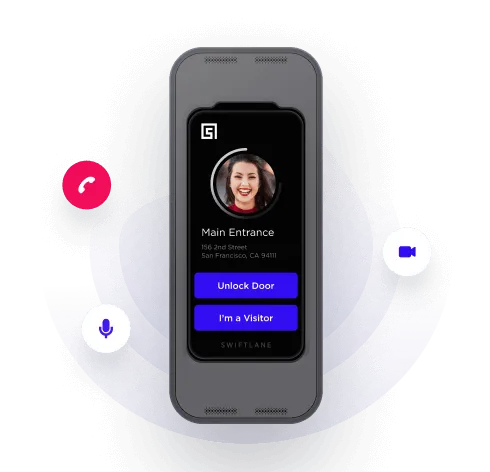
An intercom system is a two-way communication device with access control functionality that helps tenants or building staff speak to visitors at entry points and grant entry after verification.
With an intercom, human-based access management establishes a strong layer of security at entry points to residential, commercial, or office buildings. Recent market research highlights the enhanced security provided by intercom systems, particularly video intercoms, which enable real-time monitoring and controlled access.
An example of human-based intercom security:
- A visitor approaches an intercom device and initiates a call to a tenant.
- The tenant receives the call and checks who is at the main entrance.
- Based on who the visitor is, the tenant grants or denies access.
What Is an Access Control System?


Unlike an intercom, an access control system is purely credential-based and doesn’t allow communication between tenants, staff, and visitors.
An access control system can operate independently or in conjunction with an intercom. The system mainly includes:
- Credentials for access
- Reader devices
- Controllers that signal the door locks after credential verification
- Door locks that open doors
- Management platforms
An example of how it works:
- A person presents or inputs the right credentials to the reader.
- The reader sends signals to the control relay, which then signals the door release.
- The door unlocks, allowing entry to the building.
Intercom vs Access Control System: Key Differences
1. Primary Purpose
An intercom system’s main purpose is to facilitate communication. An intercom connects tenants with visitors; without a communication feature, the system is not an intercom.
Traditional intercoms, such as telephone entry or fixed-wire buzzers, and voice-only intercoms all use two-way audio. Meanwhile, smart intercoms, such as wireless and video intercoms, often include video feedback in addition to audio.
In contrast, a door access control system is used to manage access flow between areas—entry points or different rooms within a building. The access control system works by recognizing credentials and granting access to verified credentials.
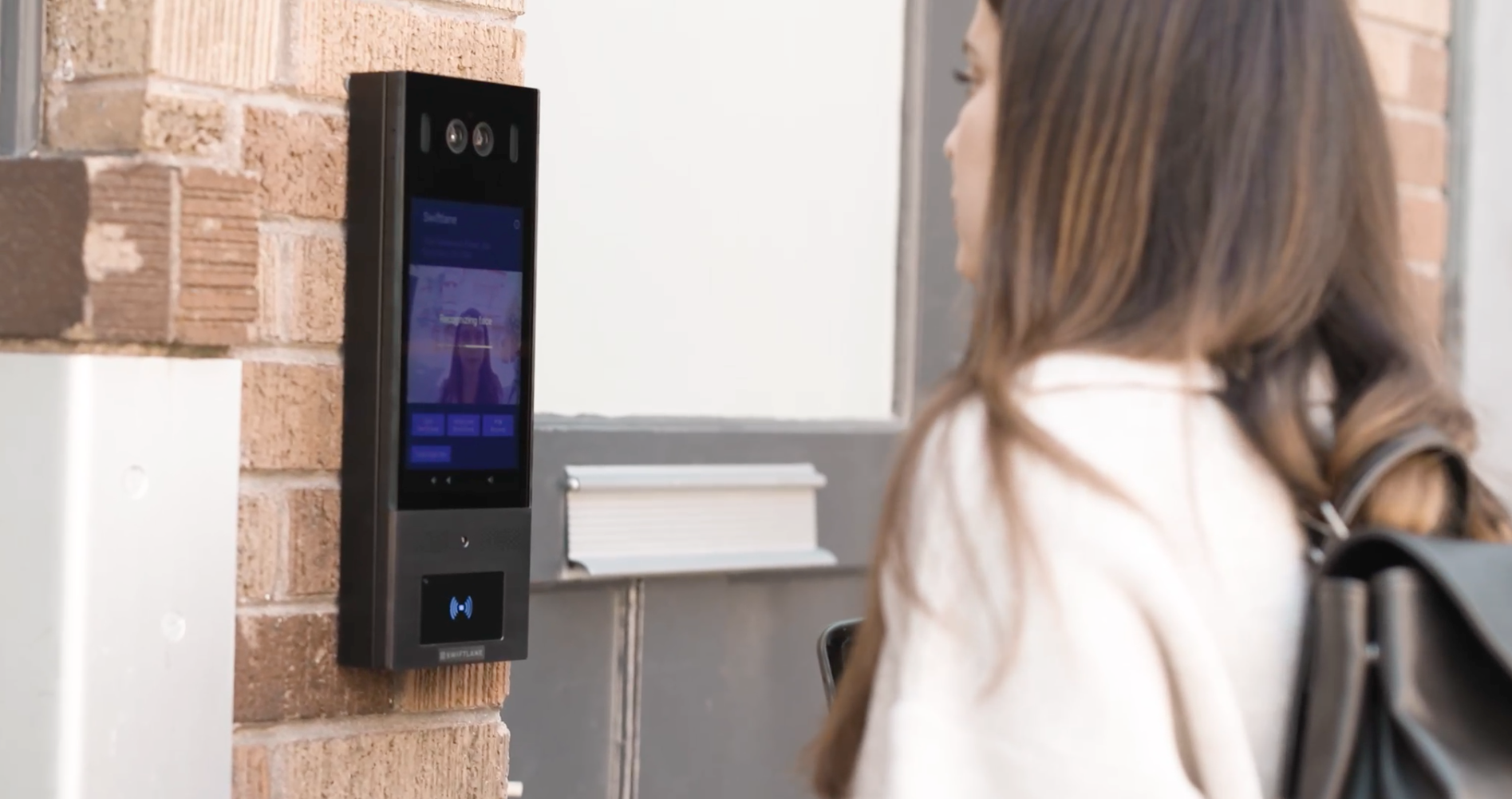
Credentials may include keycards or keyfobs, PIN codes, mobile credentials, face recognition, voice commands, Quick Response (QR) codes, Bluetooth, and more, depending on the access control device and/or provider.
2. Access Control
Intercoms secondarily control access to building entry points, and tenants or property teams generally exercise control manually. Visitors come up to the main intercom panel, contact tenants from a directory, and verify their identities. Tenants then push a button on their in-unit devices or tap their smartphones to allow access.
For access control systems, access is not directly controlled by other persons. Entry is automatically granted after a valid credential is presented to an access control device. Credentials are typically PIN codes, keycards, key fobs, mobile credentials, and biometrics.
3. Primary Users
Intercoms and access control systems overlap in terms of their user base.
Residents or businesses use intercom systems to grant entry to guests or customers at main entrances. With modern intercoms, tenants can also assign temporary credentials to delivery drivers for access to package rooms.
Meanwhile, residents or employees use credentials with access control systems for entry to apartment buildings, offices, or restricted commercial areas. In terms of credential-provisioning, however, only property managers or owners can manage verified credentials, not tenants.
4. Core Capabilities
Intercom systems typically have more extensive functionality than access control systems.
In line with their main purpose, intercoms offer various verification methods through audio or video calling and credentials. They also come with tenant directories, remote door release, and administrative platforms for access history, auditing, and management.
Meanwhile, access control systems focus only on credential management. Some devices support schedule-based access rules, which allow entry for visitors during a scheduled period of the day set by the building admin.
5. Cost Comparison
Hardware Only
Based on 12 hours of research across distributor pages on hardware prices, we’ve found that intercom systems cost more upfront than access control systems. This is due to the features that come with intercoms, which access control systems do not have.
For example, video intercom devices come with price tags of around $1,200 to $3,500. Meanwhile, access control readers only cost $150 to $400.
Hardware + Installation and Software Subscription
When considering installation and software fees as well, access systems end up with heftier price tags. Access systems cost more with more readers installed at doorways.
For an access control system at one residential entrance and two common room entry points, you would already have to pay $4,300 to $11,000. Meanwhile, two entrances with three controlled doors in commercial or office buildings may cost around $11,000 to $25,000.
In contrast, installation for a video intercom in a 30-unit apartment building may range from $3,000 to $7,000. Hardware prices and software fees are often bundled up as per-unit or per-user rates, with subscription fees at around $2 to $5 per user or unit depending on vendor.
Intercom + Access Control Bundle
Because of the price disparity for these two systems, some providers instead offer both intercoms and access control, all managed through a single platform.
See how much a bundled intercom and access control solution will cost through Swiftlane’s instant estimate generator.
6. Use Cases
Intercom systems are usually placed at main entrances, yet they can be used at any access point that needs visitor management. For example, one intercom can be used for front door salon suite access. You might also install an intercom at the door of a shared package room, allowing delivery drivers to request access for all tenants.
Places that also benefit from intercoms include:
- Multifamily apartment building entrances and elevators
- Residential community gates
- Office and commercial facility front doors, elevators, and package rooms
- Gates and garage doors of publicly-accessible parking spaces
Meanwhile, access control systems are ideal for doors that require secure entry but don’t need visual verification or visitor screening. These systems restrict access to verified users only, which means resident-only or employee-exclusive areas. For example, access readers are commonly installed at fitness center entrances to restrict use to authorized residents.
Places that can use access systems also include:
- Resident-exclusive building or community amenities
- Swimming pools or saunas
- Exclusive parking areas for residents or employees
- IT rooms
- Utility rooms
- Backdoors of commercial shops
- Main doors of different departments in a company’s office space
Intercom vs Access Control System: Quick Overview


Benefits of Both an Intercom and an Access Control System


Although intercoms and access control systems are distinct systems, they may complement each other when integrated. They offer a host of benefits that property owners, managers, and companies can take advantage of for their residential or commercial properties.
1. Centralized Management Platform
Integrated intercom and access control systems usually offer a centralized platform through cloud-based access control for management of system units and properties.
Through a single platform, property owners and managers can remotely control access across multiple buildings and manage all resident and visitor credentials. Companies may do the same for their employees over one or several office branches.
2. Multi-Layer Secure Access
The verification methods of an intercom with an access control unit add a stronger layer of security to access control systems. Unauthorized persons will have more difficulty accessing buildings or common areas.
Because of centralized management, access to different areas can also be secured. Access control may be installed in garages, package rooms, and elevators.
3. Improved Tenant Experience
With centralized management and high security, tenants may feel safer in their homes or offices. Improving the tenant experience may then lead to higher occupancy levels in residential or commercial buildings, and ultimately, higher occupancy results in better return on investment (ROI).
4. Scalability
With an integrated system, the three previous benefits can be multiplied at scale across multiple tenants and properties. Onboarding and tenant removal become seamless, and property management becomes much more efficient.
Determining Whether You Need an Intercom or Access Control System or Both
Intercoms and access control systems are technologies with distinct focuses, core capabilities, and other differences. Together, they can also be powerful tools that enable property owners and managers, as well as companies, to secure their properties.
To determine whether you need an intercom, an access control system, or both, you need to think about what kind of controlled entry you need.
An intercom is essential when your building expects visitors—people who aren’t already known or credentialed, such as guests or delivery drivers. In contrast, access readers are best for doors used only by verified residents, employees, or members who need seamless, uninterrupted entry.
However, residential, commercial, or office building managers commonly need a mix of both kinds of controlled entry. You need intercoms at visitor-facing entry points and access readers at user-restricted doorways. In these cases, an all-in-one solution of intercoms with access control systems is most fitting.
Swiftlane: Your All-in-One Video Intercom and Access Control System Provider
Swiftlane provides an all-in-one platform that helps properties manage security challenges like tailgating and unverified deliveries. With Swiftlane, tenants can remotely grant access to visitors, while property managers control entry for residents, employees, and service staff—all from a single, easy-to-use dashboard.
As your property grows or changes, Swiftlane scales effortlessly—adding new doors, users, or even entire buildings is simple and efficient. No matter how many entry points you manage, everything is controlled through one mobile or web interface.
Want to see how it works? Request a live demo or call 888-915-3779 to see Swiftlane in action.