Article Updated on July 7, 2026


Choosing the right intercom for your apartment building comes down to three things: how reliably it handles calls, how easily residents and visitors can use it, and how well it fits into your property’s operations.
This guide covers the 10 best apartment intercom systems of 2026, with side-by-side comparisons, pricing ranges, and a decision table to help you find the right fit for your building type, budget, and installation constraints.
What Is an Apartment Video Intercom System?
An apartment video intercom system lets residents or staff see and speak with visitors at the entrance, then unlock the door remotely using a mobile app, indoor station, or phone. The best systems support reliable calling, fast entry for deliveries and guests, secure audit logs, and easy directory management, and they integrate with access control for fobs, mobile unlock, PINs, or facial recognition.
How We Built This Guide
This guide is based on hands-on experience deploying intercom and access control systems across thousands of multifamily and commercial properties. Our assessments draw on verified app store ratings across iOS and Android, manufacturer product documentation, third-party reseller pricing, and feedback patterns from property managers and building operators.
Where we identified known issues, such as router incompatibilities, ecosystem lock-in, or Android app reliability gaps, we flagged them directly in the Watch-outs for each system.
TL;DR
- Best overall for most multifamily buildings: cloud-based video intercom with mobile access and strong support
- Best for retrofits: minimal wiring, PoE or cellular backup, no in-unit hardware required
- Best for high security: strong audit logs, role-based permissions, and access control integrations
- Biggest hidden cost: installation and wiring, not the panel itself
- Don’t buy before validating calling reliability, directory UX, and offline backup behavior
Table of Contents
- What is an Apartment Video Intercom System?
- Quick Decision Table
- 10 Best Apartment Intercom Systems with Video (2026)
- How We Picked These
- What Features Matter for Apartment Intercoms
- Cost and ROI
- Retrofit Readiness Checklist
- Find the Right Intercom for Your Building
- FAQs
Quick Decision Table
Not sure which system fits your building? Use this table to find the right starting point.
| Best for | Winner | Why |
| Best overall | Swiftlane | Cloud-based, mobile-first, works across building types with minimal wiring and strong ongoing support |
| Best for multifamily | Swiftlane | Scales across units, integrates with property management software, supports mobile unlock and facial recognition |
| Best for retrofits | DoorBird | Connects to existing doorbell wiring, simple installation, no subscription fees on basic models |
| Best budget | Aiphone | Lower hardware entry point, reliable audio and video, multiple series to match building size |
| Best for gated communities | LiftMaster | Built for vehicle and gate access, strong integration with LiftMaster gate operators, and video storage included |
| Best for on-premises / no cloud | 2N IP Verso | Full SIP support, local network operation, no mandatory cloud subscription |
10 Best Apartment Intercom Systems with Video (2026)
Here’s a closer look at each system from the decision table above, including the pros, watch-outs, and pricing details you’ll need to make a final call for your building.
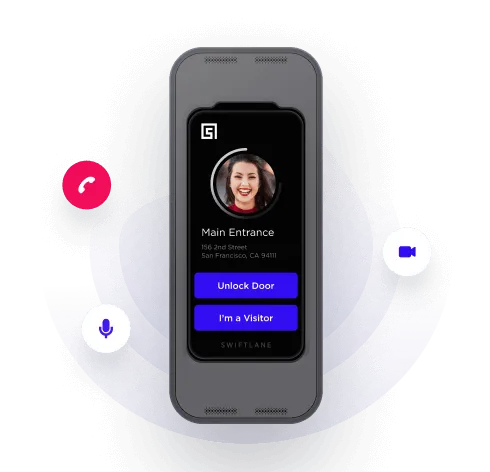
1. Swiftlane Video Intercom
Type of intercom: Two-way audio and video IP intercom with cellular backup
Best for: Multifamily properties looking for a fully managed, mobile-first system with minimal wiring and strong ongoing support. Swiftlane is deployed across 3,000+ multifamily and commercial buildings nationwide.
Pros:
- Future-proof technology accessible for all residents
- User-friendly mobile app for iOS and Android
- Minimal wiring, retrofits with legacy systems
- No in-unit master stations required
- Integrates many property management systems
- Multi-factor authentication with facial recognition, voice control, and a mobile app
- SOC 2 certified for data security
- Excellent customer support
Watch-outs:
- Monthly subscription costs, though comparable to a traditional telephone line intercom
- Bespoke pricing means you need a quote before you can budget accurately
- Not suited for single-family homes
Special features: Facial recognition, AI leasing bot (RentGPT), SOC 2 certification, cellular backup
Pricing: Entirely custom per building. Subscription costs are comparable to a traditional telephone line intercom and depend on the number of units.
2. Latch Video Intercom
Type of intercom: Two-way audio and video, WiFi, or IP intercom
Best for: Latch (now Door) is best for buildings already using or planning to adopt the LatchOS ecosystem for both building and unit-level access management
Pros:
- All-in-one building solution covering building and unit access
- Customizable with multiple entry methods
- Cloud-based management across multiple properties
- Latch Delivery Assistant for package management
- Many add-ons available
Watch-outs:
- Requires an external camera for video capabilities, which adds to the total cost
- Restrictive two-year service contract
- Monthly software fee ($5 – $12.50 per unit) on top of hardware cost
- Deep ecosystem lock-in means switching systems later is costly
Special features: Latch Delivery Assistant for package management, many add-ons available
3. 2N IP Verso Video Intercom
Type of intercom: Two-way audio, one-way video IP intercom
Best for: 2N IP Verso is best for buildings that need a highly customizable, on-premises system with SIP support and compatibility with existing access control infrastructure.
Pros:
- Modular design with 29 modules to choose from
- Retrofits with legacy systems
- No in-unit hardware required
- Integrates well with Axis products
- Bulk management via 2N Access Commander
- Supports open protocols, including SIP
- Durable hardware
- Induction loop module for hearing and visually impaired visitors
Watch-outs:
- Backbox supports only three daisy-chained modules per intercom, limiting customization per panel
- Variable video quality reported by users
- Some call forwarding issues have been reported in online forums
- My2N app is well-reviewed on Apple but has poor ratings on Google Play, which could frustrate Android users
- Instructional and setup resources are more limited than those of some competitors
Special features: SIP support, WaveKey access control, induction loop module for hearing and visually impaired visitors
4. LiftMaster CAPXLV Smart Video Intercom
Type of intercom: Two-way audio, one-way video, IP, or cellular intercom
Best for: Gated communities and properties that need vehicle and gate access integrated with their intercom system
Pros:
- Over 50 years of intercom manufacturing experience
- A cloud-based system that can be programmed remotely
- Supports up to four entry stations
- Records and stores short video clips of all attempted entries
- Strong integration with other LiftMaster gate and access products
- IP and cellular connectivity options
Watch-outs:
- Limited to the LiftMaster ecosystem, which restricts future flexibility
- Lacks SIP and WebRTC connectivity, making it incompatible with VoIP phone systems
- Must be connected to the internet to receive calls, no local fallback
- No pricing transparency on the LiftMaster website requires dealer contact for accurate quotes
Special features: Video storage (local or cloud), cellular backup, remote programming
5. AlphaTouch Intercom
Type of intercom: Two-way audio and video IP intercom (PoE)
Best for: Buildings looking for a cloud-based PoE video intercom with scheduled access and maintenance alerts, where residents are primarily iOS users, consider AlphaTouch Intercom.
Pros:
- Wired and cloud-based options available
- Scalable across multiple entry points
- Scheduled access for recurring visitors
- Well-reviewed on the Apple App Store
- Maintenance alerts for proactive system management
Watch-outs:
- Android app is extremely unreliable, averaging around 2 stars on Google Play
- Residents must be logged into the app to accept a call, meaning missed calls if the app is closed
- Hardware costs between $2,300 and $3,000+, based on third-party reseller pricing, which is high for a three-star system
Special features: Maintenance alerts, scheduled access windows
Pricing: Varies based on the number of units and entry stations. Main door station costs range from $2,300 to $3,000+, based on third-party reseller listings.
6. Akuvox SmartPlus Intercom
Type of intercom: Two-way audio and video IP or wireless intercom
Best for: Akuvox is good for properties looking to replace outdated two-wire or RF-based access control systems with a modern IP intercom that integrates with smart home technology.
Pros:
- Integrates with smart home technology
- Multiple access methods available
- Manage multiple properties through one interface
- Wiegand port for backward integration with legacy access control hardware
- Wireless and IP connectivity options
Watch-outs:
- Customer support in the US is reported as poor, which is a significant risk for buildings that need reliable ongoing assistance
- China-based manufacturer means support response times and parts availability may be slower for US-based properties
- Limited US market presence compared to competitors
Special features: Wiegand port for backward integration, smart home compatibility
Pricing: Devices range from $545 to $2,800+, depending on model and configuration.
7. Comelit Ultra Intercom
Type of intercom: Modular intercom available as IP or wired, audio-only or audio-video, touchscreen or mechanical, depending on modules selected
Best for: Buildings that need a highly modular system with flexible hardware options and a separate module for hearing-impaired residents
Pros:
- Durable hardware
- Modular design with multiple configuration options
- Good hardware variety across wired and IP versions
- Multiple design aesthetics available
- Supports up to 15 users per apartment
- A separate module is available for hearing-impaired residents
Watch-outs:
- Challenging installation on some models, particularly for less experienced technicians
- Difficult to integrate with smart home systems
- The product lineup is confusing to navigate, and customization options are not well explained on the Comelit website
- Not considered user-friendly based on community forum feedback
- Basic kits start at around $1,000, but advanced setups can exceed $7,000, making the total cost hard to predict upfront
Special features: Separate module for hearing-impaired residents, mix and match module system, multiple design options
8. DoorBird D2110V IP Video Intercom
Type of intercom: Two-way audio, one-way video IP intercom
Best for: DoorBird D2110V IP video intercom is best for smaller buildings or retrofit situations where simple installation, no subscription fees, and open API integration are the priority over advanced access control features.
Pros:
- Simple installation, connects to existing doorbell wiring
- No subscription fees on basic models
- Extensive third-party integration options via open API
- Well-reviewed mobile app on both Google Play and Apple App Store
- 4D motion sensor for proactive entry monitoring
- Cloud storage for the last 50 motion sensor events at no cost
Watch-outs:
- One-way video only, meaning visitors cannot see who they are calling, which reduces accessibility for hearing-impaired visitors
- Limited access control features compared to cloud-based competitors
- Security concerns with the door relay configuration if not set up correctly
- Not ADA compliant
- No built-in SIP or PBX support
- Multi-tenant systems are limited and rarely suitable for buildings with more than a dozen units
Special features: Open API, 4D motion sensor, no-subscription cloud storage for the last 50 motion events
9. Mircom TX3-Touch Video Intercom
Type of intercom: Two-way audio, one-way video, wired intercom operating on an IP-based network
Best for: Larger buildings that need a SIP-capable touchscreen entry system with advanced security features and are already on a VoIP or existing IP network infrastructure
Pros:
- Customizable touchscreen interface (15 – 22 inches)
- Vandal-resistant hardware
- SIP-based connectivity integrates with existing VoIP networks
- Remote access management and programming via full TCP/IP capability
- Encrypted communications
- Tamper-resistant hardware
- Supports up to 2,000 names in the directory
- Smartphone credentials and event history
- Third-party software integrations
- On-screen advertising module available
Watch-outs:
- Certain routers, including the D-Link DIR-615 and Greenwave G1100, are known to block Mircom’s SIP service. Confirm network compatibility before purchasing
- Complex installation that may require experienced technicians
- High total cost of ownership when installation and ongoing fees are factored in
Special features: On-screen advertising module, encrypted communications, tamper-resistant hardware, large touchscreen display
10. Siedle Vario Video Intercom
Type of intercom: Two-way audio, one-way video IP intercom
Best for: Buildings that prioritize premium hardware quality, modular design flexibility, and superior audio and video performance, and where US-language support resources are not a primary concern
Pros:
- Siedle has excellent video and sound quality
- Modular design with flexible mounting options (flush, surface, or freestanding)
- Easy installation with ribbon cable and color-coded plugs
- Compatible with all Siedle Secure access control products
- Multiple camera options available
- Diverse add-ons, including a range of call buttons and status display modules
- Unique ringtones designed by a sound artist
Watch-outs:
- Many instructional videos and setup resources are in German, which could slow installation and troubleshooting for US-based teams
- No pricing transparency; separate price lists for professionals and consumers make budgeting difficult upfront
- One-way video means visitors cannot see who they are calling, reducing accessibility for hearing-impaired visitors
- Limited third-party integration options compared to cloud-based competitors
- No video interface for visitors
Special features: Multiple camera options, ringtones designed by a sound artist, compatible with the Siedle Secure access control range
How We Picked These
We evaluated each system based on criteria that matter most to multifamily property managers and building operators, not just hardware specs.
- Calling reliability — whether the system consistently delivers calls to residents via mobile app, indoor station, or both, and how it behaves when the internet goes down.
- Directory and visitor UX — how easy it is for visitors to find a resident, and how residents receive and respond to calls, including full-screen notifications, video quality, and response time.
- Access methods — support for mobile unlock, key fob, PIN, QR code, and facial recognition, and whether multiple methods can run simultaneously on one panel.
- Installation complexity — whether the system requires extensive in-unit wiring, a dedicated technician, or retrofitting onto existing door hardware and network infrastructure.
- App performance — verified ratings on both the Apple App Store and Google Play, since Android reliability is a consistent pain point across this category.
- Integration depth — compatibility with property management software, access control systems, and third-party hardware like gate operators and elevator controls.
- Total cost of ownership — hardware, installation, and ongoing subscription fees across small, mid-size, and large buildings.
- Customer support — availability, response time, and whether support is handled in-house or outsourced.
What Features Matter for Apartment Intercoms


Not all intercom features carry equal weight in a multifamily setting. These are the ones that directly affect day-to-day operations and resident experience.
Delivery and Guest Access
Package theft and missed deliveries are among the most common tenant complaints in multifamily buildings. Look for systems that support one-time PINs, QR codes, or virtual keys so couriers and guests can enter without requiring a resident to be available. Some systems also support scheduled access windows for recurring visitors, such as cleaners or dog walkers.
Multi-Number Calling
Residents are not always home. The best systems allow a single visitor call to ring multiple numbers or devices simultaneously or sequentially, so an unavailable resident never blocks access.
Directory Management
For buildings with more than a handful of units, directory UX matters. Property managers need to add, remove, and update resident listings quickly, ideally from a cloud dashboard without being on-site. Residents should be easy for visitors to find without exposing personal contact information.
Audit Logs and Access History
A time-stamped record of every entry attempt, successful unlock, and visitor call is essential for security incident response and lease compliance. Cloud-based systems typically store this automatically. On-premises systems may require additional configuration.
Property Management Integrations
If your building uses software like Yardi, RealPage, or Entrata, your intercom system should connect to it. Integrations reduce manual admin work, automatically keep resident directories current, and support move-in and move-out workflows without requiring separate updates across multiple systems.
Offline and Backup Behavior
What happens when the internet goes down? Systems with cellular backup or local fallback ensure that residents and staff are never locked out during a network outage. This is especially important for buildings in areas with unreliable connectivity or for entry points that are critical to emergency egress.
Cost and ROI
Video intercom systems vary widely in price depending on the hardware, installation complexity, and ongoing software fees. Here is what to expect across each cost category.
Hardware Costs
The prices below are based on information from each vendor’s official website or third-party reseller listings at the time of writing. Costs are subject to change and do not include installation, accessories, or ongoing subscription fees. Where vendor pricing is not publicly available, we have noted that a custom quote is required. [Pricing sources listed below the table.]
| System | Entry-level hardware cost | Notes |
| Swiftlane | Custom quote | Bespoke per building, contact for pricing |
| Latch | From $3,999 | An external camera is required for video |
| 2N IP Verso | $1,000 – $1,500 | Accessories and modules sold separately |
| LiftMaster CAPXLV | $2,599 – $3,873 | Based on third-party reseller pricing |
| AlphaTouch | $2,300 – $3,000+ | Based on third-party reseller pricing |
| Aiphone | From $400 | Kits and outdoor stations exceed $4,000 |
| Akuvox | $545 – $2,800+ | Varies by model and configuration |
| Comelit Ultra | From $1,000 | Advanced setups exceed $7,000 |
| DoorBird | $600 – $3,000+ | Multi-tenant stations at the higher end |
| Mircom TX3-Touch | $7,984 – $11,941 | Based on reseller quotes |
| Siedle Vario | Custom quote | Separate pricing for consumers and professionals |
Pricing sources: Swiftlane | Latch | 2N | LiftMaster | AlphaTouch | Aiphone | Akuvox | Comelit | DoorBird | Mircom | Siedle.
Installation and Ongoing Fees
Hardware is rarely the biggest line item. Installation and wiring costs vary significantly depending on the building’s age, existing infrastructure, and the number of entry points. Key cost drivers include:
- Wiring runs to individual units (significantly higher in older buildings)
- Number of entry stations and doors covered
- Integration with existing access control or gate hardware
- Whether in-unit stations are required or replaced by a mobile app
- Ongoing software or cloud subscription fees, which range from $0 on basic DoorBird models to $5 – $12.50 per unit per month for systems like Latch
- Installation typically ranges from ~$500 to $2,500 per entry point, depending on wiring and door hardware.
Where the ROI Comes From
The upfront cost of a modern video intercom is offset over time by reductions in:
- Package theft and associated resident complaints
- Door rekeying when keys are lost or when residents turn over
- Telephone line costs for legacy entry systems
- Staff time spent managing access manually
For example, Swiftlane customers save up to $5,000 annually by eliminating package theft, telephone lines, and door rekeying costs.
Retrofit Readiness Checklist
Before choosing a system, run through this checklist to understand your building’s installation constraints. Your answers will narrow down which systems are compatible and what your installation costs are likely to be.
| Question | Yes means | No means |
| Does your building have existing intercom wiring? | Reuse may be possible; check compatibility with the new system | Budget for new wiring runs, or choose a wireless or PoE system |
| Is there a network switch or PoE infrastructure near entry points? | PoE-based systems like 2N and Swiftlane are straightforward to install | May need additional network drops or a cellular backup system |
| Do units currently have in-unit intercom stations? | Check if the new system supports legacy stations or requires replacement | Mobile-app-based systems eliminate the need for in-unit hardware |
| Is the building on a VoIP or SIP-based phone system? | Systems with SIP support, like 2N and Mircom, integrate cleanly | Cellular or cloud-based systems are a simpler path |
| Does the entry door use an electric strike or a magnetic lock? | Most systems are compatible, confirming the fail-safe or fail-secure requirement | A door hardware upgrade may be needed before installation |
| Is the cellular signal reliable at the entry point? | Cellular backup systems like Swiftlane and LiftMaster are viable | Prioritize wired IP systems with local fallback |
| Does your property management software need to integrate? | Confirm integration compatibility before purchasing | Factor in manual directory management time and cost |
| Are there multiple entry points (garage, lobby, amenity doors)? | Budget for additional panels and confirm multi-door licensing | Single-panel systems like DoorBird may be sufficient |
Find the Right Intercom for Your Building
Not sure where to start? Tell us about your building, and we’ll help you find the right solution.
What we’ll need from you:
- Number of units and entry points
- Whether you have existing wiring or network infrastructure
- Your property management software
- Any specific access requirements (vehicle gate, elevator, amenity doors)
- Your timeline and budget range
FAQs
What is an apartment intercom system?
Sometimes called an access control system, apartment entry system, or call box, an apartment intercom system allows visitors to communicate with residents or building management to gain entry. Modern systems send notifications to residents’ phones or tablets, enabling them to see, hear, and interact with visitors before granting access.
What are the different types of intercoms?
Intercoms are categorized by communication style (audio, video, or centralized access) and connectivity (wired, hybrid, IP/Ethernet, or wireless). The right type depends on your building’s existing infrastructure, budget, and residents’ preferred method of receiving calls.
How do video intercoms work in apartment buildings?
A visitor approaches the entry panel and selects a resident from the directory or dials their unit. The resident receives a notification or full-screen call on their smartphone, tablet, or in-unit device. From there, they can see and speak with the visitor and remotely unlock the door. Building managers can monitor entry activity, manage access permissions, and review entry logs through a cloud-based dashboard.
Why are video intercoms better than traditional systems?
Video intercoms visually confirm all visitors and attempted entries, which reduces unauthorized access and package theft. They also support remote access control, attract quality tenants, and are more cost-effective and easier to maintain than landline-dependent systems. The best systems include mobile apps and cloud dashboards for property managers.
How do I choose an intercom?
Start with your building’s infrastructure (existing wiring, network availability, door hardware) and your residents’ needs (mobile app, in-unit station, or both). Then evaluate systems on calling reliability, directory UX, access methods, integration with your property management software, and total cost of ownership, including installation and ongoing fees. The retrofit checklist above is a good starting point.
How much does a smart video intercom system cost?
Video intercom hardware typically costs between $400 and $12,000+, depending on the system, building size, and number of entry points. Installation and wiring add to that cost, particularly in older buildings. Ongoing subscription fees range from $0 on basic models to $12.50 per unit per month on cloud-based systems. See the cost section above for a full breakdown by vendor.
Can old intercom systems be upgraded to video intercoms?
Yes. Most property managers replace traditional wired intercoms with IP or wireless video intercoms, which support advanced features without requiring extensive in-unit wiring. Systems like Swiftlane, 2N, and DoorBird are designed to retrofit onto existing door hardware and wiring infrastructure.
How are video intercoms different from CCTV?
Video intercoms allow real-time two-way communication and identity verification before granting access. CCTV is used for passive surveillance and recording without interaction. Many video intercom systems can integrate with a building’s existing CCTV setup for a more complete security picture.
What is the best intercom for a large apartment building?
For buildings with 50 or more units, prioritize systems that support large resident directories, multiple entry points, and cloud-based management. Swiftlane, Aiphone IXG Series (up to 9,999 devices), and 2N IP Verso are strong options. Key considerations are directory scalability, multi-door licensing, and integration with your property management software.
Do I need wiring to install a video intercom?
Not necessarily. IP-based and cloud-connected systems like Swiftlane require minimal wiring and can often use existing network infrastructure. Cellular backup systems reduce dependence on hardwired connections entirely. Traditional wired systems require more extensive installation, particularly in older buildings without structured cabling.
What is the difference between SIP and IP intercoms?
IP refers to how the intercom connects to a network, using Ethernet or Wi-Fi instead of traditional phone lines. SIP (Session Initiation Protocol) is a communication standard that runs over IP and allows the intercom to make calls through a VoIP phone system. All SIP intercoms are IP-based, but not all IP intercoms support SIP. SIP is most relevant for buildings already using a VoIP or PBX phone system.
What happens if the internet goes down?
It depends on the system. Cloud-based systems with cellular backup, like Swiftlane and LiftMaster, continue to operate during an internet outage by switching to a cellular connection. Systems without a backup will lose remote calling functionality, though some support local fallback modes that allow keypad or fob access. Always confirm offline behavior with your vendor before purchasing.
Get a Swiftlane Quote
Tell us about your building and we'll help you find the best solution.