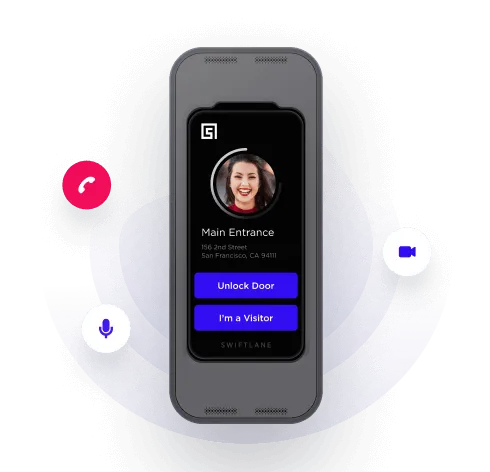
If you manage an apartment building, condo, or mixed-use property, choosing a doorbell intercom system means more than picking a device. It means deciding how visitors, residents, deliveries, and contractors will move through your building every day. This guide covers every decision point: system types, retrofit constraints, costs, must-have features, and vendor evaluation.
How We Researched This
This guide was drawn on direct experience with multifamily access control deployments across apartment buildings, condos, and mixed-use properties. It was reviewed by the Swiftlane team, which collectively covers product, installations, and property management operations.
Cost ranges reflect installer network data and real-world deployment feedback. Wiring guidance and retrofit recommendations are based on patterns observed across Swiftlane installations. Where third-party data is referenced, sources are cited inline.
This page is reviewed and updated on a rolling basis to reflect changes in system availability, pricing, and installation best practices.
Key Takeaways
- This guide explains the difference between doorbell cameras, video intercoms, and access control, and which one your building actually needs.
- We cover retrofit wiring scenarios (2-wire, Cat5/PoE, Wi-Fi) so you can assess feasibility before evaluating products.
- The cost section breaks down hardware, installation, subscriptions, and TCO, plus the key drivers that move the number up or down.
- The must-have features section is written specifically for multi-tenant buildings, not single-family homes.
- The guide closes with a vendor evaluation checklist and red flags to watch for during the sales process.
Quick Decision Flow
- Assess building type and number of controlled entrances.
- Determine retrofit constraints (existing wiring, conduit access, power).
- Define resident UX requirements (app-based, phone call, indoor station, or all three).
- Define visitor UX requirements (directory, PIN, QR code, or intercom-only).
- Evaluate security and admin needs (audit logs, role-based access, integrations).
Table of Contents
- What Is a Doorbell Intercom System?
- Doorbell Camera vs Video Intercom vs Access Control
- Wired vs Wireless Doorbell Intercom Systems: Retrofit-First Guide
- Must-Have Features for Apartment Buildings (And Why)
- How Much Does a Doorbell Intercom System Cost?
- Retrofit Implementation: What to Expect
- Operational Playbook: What Property Teams Actually Manage
- How to Choose a Doorbell Intercom Vendor: Buyer Checklist
- Frequently Asked Questions
What Is a Doorbell Intercom System?
A doorbell intercom system is a two-way communication device installed at a building entrance that lets residents see, hear, and speak with visitors, and grant or deny access, without leaving their unit. In a multi-tenant building, the system connects a shared entrance panel to individual residents via a mobile app, an in-unit station, or a phone call, and integrates with door hardware (electric strike or maglock) to enable remote unlocking.
Components of a Building Doorbell Intercom System:
- Entrance panel: touchscreen or keypad with camera, mic, speaker, and tenant directory
- Door hardware integration: electric strike or maglock connected to the panel
- Call routing: mobile app, landline/VoIP forwarding, or in-unit indoor station
- Cloud dashboard: remote admin, directory management, access logs (cloud-based systems)
- Optional: keypad or QR code for visitor PIN/code entry
Doorbell Camera vs Video Intercom vs Access Control


These three terms are often used interchangeably, but they describe meaningfully different systems. Choosing the wrong category is the most common mistake building operators make.
- If you only need to see who’s at the door, a doorbell camera (Ring or Nest) suffices, but it cannot manage a tenant directory or remotely unlock a shared entrance for multiple residents.
- If you need residents to receive visitor calls and buzz people in, a video intercom system is the correct category.
- If you need to manage who can enter the building at all times (keycard, mobile, PIN, face recognition), an access control system is required, with a video intercom as one component.
See full comparison: Doorbell Camera vs Video Intercom: What Works for Apartments?
Wired vs Wireless Doorbell Intercom Systems: Retrofit-First Guide
For existing buildings, wiring feasibility shapes your system options more than any feature preference. Evaluate your infrastructure before evaluating products.
When CAT5/6 + PoE Is Available (Or Runneable)
This is the most reliable path. PoE-powered panels draw power and data over a single cable, eliminate battery concerns, and offer the clearest upgrade path to IP-based video intercoms. If the conduit is accessible, the installation cost is worth it, even in retrofit scenarios.
When You Must Reuse Legacy 2-Wire or Analog Wiring
Many older multifamily buildings have existing 2-wire intercom runs. Several modern systems (Siedle, 2N, some Akuvox models) are designed to reuse this infrastructure. Confirm wire gauge and run length with your installer. Performance degrades over long runs on thin wire.
When Wi-Fi or Cellular Is the Only Option
Wi-Fi-dependent intercoms rely on the building’s network stability. Signal dead zones near entry points, router reboots, and ISP outages all become uptime risks. Cellular-connected panels (with LTE backup) are more reliable but incur monthly carrier costs.
Use Wi-Fi/cellular only when running cable is genuinely impossible.
Building Reliability Checklist
- Is there a UPS or PoE switch with battery backup at the IDF/MDF serving the entrance?
- What is the failsafe state of your door hardware if power is cut — locked or unlocked?
- Does your network have a guest/IoT VLAN that can isolate intercom traffic?
- Is there a cellular backup SIM in the panel for network outages?
Operator insight: “The single most common post-install complaint we hear is intermittent call quality, and in 80% of cases it traces back to Wi-Fi signal at the entrance panel, not the intercom system itself. Running a PoE drop to the entry point almost always resolves it.” — based on Swiftlane install team feedback.
Must-Have Features for Apartment Buildings (And Why)
When evaluating systems, focus on what your property management team will interact with every day, not what looks impressive in a demo.
Directory and Call Routing
The tenant directory is the operational core of the system. It needs to support multiple contacts per unit (roommates, co-owners), custom display names, and easy updates during move-ins and move-outs. Call routing should support simultaneous ring to the mobile app and a fallback (VoIP/phone number) so missed calls don’t mean missed access.
Mobile Answering and Backup Options
Residents should be able to answer and unlock from anywhere. Systems that only support in-unit indoor stations create access gaps. The backup matters too. If a resident doesn’t answer their mobile app, does the system fall back to a phone call? What happens if they’re roaming internationally?
Remote Unlock and Access Logs
Remote unlock is the baseline expectation. Access logs, a timestamped record of every entry event, door release, and failed attempt, are what transform an intercom from a convenience device into a security and liability tool. Ensure logs are exportable and retained for a meaningful period (90+ days minimum).
Multi-Entrance Support
Buildings with more than one controlled entry point (lobby, garage, package room, amenity floor) need a system that manages all entrances from a single admin dashboard, not separate systems for each door.
Admin Roles and Audit Trails
Property managers, maintenance staff, and leasing agents need different permission levels. A system with role-based admin controls prevents staff from over-granting access. Audit trails provide documentation in the event of an access dispute.
How Much Does a Doorbell Intercom System Cost?
Cost varies significantly based on building size, wiring infrastructure, and whether the system is cloud-managed. The ranges below reflect installed costs drawn from Swiftlane’s installer network across multifamily and mixed-use deployments as of 2025.
- Small building (1 entrance, under 20 units): $1,500–$3,500 installed
- Mid-size building (2–4 entrances, 20–100 units): $4,000–$12,000 installed
- Large/complex (5+ entrances, 100+ units): $15,000+; custom quote required
Key cost drivers:
- Number of controlled entrances (each entrance panel is a separate cost)
- Existing wiring; reusing legacy infrastructure vs. running new Cat5/PoE
- Door hardware upgrades; electric strikes and maglocks, if not already installed
- Cloud subscription fees; most modern systems charge $30–$150+/month per property
- Installation complexity: multi-floor conduit runs, elevator integration, or parking access
- Indoor station deployment; per-unit stations vs. mobile-only (mobile-only is significantly cheaper)
TCO checklist (first 3 years):
- Hardware (entrance panels, indoor stations if applicable, door hardware)
- Installation and commissioning
- Cloud/software subscription × 36 months
- Directory admin time (ongoing — often underestimated for high-turnover properties)
- Maintenance contract or warranty coverage
Retrofit Implementation: What to Expect

Before you evaluate a single product, a site survey tells you what your building can actually support, and prevents costly surprises during installation.
Site Survey Checklist
- Document every controlled entry point and current hardware (reader, panel, door hardware)
- Trace existing wiring type and condition (2-wire, Cat5, coax, or none)
- Confirm power availability at each entry point (dedicated circuit vs. PoE)
- Identify IDF/MDF location and network switch capacity
- Note any door hardware that needs replacement (worn strikes, incompatible maglocks)
Phased Rollout Approach
For buildings over 50 units, a phased rollout reduces resident disruption.
- Phase 1: main lobby entrance panel and cloud dashboard.
- Phase 2: secondary entrances.
- Phase 3: package room or access to amenities. Running resident communication alongside each phase (email, signage) significantly reduces the number of support tickets.
Operator insight: “In our deployments at mid-size multifamily properties — typically 50 to 150 units with legacy wiring — the most consistent finding is that buildings underestimate how many entry points actually need coverage. A property that comes to us thinking they need one entrance panel usually discovers two or three once we walk the site.
Scoping every controlled access point upfront, including garage entries and amenity floors, is what prevents a second mobilization six months later.” — based on Swiftlane installation team field experience.
Common Retrofit Pitfalls (and Fixes)
- Pitfall: Assuming existing wiring is reusable without testing. Fix: Test wire continuity and gauge before committing to a wired system.
- Pitfall: Under-specifying door hardware — old strikes that don’t hold under repeated remote release cycles. Fix: Replace aging electric strikes as part of the install scope.
- Pitfall: No resident communication plan. Fix: Draft an onboarding email and lobby notice template before install day.
- Pitfall: Single-point network dependency (one switch, no backup). Fix: Install a UPS on the PoE switch feeding the entry panels.
Retrofit Case: Mid-Size Multifamily Property, Pacific Northwest
A 78-unit apartment complex reached out after its legacy analog intercom failed during a winter storm, leaving the main lobby entrance panel unresponsive for three days. The property had assumed they needed a full rewire until a site survey confirmed usable Cat5 runs to two of their three entrance points.
The third required a new PoE drop. Total retrofit was completed in two days with no tenant displacement.
Within 90 days of go-live, property management reported that directory update requests, previously handled by an on-site manager, were being processed remotely in under two minutes each. The leading support complaint in month one was residents not downloading the app; adding a phone-call fallback in week two eliminated the issue.
(This account is based on an illustrative composite of Swiftlane multifamily deployments. Contact us for a reference customer introduction.)
Operational Playbook: What Property Teams Actually Manage
Once your system is installed, the real work begins. Here’s what your team will manage week to week and how to stay ahead of the common operational failures.
Move-Ins/Move-Outs and Directory Governance
The directory is a living document. In a 100-unit building with 50% annual turnover, you’re updating the intercom directory 50+ times a year. In high-turnover properties without a streamlined update process, directory-related access complaints are among the most common resident support tickets in the first year of operation.
Systems that require on-site access to update entries or lack bulk import/export capabilities create a real administrative burden.
Operator insight: “Directory drift is the most underestimated operational problem we see after install. A building that goes six months without a proper move-out cleanup ends up with departed residents still receiving visitor calls, and new residents wondering why their guests can’t reach them.
Tying directory updates to your lease management workflow from day one prevents about 80% of the support tickets we see in year one.” — based on Swiftlane property management team feedback.
Deliveries + Contractors + After-Hours Access
Delivery access is one of the most frequent intercom interactions in any residential building. Options range from a resident-issued temporary PIN to a carrier-specific access code (such as Amazon Key).
Contractor access during business hours should be manageable through temporary credentials with automatic expiry.
Staff and Vendor Access Controls
Maintenance staff, cleaning crews, and regular vendors should each have their own credentials with appropriate permissions. Access logs tied to individual credentials, not a shared PIN, are the only way to reconstruct what happened if an incident occurs.
What Breaks Most Often (And a Prevention Checklist)
- Network/Wi-Fi outages: Across Swiftlane deployments, the four most common post-install failure categories, in order of frequency, are network/Wi-Fi instability, directory drift, door hardware wear, and app adoption gaps. [Swiftlane support data, 2025]
- Network/Wi-Fi outages: prevent with PoE + UPS backup and a cellular SIM in the panel
- Directory drift: departed residents still listed, new residents not yet added; prevent with a move-in/move-out workflow tied to your PMS
- Door hardware wear: electric strikes that stick or fail to release after 12–18 months of heavy use; prevent with annual hardware inspection in your maintenance schedule
- App adoption gaps: residents who never download the app and miss visitor calls are prevented with onboarding instructions in the lease packet and a phone-call fallback in your system configurations
How to Choose a Doorbell Intercom Vendor: Buyer Checklist
Use this checklist to score vendors during your evaluation. Prioritize the criteria that match your building’s operational constraints.
Evaluation Criteria (score each 1–3):
- Mobile app quality — iOS and Android, call reliability, ease of resident onboarding
- Directory management — web dashboard, bulk import/export, remote admin
- Retrofit compatibility — supports your existing wiring or has a clear wiring upgrade path
- Door hardware compatibility — works with your existing strikes/maglocks, or supplies its own
- Multi-entrance support — single dashboard for all entry points
- Integration with your PMS or access control system
- Offline/failsafe behavior — what happens when the network goes down?
- Support SLA — what is the guaranteed response time for a door that won’t unlock?
- Subscription cost transparency — no hidden per-unit or per-call fees
- Reference customers — ask for buildings of similar size and type
Red Flags:
- No web-based admin — directory updates require on-site access
- No access logs or logs only available at extra cost
- Hardware-only pricing with no mention of subscription — usually means surprise recurring fees
- No offline fallback — door release fails if the internet is down
- References only from single-family or small residential installations
See our comparison of the best video intercom systems for multifamily and commercial buildings (link to best-video-intercoms cluster page)
Frequently Asked Questions
Can a Ring or Nest doorbell work for an apartment building?
No, consumer video doorbells like Ring and Nest are designed for single-family homes and cannot support a multi-tenant directory, simultaneous resident notifications, or building-wide remote unlock. They also lack the admin controls and access logging that multi-tenant buildings require.
Do doorbell intercom systems require wiring?
Not necessarily. Wireless and cellular-connected systems exist, but wired (PoE or Cat5) systems are significantly more reliable for permanent building installations. Wiring feasibility should be assessed during a site survey before choosing a system type.
What happens if a resident doesn’t have the app or a smartphone?
A well-configured system routes calls to a landline or VoIP number as a fallback. Some systems also support in-unit indoor stations. Confirm fallback behavior before purchasing. This is a common oversight for buildings with older residents or mixed demographics.
What door hardware do I need for remote unlock?
Remote unlock requires either an electric strike (fail-secure, locks when power is cut) or a maglock (fail-safe, unlocks when power is cut) wired to the intercom panel’s relay output. The right choice depends on your fire code and security requirements. Confirm with your AHJ (Authority Having Jurisdiction).
How do directories work for multi-tenant buildings?
Most modern video intercom systems include a digital tenant directory on the entrance panel that visitors scroll or search to find a resident and initiate a call. Property managers update the directory remotely via a web dashboard.
Adding new residents, deactivating those who have departed, and assigning multiple contacts per unit. Systems that require on-site access to update the directory create significant admin overhead in high-turnover buildings.
What’s the best option for a retrofit vs. a new build?
For new construction, run Cat5/6 and PoE infrastructure during the build. It costs a fraction of what retrofit wiring costs later and gives you the most flexibility in system choice. For retrofits, start with a site survey to assess existing wiring before selecting a system.
Buildings with existing 2-wire runs have more options than they often assume, as several modern systems are designed to reuse legacy infrastructure.
How do these systems help with deliveries and contractors?
Most building intercom systems support temporary access credentials, a time-limited PIN or QR code, that can be issued to delivery carriers, contractors, or service vendors without giving them permanent access. The best implementations include automatic expiry and logging every use, so you have a full record of who entered and when.
This replaces the common workaround of propping doors or issuing physical keys that never get returned.
Get a Swiftlane Quote
Tell us about your building and we'll help you find the best solution.