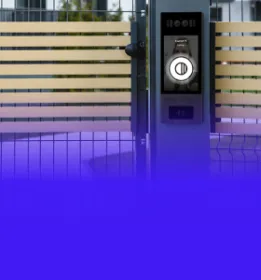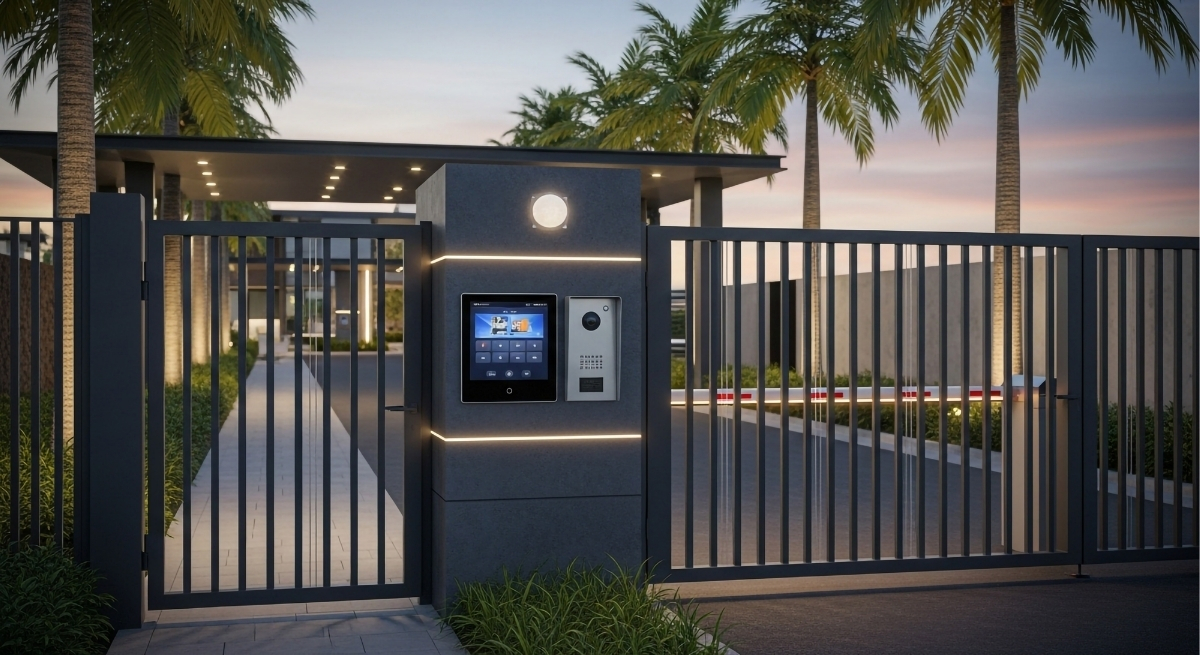
Gate security and access control become costly when hardwired or complicated by workarounds to extend Wi-Fi to the gate. In these cases, a cellular gate intercom system is a possible solution, with wireless connectivity via an LTE (Long-Term Evolution) network.
Gated communities and garden-style apartment complexes have gates to control access to their neighborhoods. Unless they have staff or an intercom system at the gate, these properties have no way to verify visitors’ identities and grant remote access to authorized persons. So, a cellular gate intercom system can be a useful investment.
Based on Swiftlane’s firsthand experience working with HOAs and property managers at thousands of multifamily residential properties nationwide, the guide below outlines what a cellular gate intercom is and whether it’s the right solution for your property.
Key Takeaways
- A cellular gate intercom is an independently powered communication and access control system at community gates that uses a cellular network to connect to the Internet.
- A cellular gate intercom does not require trenching or on-site internet, resulting in faster deployments and cloud-based remote management capabilities.
- However, a cellular gate intercom relies too much on the strength and data capacity of the mobile network, incurring cellular fees whether or not internet connectivity is available.
- A video intercom is a good alternative to a cellular gate intercom because of its Power-over-Ethernet network connectivity. It is more stable and more reliable than a cellular gate intercom.
Table of Contents: Quick Navigation
- What Is a Cellular Gate Intercom System?
- Pros & Cons of a Cellular Gate Intercom System
- Cellular Gate Intercom System Pricing Breakdown
- Swiftlane: A Mobile-First Video Intercom
What Is a Cellular Gate Intercom System?


A cellular gate intercom system—or sometimes called a smartphone gate entry system—is a communication and access control device at community gates that uses a cellular network to connect to the internet.
It can be either a pedestrian intercom for people to walk up to or a vehicle intercom for cars to drive up to. Either way, it allows visitors to speak with residents, who verify identities before remotely granting access.
How Cellular Gate Intercoms Work (LTE & 5G Connectivity Explained)
Cellular gate intercoms contain built-in cellular modems to communicate over a mobile carrier network. These modems connect using either 4G LTE (Long-Term Evolution) or 5G (Fifth Generation mobile network) data network—similar to how a smartphone connects to the internet.
Workflow:
- A visitor walks or drives up to the cellular gate intercom device and initiates a call to a resident or homeowner.
- The call is routed through the cellular modem to the cloud and directly to the resident or homeowner’s smartphone.
- The resident or homeowner receives the call, verifies the visitor’s identity, and remotely grants entry to the visitor.
How They Differ from Wired, Wi-Fi, and Power over Ethernet Gate Intercom Systems
Wired, Wi-Fi, and Power over Ethernet (PoE) gate intercom systems differ from cellular gate intercoms in their connectivity.
Wired intercoms are completely offline, relying instead on physical telephone lines to direct calls from the intercom panels to in-unit devices.
Wi-Fi and PoE intercoms are similar to cellular intercoms because they all connect to the cloud, directing calls straight to smartphones. But they connect to the internet in different ways.
If a cellular intercom uses 4G LTE or 5G mobile networks, Wi-Fi intercoms connect to nearby Wi-Fi routers, and PoE intercoms have both power and internet connections via Ethernet cables.
Pros & Cons of a Cellular Gate Intercom System
A cellular gate intercom system can simplify deployment and enable remote access management, but it’s not the right fit for every property. The advantages and tradeoffs of cellular gate intercom systems below should be carefully evaluated by HOAs and property managers.
Advantages
No Trenching and On-Site Internet Required
Because a cellular gate intercom system is wireless and relies on cellular networks, installation teams don’t have to trench for extensive wiring to each unit in an apartment. HOAs and property managers also don’t have to worry about setting up a separate Wi-Fi system for the intercom.
Faster Deployment
As a result of the advantage above, cellular gate intercom systems are also faster to install and deploy. As long as the intercoms, their power supply, and integrations (if any) are all in place, then communities or complexes can immediately implement and use these systems.
Independent Operations
The cellular connections of such intercoms separate them from other property systems that may already be installed owing to their independent power supply which is not impacted by downtimes of other systems.
Cloud-Based Remote Management
With the wireless setup of a cellular gate intercom system, HOAs and property managers can remotely control visitor access, resident information, and credentials. At the same time, they can manage multiple gate intercom devices and review access logs for security purposes using a single interface.
Disadvantages
Ongoing Cellular Service Fees
Due to their heavy reliance on cellular networks, cellular gate intercom systems will cost you ongoing cellular service fees. These fees become expensive over a long period of time.
Dependence on Carrier Signal Strength
At the same time, due to the use of cellular networks, cellular gate intercoms may provide varied experiences depending on the signal strength of the mobile carrier. A weak signal hampers access and hinders clear communication over the intercoms.
Potential Data Limitations
Related to carrier signal strength, data limitations can also disrupt intercom service. Weak signals limit the data transmission that intercoms are capable of. With data limitations, some smart and data-heavy features may not work.
Cellular Gate Intercom System Pricing Breakdown
HOAs and property managers should subsequently look at the total cost of ownership for the systems. Total cost of ownership can be divided into hardware prices, installation fees, and ongoing expenses.
Generally, although price ranges will vary depending on the community or complex, cellular gate intercom systems have upfront prices of around $2,000 to $7,000, while ongoing costs are around $20 to $150.
Hardware
Intercom hardware can range from very basic, audio-only systems to smart devices. For the basic 4G LTE, audio-only system, the price can be around $500 to $1,500. For smarter devices with video and other advanced features, prices range from $1,500 to $4,000.
Installation & Labor
Installation and labor fees can also vary depending on how complex a project site and the manufacturer offering can be. The installation of basic gate intercom systems costs around $500 to $2,500.
Ongoing Fees
Service fees will be charged every month for the service and support provided by the intercom manufacturer. Although exact prices may differ, these ongoing fees can go for around $20 to $150.
Swiftlane: A Mobile-First Video Intercom


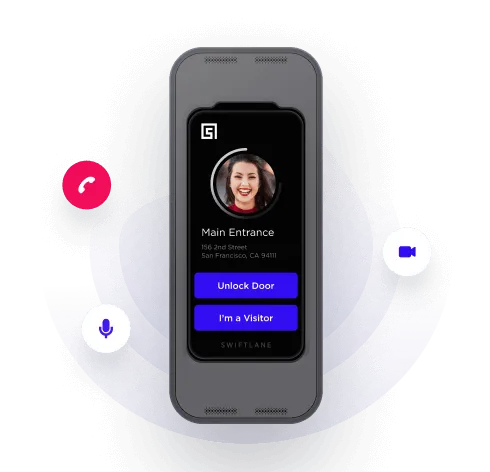
Consider Swiftlane, an intercom system with cellular, Wi-Fi, or PoE connectivity, offering a more robust, mobile-first video-ready experience.
Mainly using Power over Ethernet (PoE) but also cellular and Wi-Fi-capable, Swiftlane provides more stable and reliable communication through native video calling from the intercom device straight to a resident’s smartphone. Data restrictions and mobile carrier signal strength do not apply.
Security is baked into Swiftlane with loitering detection, alerting, PIN-sharing detection, and security incident audit records.
In addition, installation is a breeze thanks to Swiftlane’s plug-and-play deployments, which include white-glove onboarding and 24/7 support. Firmware updates are done over the air as well.
Request an instant quote from the Swiftlane team now or contact them for any questions at 833-607-9438.