The Verdict
DoorBird makes some of the best-built video intercom hardware on the market, and that reputation is earned. But it was earned on single-family doors, not multi-tenant ones, and the piece doesn’t fully catch up to that until you dig in.
If you manage a multifamily building, DoorBird actually has two tiers worth knowing about, and a lot of buyers only get quoted one of them. The D21DKV is the entry multi-tenant model: a display-and-keypad door station rated for up to 500 units, with a 720p camera. The D31 (available as the D31TDH or D31TDV) is the real flagship: a 7-inch touch display, RFID, Bluetooth, and QR code access, a 1080p Sony STARVIS sensor, and rated for up to 3,000 units. Both support SIP calling, integrate with major smart-building platforms, and are backed by ASSA ABLOY, a 51,000-employee company that isn’t going anywhere. If you’ve been quoted a D21DKV for a building that needs more scale or better video, ask why you weren’t quoted a D31. The gap between them is real and worth pricing out before committing.
Neither tier solves everything: there’s no leasing-workflow automation on either one (every unit, PIN, and credential is managed one at a time through the app). DoorBird station pricing isn’t the same as installed cost. Confirm whether the quote includes the housing/backbox, power supply, strike hardware, network drop, and labor, because inclusion varies by SKU, mount type, finish, and dealer. Installed, a single D21DKV door realistically runs $5,300 to $8,300 or more, and the D31 tier costs meaningfully more at the station level alone. Support, meanwhile, hasn’t caught up to the hardware’s backing: verified reviews from the past year still describe slow response times, well after ASSA ABLOY’s acquisition closed.
None of that makes DoorBird a bad choice. It makes it a specific one. It’s a strong fit for a single building or small portfolio that values build quality and can handle wiring, code compliance, and credential management directly or through an integrator. Also, the D21DKV-to-D31 tiering means there’s real room to scale within DoorBird’s own lineup before you’d need to look elsewhere. It’s a weaker fit for a portfolio that needs centralized, automated tenant onboarding across many units, regardless of which tier you pick. The rest of this review breaks down where each tier actually lands, starting with the multi-tenant hardware itself.
How We Evaluated This
We check every spec and price in this review against a primary source, date it, and re-verify it within the last 24 months. Figures from manufacturer marketing pages, aggregator round-ups, or a single reviewer’s opinion don’t make the cut on their own.
- Hardware specs come from DoorBird’s own current datasheets, each cited with its revision date (the D21DKV and D2101KV datasheets are both dated 08/2025; the D1101V and D31TDH are both dated 06/2026).
- Pricing reflects what named dealers actually list, not DoorBird’s MSRP. Where a full installation is priced, it’s built as a real cost stack (station, backbox, power supply, strike hardware, network drop, and labor), each line sourced to a dealer or contractor listing with the date we checked it, because the sticker price on a door station alone isn’t what a property manager ends up paying.
- Code and compliance claims (egress requirements, ADA reach-range rules, surveillance and biometric statutes) are sourced to the actual code text or statute (the IBC, NFPA 80, U.S. Access Board guidance, and named state statutes), not a secondhand summary of them.
- Customer sentiment draws on verified reviews (Trustpilot, Google, Amazon) from within the past year, weighted toward patterns across multiple independent reviewers rather than any single account.
- What we didn’t find, we say so. Where verified, independent commentary on a specific model doesn’t exist in usable form (as is currently the case for hands-on D21DKV reviews), we tell you that directly instead of stretching adjacent or vendor-sourced content to fill the gap.
If a claim in this review doesn’t meet that bar, we flag it in place rather than presenting it as settled.
Table of Contents
- DoorBird D21DKV Review
- DoorBird D31 Review (D31TDH / D31TDV)
- DoorBird Pricing
- Wiring, Relays, and What Happens on Alarm or Power Loss
- DoorBird vs Swiftlane
- What is DoorBird?
- Installation and the DoorBird App
- Reviewing DoorBird Single-Family Products
- Other Alternatives to DoorBird
- Is DoorBird Right for Your Building?
- FAQs
DoorBird D21DKV Review
The DoorBird D21DKV is the entry point into DoorBird’s multi-tenant lineup (the model the D2101KV is often mistaken for). It isn’t the top of the range: the D31 tier above it (reviewed below), rated for up to 3,000 units, is DoorBird’s actual multi-tenant flagship. It’s built around a 3.5″ display module and 16-key keypad, supports a name directory of up to 500 entries, and is rated for buildings with up to 500 units. Visitors use the display to search the directory and call a resident directly; residents answer through the DoorBird app, see live video, talk two-way, and unlock the door or gate remotely.
The D21DKV ships with a 720p camera and 180-degree wide-angle lens with night vision. It’s a step down in resolution from both DoorBird’s single-family V line and its own D31 tier, which both use 1080p sensors. It includes a 4D motion sensor, a 125 kHz RFID reader supporting up to 500 key fobs, and two configurable relay outputs for controlling two doors or gates independently. It supports SIP natively so that calls can route to landline or IP phones in addition to the mobile app, and integrates with Control4, Crestron, Loxone, and similar smart-building platforms.
As shown in the full cost breakdown below, dealer pricing for the station alone runs roughly $4,200 to $6,200 depending on finish and mount type (before the backbox, power supply, strike, wiring, and labor that a working door actually requires).
D21DKV Features
- 3.5″ display module (no touch function) with name directory, max. 500 entries
- 16-key illuminated keypad supporting up to 500 individual PIN codes
- 720p HDTV camera with 180-degree ultra-wide-angle hemispheric lens
- Night vision with 12 infrared LEDs
- 4D motion sensor
- RFID reader supporting up to 500 key fobs
- Two independently configurable relay outputs for two doors or gates
- Native SIP support for landline/IP phone calling, plus open API for third-party integration
- PoE (802.3af Mode-A) or 15V DC power
- IP65 / IK08-rated housing
- Surface- or flush-mount (housing sold separately)
Reviewers Say
Special note: Verified, independent reviews specific to the D21DKV are hard to come by. Most public commentary on this model is dealer and reseller product copy rather than firsthand accounts from property managers or installers who’ve lived with it. IPVM’s public discussion boards have integrator commentary on DoorBird (including 720p resolution as a known limitation and confirmed ONVIF/SIP compatibility for third-party visitor management system integration), but nothing specific to this multi-tenant configuration. Buyers evaluating this system for a real deployment should ask a DoorBird-authorized integrator for reference installs rather than relying on published reviews.
DoorBird D31 Review (D31TDH / D31TDV)
The D31 is DoorBird’s actual multi-tenant flagship (the model a property manager quoted a D21DKV should be asking about). It’s built around a 7-inch touchscreen (D31TDH is the horizontal variant, D31TDV is the vertical) with a name directory rated for up to 3,000 units, and includes an integrated RFID reader, Bluetooth Low Energy access, and a QR code reader alongside the touchscreen directory.
Where the D21DKV steps down to 720p, the D31 uses a 1080p Sony STARVIS image sensor with a 180-degree wide-angle lens (matching DoorBird’s single-family V line rather than trailing it). It supports SIP natively, includes two configurable relay outputs, and integrates with the same smart-building platforms as the rest of the line (Control4, Crestron, Loxone, and others).
One feature worth flagging on its own: the D31 includes a standard integrated accessibility module: status pictograms, an acoustic signal on the call button, and a hearing loop that transmits the door station’s audio directly to a visitor’s hearing aid. DoorBird states this complies with DIN 18040 (Germany), ÖNORM B1600 (Austria), SIA 500 (Switzerland), and Article 4 (France), which are all European accessibility standards, not the U.S. ADA. It doesn’t resolve the ADA reach-range question covered elsewhere in this review (that’s about call-button mounting height, a separate issue), but it’s a genuine, well-documented accessibility feature that the D21DKV doesn’t offer.
DB Store USA lists the D31TDH at $6,541 and the D31TDV also at $6,541; WorldEyeCam lists a D31TDV configuration (SKU D31TDVSS) at $4,961.88, discounted from a $6,851 list price, which is a similar dealer-to-dealer spread to what we found on the D21DKV. As with the D21DKV, treat these as station-only prices: housing/backbox, power supply, strike hardware, network drop, and labor are separate, and we haven’t built a full installed-cost stack for the D31 tier the way we did for the D21DKV below. Budget for a similar markup over the station price until you have a specific quote.
D31 Features
- 7″ touch display, hardened 6mm protective glass, individually configurable (resident directory, welcome screen, shortcuts)
- Name directory, RFID tags, and building capacity all rated up to 3,000
- 1080p Sony STARVIS image sensor with 180-degree wide-angle lens
- Integrated RFID reader (13.56 MHz), Bluetooth Low Energy, and QR code reader
- Integrated accessibility module with hearing loop (EU-standard certified, not ADA)
- 4D motion sensor, adjustable range up to 10 meters
- Native SIP support, open API, compatible with 90+ third-party smart-building integrations
- Two configurable relay outputs
- PoE+ (802.3at) power
- IP65-rated housing
Reviewers Say
As with the D21DKV, verified independent reviews specific to the D31 are hard to find (most available commentary is dealer and reseller product copy). We haven’t been able to source firsthand property manager or installer accounts of this specific tier. Ask a DoorBird-authorized integrator for reference installs before committing to this tier at scale.
DoorBird Pricing
DoorBird door station pricing isn’t the same as installed cost. Confirm whether the quote includes the housing/backbox, power supply, strike hardware, network drop, and labor, because inclusion varies by SKU, mount type, finish, and dealer.
The table below is built around the D21DKV specifically, DoorBird’s entry multi-tenant tier. The D31 tier costs more at the station level (see the D31 review above), and we haven’t sourced a full installed-cost stack for it yet. The categories below (backbox, power, strike, network drop, labor) should still apply, but confirm current pricing for that tier separately.
| Line item | Dealer price | Source | Checked |
| D21DKV station (hardware only; varies by finish/mount) | $4,236 to $5,988 | WorldEyeCam; AffordableOpeners | Aug. 27, 2026 |
| Flush-mount backbox, Select Security Supply listing (inclusion varies by SKU/dealer; confirm per quote) | $217 | Select Security Supply | Aug. 27, 2026 |
| 15V power supply (also sold separately) | $132 | EliteGates.net | Aug. 27, 2026 |
| Electric strike, installed (fail-secure hardware and installation labor combined) | $250 to $800 | Vertex Security, NYC intercom pricing guide | Feb. 20, 2026 |
| Network drop (Cat6, terminated and tested) | $150 to $300 | The Network Installers; Data Wire Solutions | July 22, 2026 / June 22, 2026 |
| Station mounting and configuration labor | $200 to $400 | Northbridge Services | Apr. 2, 2026 |
Realistic per-door installed total: roughly $5,185 to $7,837, before accounting for finish upgrades, difficult wiring conditions, or metro-market labor premiums (NYC-specific sources put commercial access control labor 20 to 30% above national averages).
Two important notes:
- The backbox is SKU-specific, and it’s easy to get wrong. Whether housing is bundled into the sticker price depends on the exact finish, mount type, and dealer. Some flush-mount configurations include the housing. Housing/backbox inclusion depends on the SKU and dealer. Current D21DKV surface- and flush-mount dealer listings may include the relevant mounting housing, but quote scope still varies by finish, mount type, accessories, and reseller. Confirm whether the final quote includes housing/backbox, power supply, strike hardware, wiring, network drop, and labor before treating the station price as a total installed price.
- Import exposure is real, and the number moves. DB Store USA, the dealer this pricing table draws from, moved to a Delivered Duty Paid model after the April 2, 2025 tariff increase on EU goods, meaning listed prices already include duties, taxes, and import fees, with no surprise charges at delivery. That policy is still in effect as of an August 2026 update to their own notice on the change.
Wiring, Relays, and What Happens on Alarm or Power Loss
DoorBird’s documentation covers how to wire its relay to a strike, maglock, or gate operator, but not what that locking hardware does during a fire alarm or a power outage. That answer depends entirely on what’s wired to the relay, not on DoorBird itself, and it has real code implications for multi-tenant buildings.
Electric strikes. Most DoorBird multi-tenant installs pair the relay with an electric strike on a door that still allows free mechanical egress from the inside. The strike controls entry, not exit. Because the egress side isn’t electrically locked, these openings are exempt from the IBC’s special locking arrangement provisions – sections like these that govern sensors, manual release stations, and fire-alarm interconnects for electrified locks (2024 IBC §1010.2.11, Sensor Release of Electrically Locked Egress Doors; §1010.2.12, Delayed Egress).
But if that door is fire-rated, the strike itself must still be a fail-secure strike listed for fire door use. NFPA 80’s positive-latching requirement means a fail-safe strike, which unlocks on power loss, would leave the door unlatched during a fire and void its rating.
Maglocks. Wiring a magnetic lock directly to a DoorBird relay is a different situation. A maglock has no mechanical latch, so it electrically locks the egress side too, which pulls the opening into the full special locking arrangement requirements: a sensor that unlocks the door as someone approaches from inside, a manual release station near the door, automatic unlock on power loss, and an interconnect that drops the lock when the fire alarm or sprinkler system activates. None of that comes with a standard DoorBird relay output; you have to engineer it into the door hardware and access control layer, not assume it.
For property managers: the relay is locking-hardware-agnostic. It fires whatever it’s wired to. The compliance burden sits with whoever specs the locking hardware and the door schedule, not with DoorBird. Loop in a licensed locksmith, security integrator, or your local fire/life-safety Authority Having Jurisdiction (AHJ) before finalizing hardware on any fire-rated or code-governed door. Requirements vary by IBC edition and by state/local amendment.
Relay tamper risk. DoorBird’s relay output sits inside the same enclosure as the outdoor-facing intercom unit. This means that the physical relay that actually triggers the door strike is mounted on the unsecured side of the door, in the unit itself.
Someone with basic tools can pry the unit off its mounting bracket, expose the relay’s screw terminals, and short them directly, bypassing the app, PIN, and RFID credential entirely, with no log of the event. This is a known weak point in any door station where the reader and the relay/controller live in the same housing; access control guidance recommends keeping the two physically separate for exactly this reason.
How to spec around it: put the actual locking relay or controller on the secure (interior) side of the door (using an external access control panel rather than relying on the intercom’s built-in relay to drive the strike directly) and add door-position or enclosure tamper sensors wired to a monitored panel so a forced or removed unit triggers an alert rather than going unnoticed.
DoorBird vs Swiftlane
DoorBird is best for single-family homes, while Swiftlane is built for a wider range of applications, including apartment buildings and condos. Here’s how they compare.
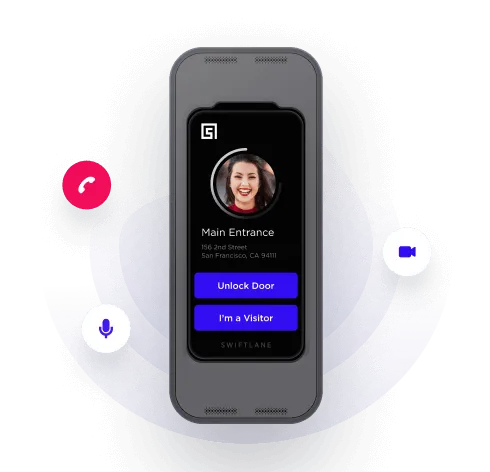
DoorBird’s multi-tenant hardware includes device-level access control. The D21DKV includes PIN codes, RFID, and relay-driven door release. What it doesn’t have is Swiftlane’s cloud-native, portfolio-wide access control: centralized management across buildings and units, PMS-integrated lease-cycle automation, and audit logging from a single dashboard.
Swiftlane is both a high-security intercom and access control system. Swiftlane uses mobile, face recognition, PIN code, and key card access, and can integrate with existing access control systems.
Visitor Management
DoorBird sends an alert or chime to your phone or tablet through its app when someone is at your door. On DoorBird’s multi-tenant hardware (the D21DKV, for buildings up to 500 units), each unit gets its own call button with its own pool of up to 8 registered devices, which is plenty for a single household.
The real gap is elsewhere: DoorBird’s entry multi-tenant tier (D21DKV) runs at 720p, though the flagship D31 tier matches the single-family V line at 1080p (per DoorBird’s own current datasheets). Thus, resolution is a tier question, not strictly a single-family-versus-multi-tenant one. The consistent gap across every DoorBird tier is leasing-workflow automation. Credentials, PIN codes, and directory entries are all managed manually per unit through the app, with nothing tying access to move-in or move-out dates the way a property management system (PMS) would.
Swiftlane can be managed remotely via a mobile app and a web-based dashboard. Swiftlane’s multi-tenant intercom system can also connect an unlimited number of mobile devices to a single door. The touchscreen directory is able to hold any number of tenants, including the ability to set up front desk calling or a virtual front desk. Cascade calling can also forward an intercom call to another person if the first doesn’t answer.
Side-By-Side Feature Comparison
| DoorBird | Swiftlane | |
| Made in | Germany | US |
| Incoming intercom call | Calls are received via push notification in the mobile app | Calls are received as a regular phone call without the need to monitor app notifications |
| Temporary visitor access | Yes, provides temporary access via PIN code access with a keypad | Yes, single-use or unique user PINs can be issued for temporary or intermittent entry |
| Unlimited tenant capacity | Two multi-tenant tiers: D21DKV supports up to 500 units, D31 up to 3,000; each unit’s call button connects up to 8 devices for that household; directory, PIN, and RFID credentials are managed per unit via the app on either tier, with no bulk or lease-cycle onboarding tools | Unlimited tenant directory |
| Automatic system updates | Some automatic firmware updates and some manual software updates | Yes, over-the-air updates with cloud-based system for continuous access to the latest software and features |
| Ongoing cost and connectivity | Flat hardware cost (hardware and installation costs are substantial upfront; please see pricing breakdown); base video/audio calling and remote unlock run without a required subscription and don’t depend on an active internet connection for local network operation | Cloud-native architecture adds a recurring software/access control subscription on top of hardware cost, and core functions (remote unlock, directory management, audit logs) depend on a live connection to Swiftlane’s cloud |
| Access control architecture | Device-level only: PIN, RFID, and relay-driven unlock per unit, managed one door at a time through the app | Cloud-based and portfolio-wide: mobile and PIN access managed centrally across units and buildings, with PMS-integrated lease-cycle automation |
| Durability rating | IP65 / IK08-rated housing on the D21DKV, per DoorBird’s current datasheet | IK10-rated housing on the SwiftReader X (the top of the 1 to 10 IK impact-resistance scale*), per Swiftlane’s datasheet |
| Remote unlock with door release | Yes, grant access to visitors remotely via app | Yes, grant access to visitors remotely via app |
| Remote configuration and management | Configuration available through the DoorBird mobile app or the browser-based admin panel at webadmin.doorbird.com | Web-based and remote-first configuration and system management, with audit log history of configuration changes |
| Support and onboarding | No formal onboarding program, but support is available via web ticket submission or a direct phone line, including two U.S. offices (California and Florida) | Comprehensive onboarding with a specialist, and continuous local support via email, chat, or phone |
| Multiple door management | Yes, with IP I/O Controller accessory | Support for managing multiple doors across multiple sites via the same interface |
| Access point security | Door relay is built into the outdoor readers, which can be tampered with to unlock the door; no door position or door held open alerts. | Door relays are secured with custom security screws on the secure side of the access point; alerts sent during abnormal door held open activity |
*IK ratings measure resistance to physical impact, from IK00 (no protection) to IK10 (the highest standard rating). DoorBird’s D21DKV rates IK08; Swiftlane’s SwiftReader X rates IK10 (a verifiable difference in impact resistance, not a marketing claim).
What is DoorBird?
DoorBird is a German-engineered video intercom system, originally built for single-family homes, that connects to a property’s existing door chime and wiring. Its multi-tenant lines (covered in detail above) extend that hardware from buildings of up to 500 units (D21DKV) to up to 3,000 units on the D31 flagship tier.
DoorBird has been owned by ASSA ABLOY since October 2022, when the Swedish access control conglomerate acquired 100% of Bird Home Automation GmbH. ASSA ABLOY operates with roughly 51,000 employees worldwide. This is a real point in DoorBird’s favor for parts availability, firmware support, and the company simply still being around in ten years, which is a legitimate risk with smaller intercom manufacturers.
It hasn’t yet changed frontline support quality: verified DoorBird reviews on Trustpilot from the past year describe slow or unresponsive support, difficulty reaching anyone for troubleshooting, and steep out-of-warranty repair costs. That pattern runs through 2025 and 2026, well after the acquisition closed.
Support is available by web ticket or phone, including two U.S. offices in California and Florida, but response times remain the recurring complaint regardless of contact method.
DoorBird Advantages
- Each unit’s call button supports up to eight registered devices simultaneously (useful for multi-person households)
- Native SIP support and an open API, with confirmed integrations across Control4, Crestron, Loxone, and third-party NVR and access control platforms
- IP65 / IK08-rated housing, built from metal rather than plastic: a real durability advantage, even where it trails Swiftlane’s IK10 rating (see comparison table)
- Flat hardware cost, with no subscription required for base video, audio, and remote-unlock functionality
- Backed by ASSA ABLOY (acquired 2022), a 51,000-employee access control leader (meaningful for long-term parts and firmware support on a decade-plus hardware purchase)
- Multiple finishes and mount configurations across the D21DKV line (surface, flush, several stainless steel finishes), letting a property match hardware to its existing aesthetic
DoorBird Drawbacks
- Relay and reader live in the same exterior housing, which creates a tamper path around the credential system entirely (see the relay tamper risk explanation above)
- DoorBird’s entry multi-tenant tier (D21DKV) ships at 720p, a real downgrade from both the single-family V line and DoorBird’s own D31 multi-tenant flagship, both of which use 1080p sensors (worth pushing for the D31 if resolution matters for your building)
- No leasing-workflow automation: units, PIN codes, and RFID credentials are managed one at a time through the app, with nothing that ties access to a move-in or move-out date the way a property-management-integrated system would
- One of the more expensive systems on the market today
- Reviewers say that the motion detection isn’t reliable and doesn’t always alert the user
- DoorBird’s 57-inch camera height recommendation is for video framing, not ADA compliance. But on units where the call button or keypad shares the housing with the lens, following that guidance can push the actual operable control above the ADA’s 48-inch reach-range maximum (ADA Standards §308–309); the button/keypad needs its own accessible-height placement independent of where the camera sits
- Some reviewers complain about glare and lens “fuzziness” when the camera is exposed to direct sunlight
- Some reviewers complain about wiring discrepancies between DoorBird and their existing system
- Lack of a robust customer service program
- Cloud recording is a paid add-on, not included with the base system, and even the paid tier caps video history at about a week
- Some users complain about a “lag” in connectivity, especially when using 2-way communication
- Reviewers are often frustrated by the video quality, as demonstrated by Out of the Box
Installation and the DoorBird App
DoorBird replaces a property’s existing doorbell or door station wiring, and most installs support either PoE (power and data over one Ethernet cable) or a standard 15V DC supply, with WiFi as a fallback where running Ethernet isn’t practical.
Surface-mounting is straightforward with basic tools; flush-mounting requires cutting a recess into the wall and is a bigger job. DoorBird’s multi-tenant models (with multiple call buttons, name directories, and RFID configuration) are complex enough that professional installation is worth the cost even for an otherwise DIY-comfortable property manager.
Configuration happens through the DoorBird app (iOS and Android), which also handles integration with third-party systems like Control4 and Crestron via DoorBird’s open API.
The app itself holds a 4.1-star rating on Google Play and 4.5 on the Apple App Store. Sentiment splits along familiar lines: positive reviews call it reliable and easy to use, while recurring complaints cite slow motion-detection alerts, push notification delays of up to 10 seconds, missing features, and weaker support for Android and Google Assistant users.
Reviewing DoorBird Single-Family Products
DoorBird’s single-family lineup spans its V line (enhanced audio and higher-resolution cameras) and single-call-button KV models (keypad and RFID access on one door). KV naming spans two different use cases worth telling apart: single-call-button models like the D2101KV below are single-family or single-tenant commercial units, while true multi-tenant models like the D21DKV (reviewed above) add a display module and directory support for up to 500 units. A KV model without that display module isn’t a multi-tenant system, whatever the name suggests.
DoorBird D1101V Review
The D1101V is DoorBird’s single-family flagship: a 1080p HD camera with night vision, an integrated RFID reader for keyless entry, weather-resistant construction, and two-way audio through DoorBird’s app. It runs $924 surface-mount or $1,260 flush-mount (DoorBird station pricing isn’t the same as installed cost, so confirm whether this quote includes housing/backbox, power supply, and wiring; see the full cost breakdown), and averages 4.5 stars across 26 Google reviews. Reviewers consistently praise the build quality and finish, and most find installation straightforward; the recurring complaints are image quality in low light, barrel distortion on close-up recording, unclear audio, and motion detection that’s occasionally slow or inaccurate.
DoorBird D2101KV Review
The D2101KV is a single-call-button video door station with an integrated keypad. It’s built for single-family homes or single-tenant commercial properties, not multi-tenant buildings (DoorBird’s own datasheet specifies it for “single-family houses and commercial buildings with 1 unit”). It ships with a 720p camera, night vision, an RFID reader, and two relay outputs for controlling two doors or gates. The flush-mount model runs $2,174. It holds a 3.8-star rating on Amazon, and reviewers are largely positive on installation, configuration, integration, and picture/audio quality; the main complaints are that opening and installing the unit requires specialized tools, and that the backbox is a required, separate purchase.
DoorBird A1101 Review
The A1101 is DoorBird’s indoor companion station: a 4″ touchscreen display for viewing live video and remotely unlocking doors, paired with two-way audio. It costs $797 (DoorBird station pricing isn’t the same as installed cost, so confirm whether this quote includes housing/backbox, power supply, and wiring; see the full cost breakdown), and averages 4.2 stars across 22 Google reviews. Reviewers like the video quality and how smoothly it integrates with DoorBird’s other devices; the main complaints are installation difficulty (reported more often by U.S. reviewers than European ones) and a display some would prefer larger.
Other Alternatives to DoorBird
Beyond Swiftlane, a few other systems are worth knowing about. 2N, Aiphone, ButterflyMX, and Akuvox are genuine multi-tenant competitors worth evaluating alongside DoorBird’s D21DKV. Wyze and Ubiquiti’s doorbell lines are single-family-only products. They’re comparable to DoorBird’s residential hardware, but not relevant to a multi-tenant buying decision.
Aiphone
With decades under its belt, Aiphone is known for its reliable and durable intercom systems. Users choose their systems for high-quality audio and video capabilities that serve both residential and commercial properties. While it doesn’t have as many third-party integrations as some competitors, it supports basic integration with building management systems. Pricing starts around $500 for basic models and can go up depending on the system complexity.
2N®
2N® provides advanced intercom systems with high-definition video, mobile access, and integration with other building management systems. They support integrations with platforms like SIP and ONVIF for broader compatibility. These features make 2N® IP Intercoms nearly identical to DoorBird in terms of functionality. Like DoorBird, it’s also a European company. Prices typically start around $1,000. There’s also an optional annual subscription for cloud calling, which can be priced per apartment or per device.
Akuvox
Akuvox provides a wide range of IP-based intercom and access control systems with advanced features like facial recognition and mobile access. They support integrations with SIP, ONVIF, and various smart home platforms. Prices vary but start around $800.
Special Note: In March 2023, CISA published advisory ICSA-23-068-01 on the Akuvox E11, covering 13 vulnerabilities discovered by Claroty’s Team82, including missing authentication, hard-coded encryption keys, and improper authorization. These flaws were severe enough that CISA recommended disconnecting affected devices from the internet until fixed. Claroty reported that Akuvox closed its support tickets and blocked its account during the disclosure process, and only went public with CISA after the vendor stopped responding. Property managers evaluating Akuvox should confirm current firmware status and patch history directly with the vendor before deployment.
Single-Family-Only Options: Wyze and Ubiquiti
Wyze and Ubiquiti both make well-regarded video doorbells, but neither is built for multi-tenant deployment. Wyze’s Video Doorbell Pro runs $59.99 to $149.99 with Alexa, Google Assistant, and IFTTT integration; Ubiquiti’s UniFi Protect G4 Doorbell line runs $250 to $449+ and integrates with the broader UniFi Protect ecosystem. Both are worth knowing about if you’re also weighing a single-family or single-unit property, but they don’t compete with DoorBird’s D21DKV on the features a multi-tenant building needs.
FAQs
How many units can one DoorBird system support?
It depends on the tier. The D21DKV, DoorBird’s entry multi-tenant model, supports up to 500 units. The D31 (D31TDH/D31TDV), DoorBird’s multi-tenant flagship, scales to up to 3,000 units, per DoorBird’s current datasheets. Both are system-wide ceilings, not per-door limits. If you’ve been quoted a D21DKV for a building near or above 500 units, ask about the D31 before assuming you need a different platform entirely.
How many devices can one resident connect to their unit?
Up to 8 registered mobile devices, but that limit applies per call button, which means per individual unit, for that household’s own phones, not across the building. A 500-unit system has up to 500 independent call buttons, each with its own pool of 8 devices. DoorBird’s own FAQ confirms this directly.
Does DoorBird require a subscription?
No subscription is required for base functionality. Live video, two-way audio, push notifications, and remote unlock all work without a recurring fee. Cloud video recording is a paid add-on, and even on the paid tier, video history is limited to about a week of storage.
What happens to a DoorBird-connected door during a power outage or fire alarm?
It depends entirely on what’s wired to DoorBird’s relay, not on DoorBird itself. An electric strike that still allows free mechanical egress from inside is exempt from the IBC’s special locking arrangement requirements, though it must be a fail-secure strike if the door is fire-rated (a fail-safe strike would unlock and void the door’s fire rating). A magnetic lock wired to the relay is a different situation. Because it electrically locks the egress side too, it triggers the full special locking arrangement bundle: sensor release, a manual release station, automatic unlock on power loss, and a fire-alarm interconnect. None of that comes standard with DoorBird’s relay output; it has to be engineered in at the door hardware layer. Loop in a locksmith, integrator, or your local AHJ before finalizing hardware on any code-governed door.
Does DoorBird support SIP or landline/PBX calling?
Yes. DoorBird’s multi-tenant hardware (the D21DKV and D2101KV) supports SIP natively, so calls can route to landline or IP phones in addition to the mobile app, and integrates with third-party SIP/PBX systems through DoorBird’s open API.
Is DoorBird ADA compliant?
DoorBird recommends mounting the camera lens around 145 cm (57 in) from the ground for optimal video framing. That height governs the camera only. ADA reach-range rules (48 in max, 15 in min) apply to operable parts like a call button or keypad, not to a camera lens (ADA Standards §308–309, U.S. Access Board guidance). The practical risk: many DoorBird units combine the lens and call button in one housing, so mounting for good camera framing can push the button above the accessible reach range. Confirm the operable control itself sits within 15 inches to 48 inches, independent of where the camera sits.
Who owns DoorBird?
DoorBird has been owned by ASSA ABLOY since October 2022, when the Swedish access control conglomerate acquired 100% of Bird Home Automation GmbH. ASSA ABLOY operates with roughly 51,000 employees worldwide, a meaningful point in DoorBird’s favor for parts availability and long-term firmware support on a decade-plus hardware purchase. It hasn’t yet translated into faster frontline support: verified reviews from 2025 and 2026, well after the acquisition closed, still describe slow response times.
Do DoorBird devices pose any liability issues?
Two areas carry legal exposure. First, DoorBird’s two-way audio records conversations, not just video, and several states require all-party consent to record: California (Cal. Penal Code § 632), Florida (Fla. Stat. § 934.03), Illinois (720 ILCS 5/14-2), Maryland (Md. Cts. & Jud. Proc. § 10-402), Montana (Mont. Code Ann. § 45-8-213), New Hampshire (N.H. Rev. Stat. § 570-A:2), Pennsylvania (18 Pa. Cons. Stat. §§ 5703-5704), and Washington (Wash. Rev. Code § 9.73.030). Massachusetts (Mass. Gen. Laws ch. 272, § 99) is the strictest: illegal recording is a felony there regardless of circumstance. Delaware and Oregon also apply here: Oregon requires all-party notice for in-person conversations (ORS § 165.540), and Delaware’s conflicting statutes make all-party the cautious read. Connecticut and Nevada are often listed as all-party states, but that’s based on their phone-call statutes. Both treat in-person conversations, like a doorstep exchange, as one-party. One caveat: these statutes only cover conversations with a reasonable expectation of privacy, and whether a chat at a building’s front entrance (audible to passersby, residents, or delivery staff) meets that bar is genuinely unsettled. Don’t assume every doorstep exchange is automatically covered, but don’t assume it’s exempt either. Second, facial recognition on an intercom triggers biometric privacy laws: Illinois’ BIPA (740 ILCS 14), Texas’ CUBI (Tex. Bus. & Com. Code § 503.001), and Washington’s RCW 19.375 require notice and sometimes consent before collecting biometric identifiers. Provide notice, obtain consent, maintain insurance, and train tenants to limit exposure.
Is my data (and my tenants’ data) safe with DoorBird?
DoorBird designs its devices with security in mind, but building owners must also implement best practices to protect users’ data. Users should secure devices that capture video and audio recordings to prevent unauthorized access. They should also regularly update firmware, implement robust password policies, and comply with local data protection laws. As a building owner or property manager, you must also inform tenants about data collection and usage and ensure that data encryption helps safeguard against privacy breaches.
How does DoorBird’s data security compare to Swiftlane’s?
DoorBird and Swiftlane both prioritize data security, but they employ different approaches. DoorBird uses end-to-end encryption, regular firmware updates, and GDPR compliance (required in the EU) to protect user data. In contrast, Swiftlane offers advanced AES-256 encryption, integrates AI for enhanced security measures like facial recognition and anomaly detection, and conducts regular security audits. Swiftlane is also quite transparent about its data storage policies. You can learn all about their approach through this comprehensive resource. While both systems provide robust security and user control over data, Swiftlane’s advanced features and regular audits offer an additional layer of protection that may appeal to users seeking the highest level of data security.
Can DoorBird integrate with existing building security systems?
Yes, DoorBird can be integrated with existing security and access control systems, offering a seamless upgrade to modern smart intercom technology. The open API allows for extensive customization and compatibility with various third-party systems.
Is there a way to manage deliveries for multiple tenants?
DoorBird systems can notify tenants of deliveries and provide remote access to delivery personnel, which reduces the risk of missed or stolen packages. The app can send alerts when a delivery arrives, and tenants can grant temporary access as needed.
Is DoorBird Right for Your Building?
DoorBird is a legitimate choice if you manage a single building or portfolio up to 3,000 units, already have wired infrastructure or budget for it, don’t need lease-cycle automation tied to a PMS, and can absorb thin direct support even under ASSA ABLOY’s ownership. The D21DKV covers buildings up to 500 units at 720p and a lower price point; the D31 tier covers up to 3,000 units at 1080p and a meaningfully higher one. Match the tier to your actual scale and video-quality needs before requesting a quote. Don’t default to the entry tier without asking what the flagship costs.
DoorBird is the wrong choice, at either tier, if you need bulk or automated tenant onboarding tied to move-in/move-out dates, if you need responsive vendor support as a dealbreaker, or if your portfolio exceeds 3,000 units on a single system. Those gaps are structural to DoorBird’s current hardware and support model, not something a specific SKU or firmware update fixes.
More Reviews Like This
Start Improving Your Building Security
Contact a Swiftlane specialist about learn more about alternatives to DoorBird intercom, and find the best access and intercom solution for your building.