Managing access across multiple doors, lobby, parking, server room, and amenity floors from separate systems creates real operational risk: credential sprawl, no central audit log, and manual offboarding at every door. This guide covers how multi-door access control systems solve that, what they cost, and how to choose the right one for your building or portfolio.
How We Researched This Guide
This guide draws on Swiftlane’s deployment data from 3,000+ buildings, hardware specifications, and vendor pricing data current as of 2026, and security industry standards from SIA, ASIS International, and NIST SP 800-116 Rev. 1. Controller and platform comparisons are based on published product documentation and publicly available feature information from each vendor.
Pricing figures reflect installer quotes and published vendor data and may vary by region, installation complexity, and contract size.
Key Takeaways
- A multi-door access control system manages credentials, schedules, and audit logs for two or more doors on a single platform.
- The right controller type depends on door count, cloud requirements, and credential needs.
- Costs vary significantly by door count and system type. See the full pricing breakdown below.
- Multi-door, multi-site, and multi-building are not the same thing, and the difference determines which platform tier you need.
- Cloud is the right fit for most buyers. On-premises is worth considering only for government or air-gapped environments.
- Legacy 125kHz fobs are cloneable and should be phased out where security is a priority.
- Before committing, verify that the system scales without re-platforming and that multi-site management doesn’t incur extra costs.
- Swiftlane handles lobby intercom, parking, package rooms, amenity floors, and elevator access from one dashboard.
Table of Content
- What Is a Multi-Door Access Control System?
- Multi-Door Controller Types: Which One Do You Need?
- 2026 Pricing by Door Count
- Multi-Door vs. Multi-Site vs. Multi-Building: What’s the Difference?
- 5 Use Cases: Matching Systems to Buildings
- 7-Step Buyer’s Framework
- Head-to-Head: Top Multi-Door Systems for Commercial Buyers
- Multi-Door System Architecture: What the Installation Looks Like
- Common Installation Questions
- Why Property Managers Choose Swiftlane for Multi-Door Buildings
- FAQs
What Is a Multi-Door Access Control System?
A multi-door access control system is a single platform that manages credentials, schedules, and audit logs for two or more doors. Instead of separate keypads at each entry point, all doors connect to one controller and cloud dashboard, so you can grant, restrict, or revoke access from one place.
The short version:
| Doors | Best Fit | Typical Cost |
| 2–5 doors | IP-based controllers | $350–$800/door hardware + software |
| 6–20 doors | Cloud-managed panel | $500–$1,200/door, includes mobile app + audit log |
| 20+ doors / multi-site | Enterprise cloud with SSO and API | $800–$2,500/door |
Swiftlane scales from 1 door to 500+ buildings on one dashboard.
Multi-Door Controller Types: Which One Do You Need?
Not all multi-door systems are built the same. The right controller type depends on how many doors you’re securing, whether you need cloud management, and what credentials your tenants or staff will use.
1. IP-Based Door Controllers (2–8 Doors)
Best for: small offices, co-working spaces, SMB warehouses.
- Each door gets its own IP controller connected to your LAN
- Hardware-only or cloud-optional
- Credentials: key fob entry systems for buildings, no native mobile app
- Examples: HID EDGE EVO, Suprema CoreStation
- Cost: $300–$700/door hardware, software $20–$60/month
2. Cloud-Managed Access Panels (4–50 Doors)
Best for: mid-size offices, multifamily buildings, retail chains.
- Panel connects all doors to cloud software via LTE or Wi-Fi
- Credentials: mobile app, face recognition, fob, PIN
- Remote management, real-time alerts, and audit log
- Examples: Swiftlane, Brivo, Avigilon Alta (formerly Openpath)
- Cost: $450–$1,200/door hardware + $30–$80/month SaaS
3. Enterprise On-Premise Systems (50+ Doors, Multi-Site)
Best for: corporate campuses, government, and enterprise with strict IT requirements.
- Server-based, on-site, or private cloud
- Integrates with Active Directory and SSO
- Examples: Lenel OnGuard, Software House C•CURE 9000, Genetec
- Cost: $1,500–$5,000/door + $100K+ implementation
2026 Pricing by Door Count
Costs vary significantly based on door count, controller type, and whether you’re adding SaaS software on top of hardware. The tables below break down typical ranges for both.
Hardware + Installation
| Doors | Controller Type | Hardware/Door | Install/Door | Year 1 Total |
| 2 doors | IP single-door | $350–$600 | $200–$400 | $1,100–$2,000 |
| 4 doors | IP multi-door panel | $400–$700 | $250–$450 | $2,600–$4,600 |
| 8 doors | Cloud panel | $500–$900 | $300–$500 | $6,400–$11,200 |
| 16 doors | Cloud panel | $550–$1,000 | $350–$600 | $14,400–$25,600 |
| 32 doors | Enterprise cloud | $700–$1,500 | $400–$800 | $35,200–$73,600 |
| 50+ doors | Enterprise cloud/on-prem | $800–$2,500 | $500–$1,200 | Custom |
SaaS / Software Costs (Annual)
| Platform | Per Door/Month | 8-Door Annual | 16-Door Annual |
| Swiftlane | $35–$65 | $3,360–$6,240 | $6,720–$12,480 |
| Brivo | $40–$80 | $3,840–$7,680 | $7,680–$15,360 |
| Avigilon Alta | $45–$85 | $4,320–$8,160 | $8,640–$16,320 |
| Kisi | $50–$90 | $4,800–$8,640 | $9,600–$17,280 |
| Lenel OnGuard | Custom ($100K+) | — | — |
Pricing ranges reflect installer quotes and vendor-published data as of 2026 and may vary by region, installation complexity, and contract size.
Multi-Door vs. Multi-Site vs. Multi-Building: What’s the Difference?
These three terms get used interchangeably, but they describe different deployment scenarios. Knowing which one applies to your situation will help you choose the right platform from the start.
| Term | What It Means | Typical Buyer |
| Multi-door | Multiple doors at one location | Office manager, warehouse ops |
| Multi-site | Multiple separate locations, managed centrally | Retail chain, co-working operator |
| Multi-building | Multiple buildings on one campus | University, corporate HQ, hospital |
Swiftlane handles all three. Whether you’re managing a 4-door office or a portfolio of 500 apartment buildings, everything runs from the same dashboard with per-building or portfolio-wide credential policies.
5 Use Cases: Matching Systems to Buildings


1. Commercial Office (8–50 Doors)
- Doors to secure: lobby, parking garage, server room, executive floor, conference wing.
- Best fit: cloud-managed panel with mobile credentials and face recognition.
- Key requirements: Active Directory sync, visitor management, and after-hours lockdown.
- Swiftlane coverage: all of the above.
- Typical cost: $8,000–$45,000 installed + $400–$1,200/month SaaS.
2. Multifamily Apartment Building (4–20 Doors)
- Doors to secure: lobby, parking, package room, amenity floors, and rooftop.
- Best fit: cloud panel with video intercom and mobile app for residents
- Key requirements: resident self-enrollment, lease-expiry auto-revocation, and delivery PIN.
- Swiftlane coverage: all of the above. Swiftlane is active across more than 3,000 US buildings.
- Typical cost: $6,000–$30,000 installed + $300–$900/month SaaS.
3. Warehouse and Industrial (2–12 Doors)
- Doors to secure: dock doors, employee entrance, office, cage or vault.
- Best fit: rugged IP controllers with a cloud dashboard.
- Key requirements: shift scheduling, contractor temp access, audit log.
- Swiftlane coverage: shift schedules, temp credentials, audit log.
- Typical cost: $4,000–$18,000 installed + $200–$700/month SaaS.
4. Retail Chain (Multi-Site, 2–4 Doors Each)
- Doors to secure: storefront, back-of-house, safe room.
- Best fit: centrally managed cloud with per-location policy override.
- Key requirements: employee transfers, standardized hardware, and remote lockdown.
- Swiftlane coverage: multi-site dashboard with role-based management.
- Typical cost: $1,500–$5,000/location installed + $100–$300/location/month SaaS.
5. Healthcare and Compliance (10–50 Doors)
- Doors to secure: patient areas, pharmacy, records, staff-only zones.
- Best fit: cloud with full audit log and HIPAA reporting.
- Key requirements: zone-based access, badge and biometric, and compliance export.
- Swiftlane coverage: role-based zones, audit exports, face and mobile credentials.
- Typical cost: $15,000–$80,000 installed + $700–$2,500/month SaaS.
7-Step Buyer’s Framework
Use this framework to evaluate any multi-door access control system before you buy, whether you’re securing a 4-door office or a 50-door mixed-use building.
Step 1: Count Your Doors
Lobby, parking, stairwells, and elevators all count as individual doors. Don’t overlook server rooms, rooftops, and utility areas. A simple rule: if it needs a credential, it’s a door.
Step 2: Decide Between Cloud and On-Premise
Cloud access control systems offer lower upfront costs, remote management, and automatic updates. They’re the right fit for 90% of buyers. On-premise is worth considering for government facilities, classified environments, or air-gapped networks where cloud connectivity isn’t permitted.
Step 3: Choose Your Credential Types
- Mobile app (BLE/cellular): best experience for residents and staff, no cards to lose
- Face recognition access control: hands-free, no device to carry required, ideal for high-traffic entry points
- Key fob or card: budget option, compatible with legacy readers
- PIN codes: useful for visitors and deliveries, not recommended as the primary credential for full-time employees
A note on biometric privacy: Face recognition and other biometric credentials are subject to state-level biometric privacy laws in a growing number of states, including Illinois (BIPA), Texas (CUBI), and Washington (RCW 19.375). These laws generally require advance notice, consent, and a defined retention/deletion schedule before biometric data can be collected.
If you’re evaluating face recognition for a multi-door deployment, confirm your vendor supports compliant consent workflows and gives you control over retention and deletion.
Step 4: Plan Your Integrations
The more your access control system connects to your other tools, the less manual work your team does.
- HR system: auto-revoke credentials on termination
- Active Directory or SSO: provision access from your org chart
- Video surveillance: link access events to camera footage
- Visitor management: auto-generate temporary credentials for guests
Step 5: Plan Your Controller Infrastructure
Choose between a single controller per door and multi-door panels with 4, 8, or 16 ports. For wiring, Ethernet is the most reliable option. Wi-Fi works well for retrofits, and cellular is best for remote gates or outbuildings.
Any door on an egress path must be configured fail-safe (unlocking on power loss or fire alarm activation) per local fire and building code. This is separate from battery backup, which keeps the system operational during an outage but doesn’t override a fail-secure lock’s default state. Confirm fail-safe vs. fail-secure configuration door-by-door with your AHJ or fire marshal before installation.
Step 6: Verify Scalability
Before committing to a platform, confirm three things. First, whether the system can grow to 50+ doors without requiring a full re-platform. Second, whether pricing scales linearly per door or jumps at tier thresholds. Third, whether multi-site management incurs additional costs.
Step 7: Calculate Total Cost of Ownership
Four cost categories to account for:
- Hardware and installation, one-time
- SaaS subscription, recurring
- IT admin time, internal
- Support and maintenance, ask your vendor for specifics
Head-to-Head: Top Multi-Door Systems for Commercial Buyers
The table below compares the five most commonly evaluated platforms for multi-door deployments across commercial and multifamily properties.
| Feature | Brivo | Swiftlane | Avigilon Alta (formerly Openpath) | Kisi | Lenel OnGuard |
| Cloud-native | ✅ | ✅ | ✅ | ✅ | ❌ (on-prem) |
| Mobile app | ✅ | ✅ | ✅ | ✅ | ❌ |
| Face recognition | ❌ (3rd party) | ✅ built-in | ❌ (3rd party) | ❌ | ✅ (add-on) |
| Video intercom | ❌ | ✅ built-in | ❌ | ❌ | ❌ |
| Multi-site | ✅ | ✅ | ✅ | ✅ | ✅ |
| Open API | ✅ | ✅ | ✅ | ✅ | ✅ |
| Starting price | $40/door/mo | $35/door/mo | $45/door/mo | $50/door/mo | Custom |
| Best for | Enterprise commercial | Multifamily + commercial | Tech offices | Modern offices | Government/enterprise |
| Watch for | No native face recognition or video intercom — relies on 3rd-party add-ons | Premium pricing vs. intercom-only point solutions; lighter fit for fully air-gapped/on-prem enterprise requirements | No native face recognition or video intercom — relies on 3rd-party add-ons | No face recognition or video intercom option | No mobile app; on-premise deployment adds IT overhead vs. cloud-native platforms |
Swiftlane coverage: role-based zones, audit exports, face and mobile credentials. (Face recognition credentials are subject to state biometric privacy laws — see the biometric privacy note above.)
Multi-Door System Architecture: What the Installation Looks Like
Understanding how the components connect helps you plan your installation and avoid surprises on deployment day.
Key Components
Every multi-door system is built from the same five layers. The reader sits at each door and captures the credential, whether that’s a mobile app, face scan, fob, or PIN. It sends that signal to the controller or gateway, which connects all readers to the cloud and handles offline fallback when internet connectivity is interrupted.
At the door itself, an electric lock, mag-lock, or strike does the physical work of securing or releasing the door based on the controller’s decision. Above all of that sits the cloud software, which manages credentials, schedules, alerts, and reporting from any browser or mobile device. Your team interacts with all of it through the admin portal or mobile app, where day-to-day tasks like granting access, setting schedules, and pulling audit logs happen.
How It Connects
Here’s what that looks like in a real deployment, using a Swiftlane installation as an example.
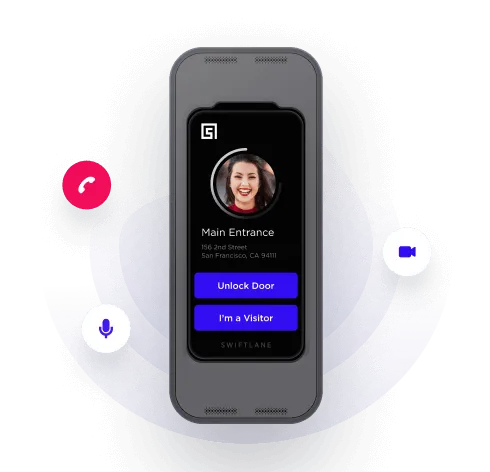
A typical 4-door Swiftlane deployment runs a SwiftReader at the lobby, parking gate, package room, and amenity floor.
All four readers connect to the Swiftlane cloud gateway, which feeds into the Swiftlane Cloud Platform. From there, your team manages everything through the admin dashboard, and residents or staff use the mobile app.
Common Installation Questions


Can I add doors later without replacing the controller?
Yes. Most multi-door panels have expansion ports that support additional readers without hardware replacement. Swiftlane’s gateway supports a high number of readers per location — check with sales for the specific limit on your deployment.
What happens if the internet goes down?
Swiftlane stores credentials locally on the gateway. Doors continue to function offline, and changes sync automatically when connectivity is restored.
Do all doors need to be wired?
No. Swiftlane supports wired (Cat5/Cat6), Wi-Fi, and cellular readers, which makes it practical for gates, outbuildings, and retrofit scenarios where running new cable isn’t feasible.
How long does installation take?
A 4-door office typically takes one day. A 20-door building runs two to three days, depending on wiring runs and door hardware complexity.
Can we integrate with our existing cameras?
Yes. Swiftlane’s SwiftReader X has a built-in camera. For existing surveillance systems, Swiftlane integrates via webhook and API with most VMS platforms.
Why Property Managers Choose Swiftlane for Multi-Door Buildings
Swiftlane serves multifamily properties and Class A office towers across the US. Here is what property managers consistently cite when asked why they standardized on Swiftlane.
One platform for every door type. Lobby intercom, parking, package room, amenity floors, and elevator access all run on Swiftlane, so your team manages one system instead of juggling multiple vendor portals.
Face recognition is built in. No add-on required. Residents and staff can enter without pulling out a phone or fob, which matters most during high-traffic hours and package delivery windows.
Lease-expiry auto-revocation. Resident access is automatically turned off on the move-out date. No manual deactivation, no forgotten credentials left active after a tenant leaves.
Delivery PIN management. Generate one-time PINs for Amazon, UPS, and FedEx without granting any carrier permanent access. PINs expire automatically after use or after a set window.
Multi-site dashboard. Manage one building or 500 from the same screen, with the ability to set portfolio-wide credential policies or override them at the individual property level.
Next Steps
Ready to secure multiple doors with one system?
→ Get a Free Multi-Door Quote from Swiftlane
→ See How Swiftlane Works for Offices
→ Explore Swiftlane for Apartment Buildings
FAQs
1. What is a multi-door access control system?
It’s a single access control platform that handles multiple entry points, two doors or two hundred, under one set of credentials and one audit trail, rather than programming each door’s keypad or reader separately. An admin can add, restrict, or revoke someone’s access across every door from one dashboard, instead of visiting each entry point individually.
2. What is the minimum number of doors for a multi-door system?
Most systems start at 2 doors. Swiftlane is designed to scale from a single door to 500+ buildings without switching platforms, making it a practical choice for properties that expect to grow.
3. How much does a multi-door access control system cost?
Typical installed costs run $1,100–$2,000 for 2 doors, $6,400–$11,200 for 8 doors, and $35,200 or more for 32 doors. SaaS fees range from $35–$90/door/month, depending on the platform. See the full pricing breakdown above.
4. Which door controllers work best for multi-door setups?
For cloud-managed deployments, Brivo, Swiftlane’s gateway, and Avigilon Alta are the most commonly evaluated options. For enterprise or on-premise requirements, Lenel, Software House, and Genetec are the standard choices. The right fit depends on whether you need mobile credentials, face recognition, and multi-site management.
5. Can I manage multi-door access from a phone?
Yes. Cloud platforms like Swiftlane offer iOS and Android admin apps for managing credentials, viewing audit logs, granting temporary access, and receiving alerts from anywhere.
6. What is the difference between multi-door and multi-site access control?
Multi-door means multiple doors at one location. Multi-site refers to multiple separate buildings or locations managed from a single platform. Swiftlane handles both from a single dashboard, whether that’s a 4-door office or a portfolio of 500 apartment buildings.
7. How do I handle contractor or visitor access across multiple doors?
Cloud platforms handle this through temporary credentials: time-limited PINs, single-use mobile passes, or scheduled fob access. Swiftlane’s visitor management module lets you generate temporary access for any door or set of doors, with automatic expiration.
8. Do multi-door systems work with existing key fobs or cards?
Most systems support legacy fob and card formats used in RFID access control systems, including 125kHz, 13.56MHz MIFARE, and HID iCLASS. Note that 125kHz fobs are cloneable and should be phased out where security is a priority. Swiftlane supports all major credential types, as well as face recognition and mobile credentials, so you can migrate gradually without replacing everything at once.