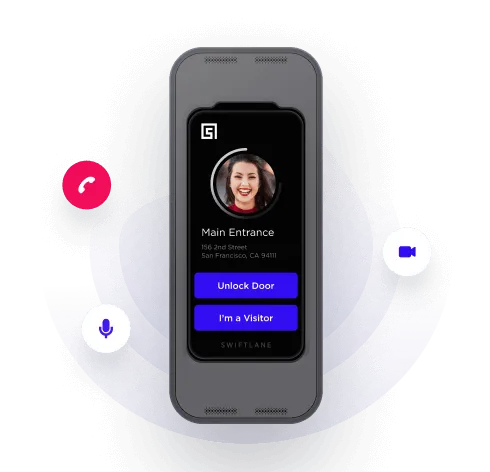
Do you want higher security for properties you manage without breaking the bank? Higher security in residential, commercial, or office properties usually entails higher costs for security hardware, but tenant safety doesn’t necessarily have to mean more expenses.
A QR code intercom system is a communication and access control solution that does away with most on-premises hardware by utilizing your smartphone as the “intercom”. It is a cloud-based system, which means it is hosted and managed on remote internet servers.
With experience supporting thousands of residential and commercial properties through Swiftlane’s intercom solutions, we’ve seen firsthand how easily tenants can operate QR code intercoms just like traditional systems. They can speak with visitors and remotely grant access with a few taps on their smartphone.
Read our guide below, and we’ll take you through how a QR code intercom works, how to choose, and what it costs.
Key Takeaways
- A QR code intercom is a cloud-based system accessible to visitors by scanning a plate-mounted QR code at a building entrance. A QR code intercom brings most of the benefits of a fully physical intercom, without the on-prem hardware.
- Although QR code intercoms save on on-prem hardware and installation costs, they are not always the cost-efficient solution. Depending on building type, visitor traffic, security expectations, and more, you can do better with a full-fledged intercom system.
Table of Contents: Quick Navigation
- What Is a QR Code Intercom System?
- Benefits of a QR Code Intercom System
- Determining if a QR Code is Right for Your Property
- QR Code Intercom: Price Breakdown
- Swiftlane As Your QR Code Intercom Provider
What Is a QR Code Intercom System?


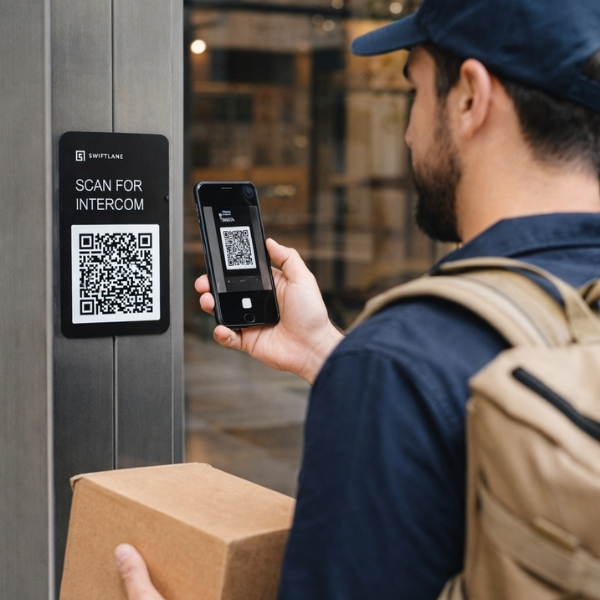
A QR code intercom system involves a plaque or plate containing a QR code at a property entrance. Scanning the mounted QR code leads to a cloud-based interface with intercom-like options such as door unlock, directory, package room, or calling.
This intercom is a software-driven approach to communication and verification at building entrances. It does away with physical devices and replaces them with mounted QR code plaques or plates.
How It Works
- Visitors scan the QR code posted by the entrance of a building using their smartphone cameras.
- The scan leads to a web-based interface—no app download is usually necessary.
- Visitors can then initiate calls to tenants or enter credentials such as PIN codes for access.
- Tenants receive notifications or calls on their mobile phone and remotely grant entry.
Benefits of a QR Code Intercom System
Reduced On-Prem Hardware
Smart or traditional intercoms keep some sort of on-prem hardware, but QR code intercoms do away with most physical components. This component reduction saves on hardware, installation, and maintenance costs.
Quick Deployment & Configuration
You won’t need an installation crew for a QR code intercom, except for the door release, which eliminates significant time from the total installation. Post the QR code and manage the system almost instantly.
Practical Fit
Property managers or owners may not have the budget to retrofit a small apartment with a full-scale video intercom, so a QR code intercom can provide intercom functionality without high costs. Older buildings can also be preserved since no physical installations will be necessary.
Remote Access Control
Because tenants control the QR code system through their smartphones, they can remotely grant access to guests or deliveries when they are away from the location.
Centralized Management
Property teams that handle several residential and commercial properties can easily manage access across their entire portfolio with a QR code intercom system.
Temporary Visitor Access
Frequent visits from deliveries, domestic service workers, and house guests can be granted short-term or scheduled access without issuing permanent credentials.
Operational Cost Deductor
QR code intercoms reduce the need for reception desk teams, directing visitors to apartment units, employees, or departments.
Support for Flexible and Hybrid Work
Even employees who work from home can remotely grant access to visitors.
Determining if a QR Code is Right for Your Property
A QR code intercom can be a great fit for some properties, but it can be a less effective choice for others. To help you assess whether a QR-based intercom system works with your daily operational requirements, you have to consider the following practical factors.
Building Type and Layout
QR code intercoms are ideal for small to mid-sized building types and secondary doors.
Walk-up or mid-rise apartment buildings and boutique residential properties usually have no front desk staff and see sporadic visits. A QR code intercom sufficiently helps visitors with its simple “scan to call” workflow.
Small to medium-sized businesses, professional services, and tech companies with hybrid workforces are also small enough to see little visitor activity. A QR code intercom is enough to welcome the occasional visitor or delivery.
Secondary doors, rear entrances, and service docks are not the primary entry points for visitors, so QR code intercoms work well for them as well.
However, in large residential condominiums, offices, and commercial buildings that see a high volume of traffic, a video intercom system becomes more practical for ease of use and quick workflows.
In these places, visitors can congest entry points if QR code intercoms are used because of their unique workflow (take out phone → scan QR → browse interface on smartphone → call tenant → door unlock).
A video intercom works quickly: tenants can assign temporary credentials to visitors. Visitors without credentials also experience shorter workflows (browse intercom directory → initiate call to tenant → tenant verifies and unlocks the entrance door).
Visitor Flow, Volume, and Classification
Who are the visitors that come to your property, and how often do they come? A QR code “self-serve” intercom is a strong fit if:
- Visitors arrive one or two at a time
- Visitors are usually first-timers (delivery drivers, clients, contractors)
- Visitor activity is unpredictable
- Apartments are not luxury or Class A
Meanwhile, a full-fledged intercom more strongly suits properties with:
- High-traffic (5-20 people arriving simultaneously)
- Predictable surges (rush hours, lunch breaks, delivery days)
- Daily repeat visitors (residents, employees, customers)
These instances require quick, easy entrance using verified credentials that only an intercom device can recognize.
In turn, luxury and Class A properties serve a certain clientele, and visitors are often of the same classification. Entry points of these buildings should be outfitted with a full intercom system to provide a high-class experience to residents and their visitors. QR code intercoms can still be used but only for secondary doors and rear entrances.
Comfort with Technology
Tenants and visitors depend on smartphones to scan the QR code and access the cloud-based intercom system. Properties with techy populations can do well with QR code intercoms because they can follow on-screen prompts on their smartphones.
However, if your property serves a population that is less comfortable with smartphones, such as senior living facilities, a physical intercom system can work better.
Security Expectations
As security experts, we’ve observed that QR code intercoms provide adequate security for requesting access.
Call logs show usage patterns that property managers or owners can check. Neither the weather nor vandalism can do any damage to hardware. With some QR code intercoms, visitors can video call tenants, and tenants can verify identities.
However, video intercoms focus on visitor verification. Tenants use verified credentials. And intercom devices have IP and IK ratings for weather and vandalism resistance.
Installation Constraints
QR code intercoms are non-intrusive, space-saving systems because you only need space for a plaque or plate at an entrance.
They make sense when you need to quickly install an intercom at multiple entrances. If you are deploying a complete intercom system, which takes time, a QR code intercom can also make sense as a temporary access control system.
However, if you have the existing wiring or space for intercom hardware, plus other reasons justifying a full system, you can go with a video intercom system. Most modern systems require minimal hardware on-premises, so a full system will not take too much space too.
Budget and ROI
QR code intercom systems significantly reduce upfront hardware and long-term operational costs, great for limited visitor traffic. You will only have to pay for the software subscription fees. However, they are not always the cost-effective solution.
Video intercom systems have higher costs upfront and long-term than QR code intercoms, but the benefit of a full system ensures secure and quick access for high-traffic buildings.
QR Code Intercom: Price Breakdown
Based on Swiftlane’s 20-hour market research and recent customer deployments, QR code intercom pricing typically includes a per-door QR plaque, optional door hardware, installation labor, and an ongoing software subscription.
- Weatherproof Plaques: QR code plaques will be mounted beside entrances for around $150 to $200 per door.
- Door Locks/Controllers: For remote door release, you can bundle electronic door locks when getting a QR code intercom, or get a controller to integrate with existing door release mechanisms. These can cost around $300 to $1,200 per door.
- Installation of Plaques: Installation fees can be around $300 to $1,000 per entrance, depending on plaque mounting and integration with door release.
- Ongoing Subscription: Software fees are ongoing expenses per month for continuous QR code intercom service. Fees can be around $10 to $50, depending on the provider.
Swiftlane As Your QR Code Intercom Provider


Swiftlane is trusted by 8 out of the top 10 property management companies, and we offer a QR code intercom system to let property managers or owners access the functionalities of a full intercom, but without the hardware. You can save on cost, space, and time by quickly deploying a cloud-based QR code intercom system.
If you wish to see how our QR code intercom works, send in a request, and our team will set up a live demonstration.
This solution provides centralized management, remote access control, and tight security benefits for different building types. Check out customer reviews and see how their Swiftlane experience has been.
To choose the right QR code intercom, consider your building type, visitor traffic, security concerns, installation conditions, and budget constraints. Swiftlane brings an end-to-end solution for property teams who need tighter security for their properties.
Whether you need a QR code intercom or a full-fledged video intercom system, call 888-292-1394 for a free consultation or get instant pricing for your building.