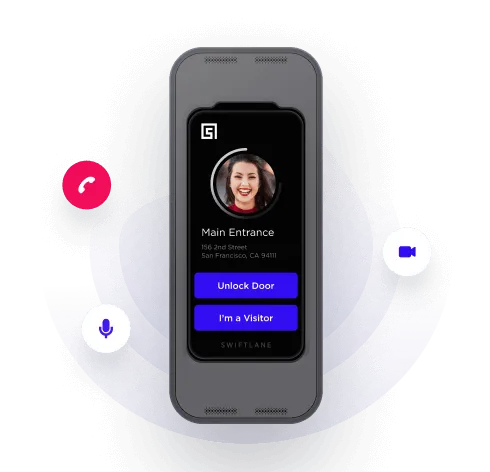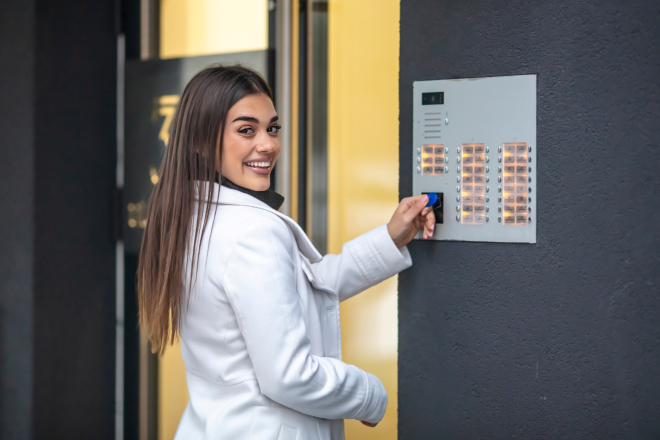
Modern apartment intercom systems with key fob access are designed to support multiple entry methods. While mobile phones, PIN codes, and biometric credentials are becoming more common, key fobs remain a dependable option for residents accessing building entrances, garages, and amenity spaces. Their simplicity and reliability make them a practical choice in today’s increasingly flexible access-control environments.
But key fob access at the main entrance is often misunderstood.
Many buildings assume that if they use fob credentials across the property, residents will also be able to use them at the intercom. In reality, that’s not always the case. Some apartment intercom systems support key fob access directly at the entry. Others don’t, even though the rest of the building relies heavily on fobs.
That distinction often isn’t clear until after installation, when property managers discover gaps between resident expectations and how the intercom actually handles credentials at the front door.
This guide explains how key fobs actually work with apartment intercom systems, what “key fob compatible” really means at the front door, and what property teams should understand before choosing an intercom. Understand how intercom and access systems are deployed and used in real apartment buildings, including common post-installation issues, so you can make a decision that works day to day.
Key Takeaways
- Not all apartment intercoms support key fob access at the main entrance, even if fobs work elsewhere in the building.
- “Key fob compatible” doesn’t always mean residents can tap their fob directly at the intercom.
- A strong system supports both resident credential entry and visitor call-based access.
- Compatibility gaps are often discovered after installation, not during sales conversations.
- Always ask: Can a resident unlock the main entrance by tapping their key fob at the intercom?
Table of Contents
- What Is a Key Fob?
- How Key Fobs Work at Apartment Intercom Entrances
- Key Fob Implementation Scenarios
- How Key Fob Fits Into Daily Intercom Use
- Questions to Ask When Evaluating Intercom with Key Fobs
- Let’s Wrap Up
- FAQs
What Is a Key Fob?


A key fob is a small physical credential that residents use to unlock a door by tapping it near a reader. In apartment buildings, key fobs are commonly used for shared entrances, garages, amenity spaces, and other secured areas where quick, repeat access is needed.
In access control, key fobs are categorized as physical credentials used to authenticate users at controlled entry points.
Each fob is linked to a resident’s access permissions, allowing the building to control where and when it can be used. If a fob is lost or no longer needed, access can be removed without changing locks or reissuing physical keys.
If you’re looking for a deeper breakdown of how fob credential systems work, including credential types, security, and installation. We cover that in our complete guide for key fob entry systems.
How Key Fobs Work at Apartment Intercom Entrances


In many apartment buildings, key fobs are used for shared access points like perimeter doors, amenity spaces, and garages. Whether they’re also used at the main intercom entrance depends on the building’s setup.
When an intercom system supports fob credential access, it means the intercom reader can recognize and respond to a resident’s fob just like it would a PIN or mobile credential.
At a basic level, here’s what that experience looks like:
- A resident walks up to the main entrance and taps their key fob near a reader that’s part of the intercom unit.
- The system checks the fob’s credentials against its access control list. If the credential matches, the door unlocks and the resident walks in.
- In most deployments, the intercom reader connects to the building’s access control system, either an on-site panel or a cloud-based platform, which validates the credential before triggering the door release.
- If the credential matches, the door unlocks, and the resident walks in.
This process keeps entry fast and predictable for people who use key fobs every day.
In more modern access setups, key fobs can coexist alongside other credentials, such as mobile tap, PIN codes, and biometric options. Often, mobiles make fob-based entry unnecessary, and visitors gain entry via simple phone-based access.
Key Fob Implementation Scenarios

Not every apartment intercom supports key fob access at the main entry, and that’s where confusion often starts. A building may use fob credentials throughout the property, but that doesn’t automatically mean residents can tap a fob at the intercom door itself.
During the sales process, “key fob compatible” is often interpreted as front-door fob access. In deployment, that’s not always the case.
When an intercom does support key fob access, it’s because the intercom is designed to recognize a fob as a valid entry credential at that specific door.
In practice, “key fob support” at the intercom can be implemented in several different ways. Understanding these distinctions is critical when evaluating system capabilities at the main entry. Below are the most common implementation scenarios.
Key Fob Readers Built Into the Intercom
In some apartment setups, the intercom includes a built-in key fob reader at the entry panel. Residents or tenants can tap their fob at the intercom to grant access, without needing to place a call, enter a code, or open an app.
From a resident’s perspective, this feels simple and familiar: tap and enter. From a building standpoint, the intercom is acting as both a communication tool and an access point, rather than just a call box.
Key Fob Access as One Credential Option at the Intercom
Key fob access at the intercom doesn’t replace other entry methods; it adds to them. In most apartment buildings, it exists alongside traditional intercom functions, such as calling a resident to buzz in a guest or unlock the door remotely.
When key fobs are enabled at the entry panel, they simply provide residents with another way to authenticate at that same door. Residents with credentials can tap and enter, while visitors without fobs can still use the intercom to request access.
What “key fob compatible” actually means at the door
When an apartment intercom is described as “key fob compatible,” that phrase can mean very different things depending on the system.
In a true key fob–enabled intercom setup, a resident can walk up to the main entrance, tap their key fob at the intercom panel, and grant access. No call, no code, no app required.
In other setups, “key fob compatible” may only mean that:
- Key fobs are used elsewhere in the building, but not at the front entry controlled by the intercom, or
- The building’s access control system manages fobs for other doors, but residents cannot tap a fob directly at the intercom panel to unlock the main entrance.
For property teams, the distinction matters. If residents can’t use their existing key fobs at the intercom entrance, the front door becomes a different access experience than the rest of the building.
The simplest way to evaluate compatibility is to ask one direct question: Can a resident unlock the main entrance by tapping their key fob at the entrance?
If the answer isn’t clearly yes, the intercom doesn’t truly support key fob access at the entry.
How Key Fob Fits Into Daily Intercom Use

The main apartment entrance has to serve two very different groups: residents who enter multiple times a day, and visitors who may be arriving for the first time. Whether key fob access works at the intercom directly affects how smooth or frustrating that experience becomes.
How residents use key fobs at the intercom
For residents, key fobs are about speed and routine. When an intercom supports key fob access at the entry, residents can approach the door, tap their fob, and walk in without thinking.
When that option isn’t available, residents are often forced to:
- Use a PIN code instead of their usual credential
- Rely on a mobile app, they don’t always want to use
Over time, these workarounds add friction to something that should feel automatic, especially in busy buildings or during peak entry times.
How visitors enter when key fobs are in use
Visitors, delivery drivers, and service providers don’t have key fobs, which means the intercom’s communication features remain essential. Guests still rely on the intercom to call residents, who can then grant access remotely.
In buildings where residents primarily use key fobs at the intercom, the system needs to support both flows clearly:
- Fast, credential-based entry for residents
- Simple, call-based access for visitors
When these two experiences aren’t designed to work together, the result is often confusion at the door, missed deliveries, and increased support requests for building staff.
Why this balance matters in apartment buildings
Apartment entry systems shape the daily experience of residents, guests, and staff. At scale, entry is about managing volume, turnover, and expectations.
Residents expect fast, frictionless access that works every time. Visitors need clear, intuitive instructions at the door. Property teams need a system that aligns both experiences without creating operational complexity.
When key fob access at the intercom is implemented correctly, it supports that balance. Residents can enter instantly using their credentials, while the intercom remains a controlled entry point for guests. When it’s not, the main entrance becomes a friction point, inconsistent with the rest of the building’s access experience.


Questions to Ask When Evaluating Intercoms with Key Fobs
When you’re evaluating an apartment intercom that claims to support key fobs, it helps to step back and pressure-test what that support actually looks like in practice. These are the questions worth answering before you move forward:
- Can residents use a key fob directly at the intercom entrance, or is fob access limited to other doors in the building?
- How are key fobs issued, revoked, and replaced during move-ins, move-outs, and day-to-day changes?
- Does key fob access work alongside other intercom entry methods, like calling a resident or remote unlock?
- What happens when a resident forgets or loses their key fob? Are there easy backup options for entry?
- How quickly do access changes take effect once a fob is added or removed?
- Does the intercom experience remain intuitive for visitors without credentials?
- How well does key fob access at the intercom align with how access is managed across the rest of the property?
- As the building grows or access needs change, how flexible is the setup to support additional users or entry points?
Let’s Wrap Up

Key fobs play a central role in how apartment buildings manage everyday access. When they function at the intercom entrance, entry is faster and more consistent for residents, and simpler to manage over time.
Challenges arise when the intercom and key fob system operate separately. While that setup can work, it often means managing access in multiple systems and creating different entry experiences at different doors.
With Swiftlane, intercoms are part of a cloud-based access platform that integrates video calling, remote unlock, and physical credentials. In supported configurations, residents can use key fobs directly at the intercom entrance, with access rules extending to other entry points, such as amenities and garages. Access changes can be issued or revoked remotely, reducing on-site workload and minimizing risk during turnover.
The result is a front entrance that works like the rest of the building: familiar for residents, clear for visitors, and centralized for property teams.
Ultimately, the right setup depends on how your building already uses key fobs—and whether you want the front door to feel integrated or separate. Clarifying upfront helps avoid post-install surprises and creates a smoother overall experience.
Make sure your intercom actually supports the way your building uses key fobs.If you’re evaluating an apartment intercom system, Swiftlane can help you assess whether key fob access works directly at the front door and how resident, visitor, and staff access can be managed from a single platform. Talk to our team to understand how Swiftlane supports key fobs at the intercom and across your property.
FAQs
Can all apartment intercoms work with key fobs?
No. Some intercoms support key fob access directly at the entry, while others don’t. In many buildings, key fobs may work elsewhere on the property but not at the intercom itself. It’s important to confirm where fob access is actually supported.
Does key fob access replace the intercom’s visitor features?
No. Key fobs are typically used by residents for quick entry. Visitors, delivery drivers, and guests still rely on the intercom to call residents or request access. A well-designed system supports both flows.
Can residents still enter if they forget their key fob?
Yes, in most modern setups. Residents can usually enter through other intercom-supported methods, such as remote unlock or mobile access, depending on the system in place.
Are key fobs used only at the main entrance?
Not usually. In apartment buildings, key fobs are often used to access multiple points, including garages, amenity spaces, side doors, and package rooms. Whether they’re also used at the intercom depends on the system.


![Guide to Apartment Key Fob Systems [2026]](/static/38e0e833c81a96186ffdb81ec5a99252/4c247/keyfob-2.webp)