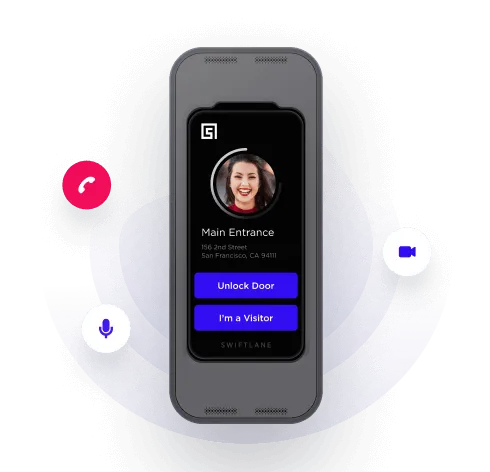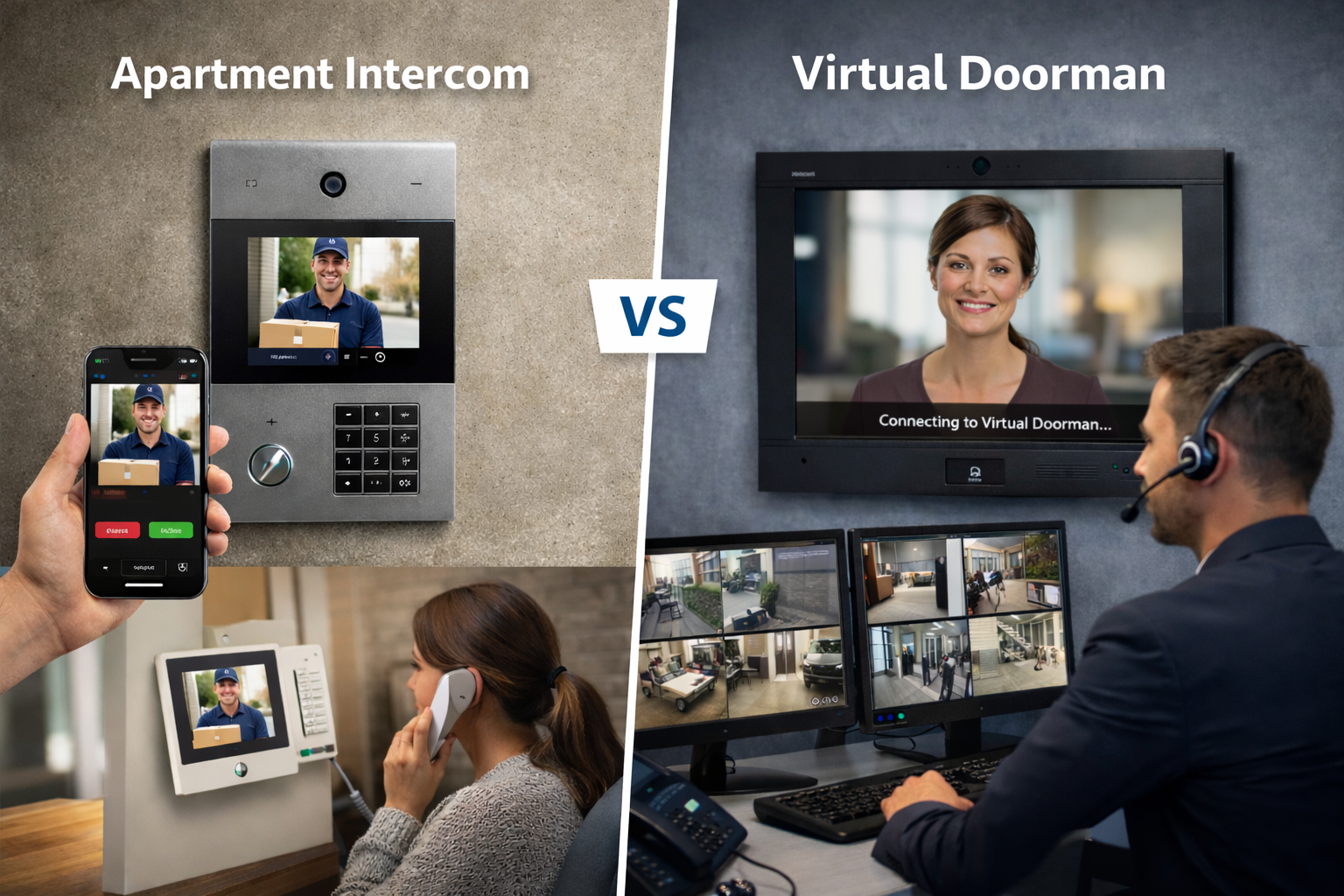
Choosing between an apartment intercom vs virtual doorman may be difficult when their differences are unclear for most buyers. At a glance, an apartment intercom system is operated by residents and visitors, while a virtual doorman is operated remotely by human staff.
Having worked closely with the Swiftlane team to implement access solutions in communities of all sizes, I’ve seen firsthand how apartment intercoms and virtual doorman systems compare—both in the numbers and in the real stories from property staff and residents.
This article brings together what we’ve learned through supporting thousands of buildings, with actionable insights you can use right now.
Key Takeaways
- A virtual doorman is an operator-controlled service that manages visitor access. Remote operators verify residents and visitors before granting building entry.
- Virtual doorman systems prioritize human oversight and interaction, while apartment intercoms value convenience and quick entry through credentials.
- Swiftlane’s Swiftreader X is a cloud-based video intercom that enables residents to manage visitor access. In the meantime, Carson Living offers 24/7 remote doorman services and third-party security integrations.
- Choosing between an apartment intercom and a virtual doorman depends on the resident experience and operational model that property managers want. Evaluating daily operational realities is essential when selecting the right system for multifamily residential buildings.
Table of Contents: Quick Navigation
- What Is a Virtual Doorman?
- Apartment Intercom vs Virtual Doorman: Key Differences
- Apartment Intercom and Virtual Doorman: Examples
- Picking between an Apartment Intercom vs Virtual Doorman
- Swiftlane: A Modern, Cost-Effective Alternative
What Is a Virtual Doorman?


If a doorman is a person who stands by apartment building entrances to welcome and assist residents and visitors, a virtual doorman (also called a virtual concierge, remote doorman, digital doorman, or cyber doorman) is a remote operator who interacts with residents and visitors through a communication device by the entryway. The operator then verifies identities and allows entry to the building.
Apartment Intercom vs Virtual Doorman: Key Differences
As access control and visitor management experts, we’ve observed key differences between apartment intercom systems and virtual doormen. These distinctions are outlined as follows:
Core Function and Purpose
Apartment intercoms and virtual doormen both control access to buildings, but they differ in who controls access. Apartment intercoms are operated by residents or property administrators, while virtual doormen are operated by remote support teams.
When using apartment intercoms, visitors walk up to the intercom device, initiate a call to a resident from the directory, and speak with the resident via audio or video. Residents can then grant remote access to visitors.
Meanwhile, virtual doormen connect visitors with remote door operators who then verify identities before allowing access.
Core Flow Summary:
- Apartment Intercoms: Visitor arrives → Calls resident via intercom → Resident speaks to visitor → Resident grants access
- Virtual doormen: Visitor or resident arrives → Connects with remote operator → Operator verifies and unlocks door
Staffing and Operating Model
Apartment intercoms are unstaffed systems that rely on input from property teams, residents, or visitors.
Residents grant visitors access to the building by pressing a button, tapping on a mobile application, or clicking on a web dashboard. Otherwise, if supported by the intercom, they may set up scheduled access permissions or temporary credentials.
In turn, residents gain access to the building using supported credentials, such as mobile applications, face recognition, Radio Frequency Identification (RFID), and more.
On the other hand, virtual doormen are staffed solutions that rely on the assistance provided by remote attendants. Both visitors and residents gain access by interacting with the outsourced concierge service.
Staffing and Operating Model Summary:
- Intercoms: Controlled by residents
- Virtual doormen: Controlled by remote staff
Resident and Visitor Experience
An apartment intercom system is designed for self-service and convenience through resident control. Especially for temporary apartment staff (e.g., repairmen, nannies) and delivery drivers, intercoms also allow for quick access and exit from the apartment building.
In contrast, virtual doormen highlight warmth and connection through human interaction. These elements are particularly suitable for luxury apartments and senior living communities because residents experience hands-free assisted entry.
Resident and Visitor Experience Summary:
- Intercoms: Speed and convenient autonomy through resident operation
- Virtual doormen: Human interaction through assisted access
Security and Access Control


Apartment intercom and virtual doorman systems mostly share the same hardware components for security and access control. They both support audio communication, integrate with door release systems, and monitor persons through video cameras.
However, apartment intercoms utilize resident-specific credentials for building entry (e.g., mobile applications, face recognition, RFID, Quick Response (QR) codes, keycards and fobs, and PIN codes).
Virtual doormen solely use human judgment to verify residents and visitors before allowing access.
Security and Access Control Summary:
- Intercoms: Credential-based verification and access control
- Virtual doormen: Human-verified entry
Price Structure
Because apartment intercoms are not staffed, long-term costs are lower than costs for virtual doormen. Support services will only be needed for on-site service calls or software updates.
For virtual concierge services, the staffing model requires a constant human component that costs more over time and at scale. Prices climb depending on supported hours, number of entrances, and call volume. Support for device maintenance will also be a separate expense.
Price Structure Summary:
- Intercoms: No staff results in lower long-term costs
- Virtual doormen: More costs due to staffing requirements
Best Use Cases
When choosing between an intercom system and a virtual doorman, property managers or owners must consider cost, scalability, and the resident experience.
Generally, intercom systems are ideal for large, high-traffic properties; virtual doormen shine in boutique and luxury buildings. However, operational realities such as increasing traffic and rising staffing costs can render virtual doorman systems inefficient.
When staff expenses and congested entryways start becoming a concern, even in boutique and luxury properties, intercom systems scale easily without raising costs too much.
Summary:
- Intercoms: Wherever cost efficiency and scalability are concerns, especially large, high-traffic buildings
- Virtual doormen: Small, low-traffic boutiques or luxury residences
Apartment Intercom vs Virtual Doorman: Quick Overview


Apartment Intercom and Virtual Doorman: Examples
For a better understanding of the differences between an apartment intercom vs virtual doorman, specific examples of the two systems may help in comparing real systems and their features. One example will be provided for each of the two systems below.
Apartment Intercom: Swiftlane’s Swiftreader X
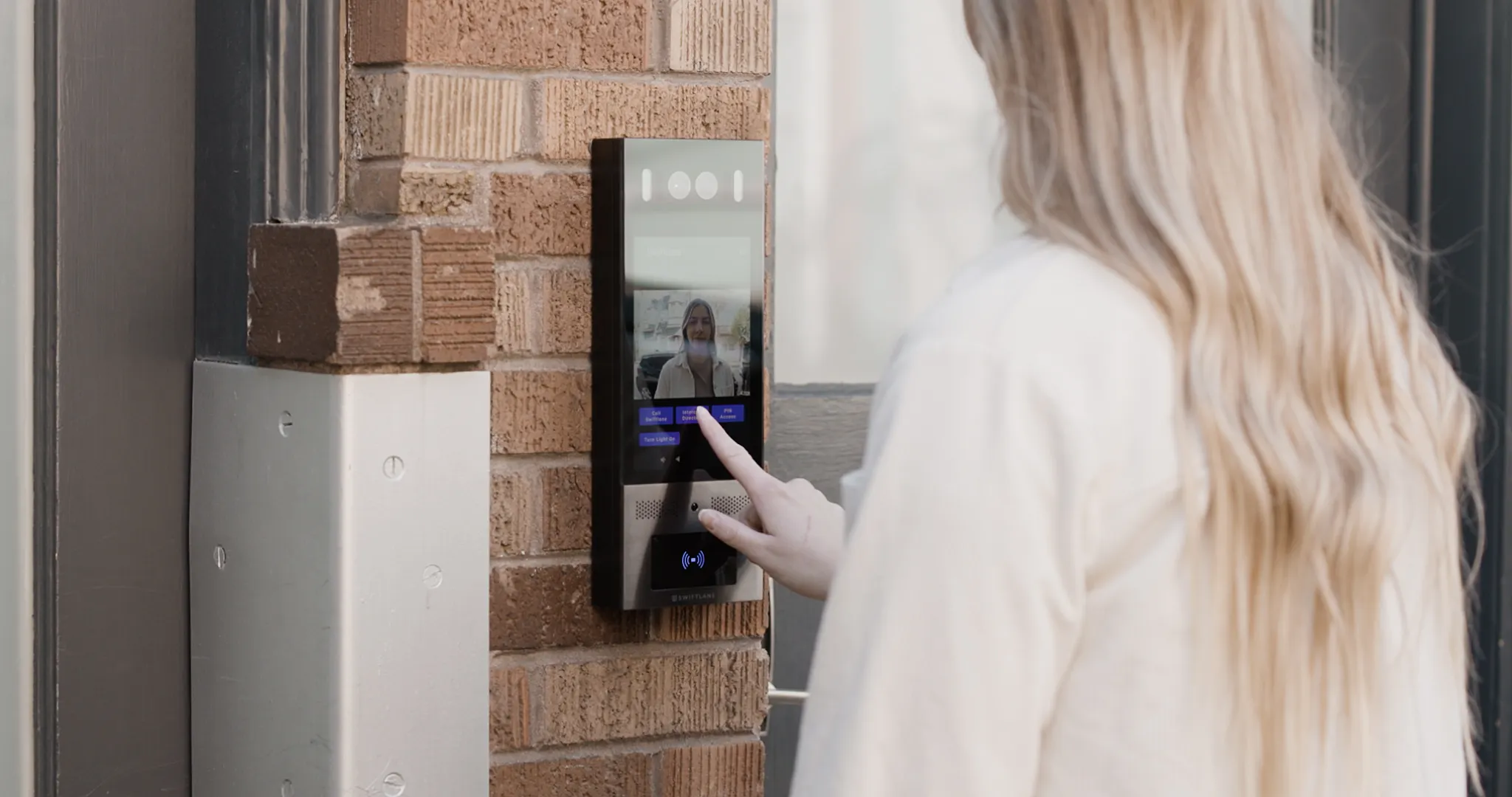
- Core Function and Purpose. Swiftlane’s Swiftreader X provides two-way audio and video communication to connect visitors with residents.
It also supports several credentials—facial recognition, key cards, key fobs, QR codes, and PINs—to provide higher security verification and improved resident satisfaction.
- Staffing and Operating Model. Swiftreader X is an unstaffed apartment intercom that aims to make operation and management easy for property teams, residents, and visitors.
Aside from the primary intercom device, users may also utilize the system via the web-based dashboard or the accompanying mobile application.
- Resident and Visitor Experience. Swiftlane aims to make intercoms accessible to all residents and visitors, even those who are not tech-adept. Swiftreader X’s support for many credentials allows different verification methods for user preference and ease.
- Security and Access Control. The verification methods of Swiftreader X provide layers of security for apartment building entry.
Property teams and residents may also manage visitors and access permissions conveniently through the web dashboard or mobile app. Access logs and audit reports are also available.
- Price Structure. The Swiftreader X is a wireless IP-based intercom solution for apartment buildings, priced at $1,500 to $3,000 with installation and ongoing software subscription.
- Best Use Cases. Swiftlane has supported small to large and mid-market to luxury apartment buildings. The Swiftreader X provides easy scalability and management for property managers and owners across multiple properties.
Virtual Doorman: Carson Living
- Core Function and Purpose. Carson Living is a virtual doorman and resident services platform that connects a property’s existing intercoms, access control hardware, and cameras into a unified building experience. Through its live remote doorman team, Carson vets guests, deliveries, and vendors before granting access.
- Staffing and Operating Model. Carson Living uses a 24/7 remote staff model to make property security and access easy for residents. However, property teams and owners may also manage the integrated system themselves through a dedicated mobile application.
- Resident and Visitor Experience. Carson Living practically provides a hands-free experience for residents and visitors. Remote operators perform human verification before granting entry to the apartment building.
- Security and Access Control. Carson Living’s live remote doorman adds a human layer of security to building entry. It also integrates with cameras and keeps video and access logs. Attempted entry by unauthorized persons notifies residents or property teams for checking.
- Price Structure. Price information is not readily available online, and Carson Living partners with other companies for system integration, making pricing more varied depending on the partners involved and building requirements.
Contact their team for inquiries.
- Best Use Cases. Because of their 24/7 live virtual doorman, Carson Living may be cost-effective in retrofit installs because of how integrated their service is with different systems.
It may also be suitable for small to medium apartment buildings, luxury or not, virtually elevating resident and visitor experience through the remote concierge service.
Picking between an Apartment Intercom vs Virtual Doorman


A virtual doorman is a fully remote operator-enabled service that welcomes and grants access to residents and visitors. In contrast, an apartment intercom is an autonomous communication system that supports security verification and access control.
The differences between the two systems lie in their staffing and operating models. Remote doorman systems prioritize human connection, while apartment intercom systems make building entry quick and is controlled directly by residents or staff. Swiftlane’s Swiftreader X and Carson Living are two great examples of each of these systems.
Selecting between a virtual doorman and an intercom system depends on what property teams and owners value for the resident and visitor experience. So, evaluate what you want to bring to your apartment building that will improve resident satisfaction and visitor management operations.
Swiftlane: A Modern, Cost-Effective Alternative
Swiftlane delivers a modern, cloud-managed video intercom and access control platform designed for all types of apartment buildings—from boutique communities to large multifamily portfolios.
With Swiftlane, property managers and owners get secure, scalable entry management that combines multiple credential options: face recognition, mobile app, PIN, and key fobs.
Every system is centrally managed via an intuitive cloud dashboard, making it easy to add or remove residents, issue visitor passes, and review detailed access logs—whether you’re onsite or remote.
Residents benefit from convenient, touchless entry and flexible visitor management, while property teams gain full visibility and control without needing to maintain on-premise servers or hire on-site staff.