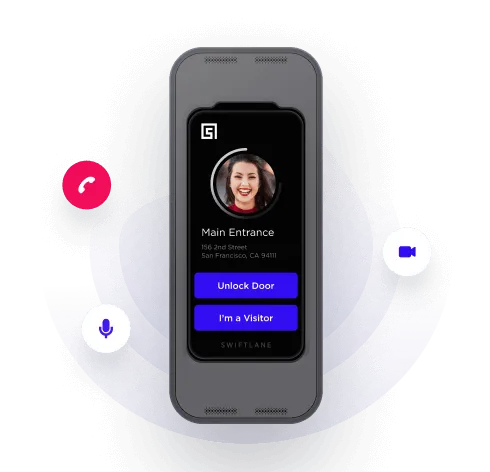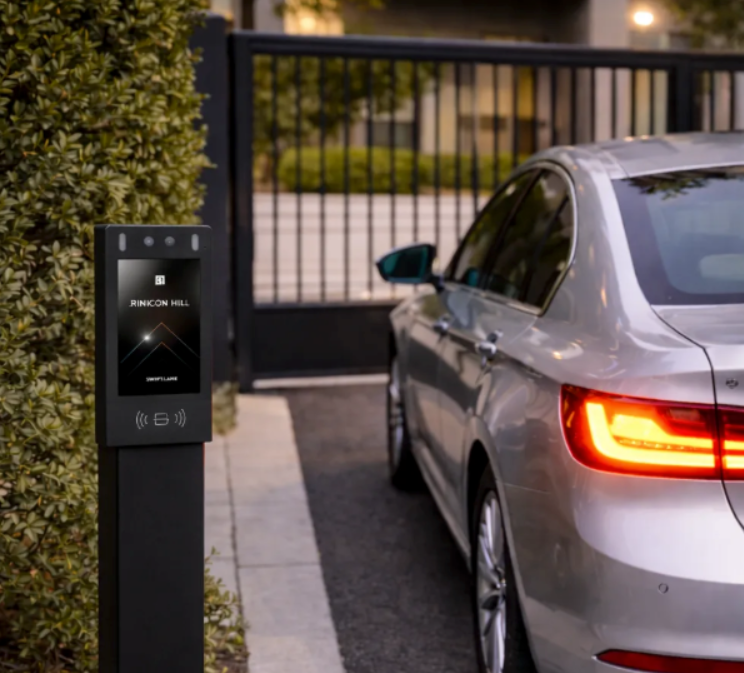
The best intercom system for a gated community is a cloud-based video intercom that lets residents open the gate from their phone, allows video verification of visitors, and integrates with existing gate operators. For most HOAs and private gated communities, Swiftlane SwiftReader X, LiftMaster CAPX, and CellGate Watchman are the top-rated options in 2026.
Telephone entry systems like Doorking remain a reliable choice for budget-conscious properties. Pricing typically runs $3,000 to $9,000 upfront per gate, plus $60 to $200 per month for cloud service.
How We Researched This
This guide draws on Swiftlane’s direct experience installing cloud-based gate intercom systems across gated residential communities in all 50 states. Our team reviewed product specifications for Swiftlane SwiftReader X, LiftMaster CAPX, CellGate Watchman, Doorking DKS, and Aiphone IXG Series.
Pricing ranges were validated against Swiftlane-verified installer estimates and published HOA project data reviewed from 2024 to 2026.
Key Takeaways
- A gated community intercom system controls vehicle access by allowing visitors to call residents or guards for entry approval.
- Modern gate intercoms combine video calling, mobile access, and remote gate control to reduce congestion and improve security.
- Telephone entry systems are the legacy standard. Cloud-based video intercoms are the modern upgrade. The right choice depends on your community’s budget, size, and security priorities.
- The best systems integrate with existing gate operators and work reliably in outdoor, high-traffic environments.
- Features like resident directories, access logs, and cloud-based management help HOAs and property managers run entrances more efficiently.
- Choosing the right gate intercom depends on traffic volume, security needs, guard staffing, connectivity, and long-term management requirements.
Table of Contents
- What Is a Gated Community Intercom System?
- How It Works: Step-by-Step
- Telephone Entry System vs. Video Intercom: What’s the Difference?
- Key Features to Look For
- 55 Best Systems for Gated Communities
- How Much Does It Cost?
- How HOA Boards Should Evaluate Their Options
- What to Compare Before You Buy
- Real-World Example: Replacing a Legacy Gate System
- Let’s Wrap Up
- FAQs
Also, read
- Residential Gate Access Control Systems: A Complete 2026 Guide
- Gate Intercom Systems: How to Choose the Right One for Your Property (2026 Checklist Included)
- Commercial Gate Entry Systems: The Ultimate 2025 Guide
What is a Gated Community Intercom System?


A gated community intercom system is a communication and access-control device installed at the gate of an HOA or apartment community. It allows visitors to contact a resident, guard, or property staff and request access before the gate opens.
These systems are mounted at the vehicle entry lane so drivers can pull up, search a directory, and place a call without leaving their vehicle. Once the visitor is verified, the resident or guard grants access remotely.
Modern gate intercoms fall into two categories. Telephone entry systems connect visitors to residents via a phone call and have been the standard for decades. Cloud-based video intercoms are the modern upgrade, adding live video verification, mobile app access, and remote management. For most HOAs evaluating a new or replacement system in 2026, a cloud-based video intercom is the default recommendation.
Most systems combine several functions in one device:
- Visitor calling and communication
- Remote access control
- Resident directory access
- Access logging and activity tracking
- Integration with the gate operator
In short, it is the system that controls who gets in and how easily they get through.
How It Works: Step-by-Step
The goal is simple: verify who is at the gate and let the right people in without slowing down traffic.
Step 1. The visitor arrives and places a call
The driver uses the intercom to request access by pressing a call button, browsing a directory, entering a unit number, or scanning a QR code, all without leaving their vehicle.
Step 2. The call is routed to a resident or guard
The call goes to a staffed guard station or directly to the resident’s smartphone. With video intercoms, the recipient can see who is at the gate before responding.
Step 3. The visitor is verified
The resident or guard confirms the visitor’s identity before granting access. Video and two-way audio make it significantly harder for unauthorized visitors to talk their way in.
Step 4. The gate is released remotely
The gate is unlocked instantly from a phone, tablet, or guard console. No walking to the gate, no shared codes, no physical credentials needed.
Step 5. Access is logged automatically
Entry events, call history, and access activity are recorded automatically, creating an audit trail for security reviews and incident investigations.
Step 6. Records are stored in the cloud for HOA review
Cloud-based systems retain a searchable history of gate activity over time, useful for resolving disputes, investigating incidents, and reporting to the board.
Telephone Entry System Vs. Video Intercom: What’s the Difference?

Both control access at the gate. The right choice depends on your community’s size, budget, and security priorities.
Telephone Entry System
A keypad or call box that connects visitors to residents via a standard phone call. The resident answers, speaks with the visitor, and presses a key to release the gate. No app, no camera. Works over a phone line or cellular connection. Straightforward to install, affordable to maintain, and widely supported by dealers and installers across the country.
Cloud-Based Video Intercom
Replaces the phone call with a video call routed through a mobile app. Residents see who is at the gate and tap to unlock from anywhere. Access logs, resident directories, and permissions are managed through a web dashboard. Adds visual verification and gives property managers full remote control over the access workflow without on-site visits.
Side-by-Side Comparison
| Feature | Telephone entry system | Cloud-based video intercom |
| Visitor communication | Audio only | Two-way video and audio |
| Resident interface | Phone call | Mobile app |
| Visual verification | No | Yes |
| Remote management | Limited | Full cloud dashboard |
| Access logs | Basic or none | Detailed, searchable |
| Guest and vendor access | Shared codes or call-in | Temporary credentials, QR codes |
| Typical hardware cost per gate | $1,000 to $3,000 | $3,000 to $7,000 |
| Monthly software fee | None or minimal | $60 to $200 per month |
| Best for | Budget-conscious HOAs, rural properties, simple communities | HOAs prioritizing security, larger communities, modern resident experience |
When to Choose a Telephone Entry System
A telephone entry system is a practical choice when your community has a limited capital budget, a small number of residents, minimal visitor traffic, or unreliable internet connectivity. It is also a reasonable option when residents are less likely to adopt a smartphone-based system.
When to Choose a Video Intercom
A cloud-based video intercom is the better fit for communities with more than 50 units, frequent visitor and delivery traffic, active property management needs, or a board that wants detailed access reporting. In 2026, video intercoms have become the default recommendation for new installations and system replacements in mid- to large-sized HOA communities across the country.
Key Features to Look For
Not all gate intercom systems are built for the demands of a busy gated community entrance. These are the features that matter most.
- Video calling with clear visibility: Look for cameras with wide-angle views and good low-light performance so faces, license plates, and vehicles are clearly visible at all times.
- Mobile credentials and app-based access: Residents should be able to receive visitor calls and open the gate from their smartphone, without needing physical remotes or shared gate codes.
- Guard station integration: For communities with on-site security, the intercom should connect directly to the guard station with video, two-way audio, and remote gate control. A well-integrated system can also reduce the need for a dedicated gate guard, freeing staff for patrol duties instead.
- Cloud-based access management: Property managers should be able to add and remove residents, update directories, and review access logs from a web dashboard without visiting the gate hardware.
In our experience working with gated communities, the properties that struggle most with access management are not those with the wrong hardware. They are the ones running a modern system on top of an outdated directory management process. Cloud-based systems solve both problems at once.
- Access logs and audit trails: Look for systems that store searchable logs in the cloud, organized by date, resident, or entry point.
- Resident directory with multi-unit support: The directory should be easy to update as residents move in and out, ideally synced with your property management software.
- Windshield tags and vehicle RFID: For communities with more than 100 homes or a single high-traffic entry lane, windshield tags allow credentialed residents to pass through without stopping. Visitors still use the intercom as normal.
Mobile vs. physical credential transition: Look for a system that supports parallel operation during the transition, so residents can use either their phone or their existing clicker while the community migrates.
5 Best Systems for Gated Communities
Here are the five best intercom systems for gated community entrances in 2026.
1. Swiftlane Swiftreader X — Best Overall for HOAs and Gated Communities
Swiftlane’s SwiftReader X combines video intercoms, mobile access, and access control into a single cloud-managed platform. Hardware is IK10-rated for outdoor and high-traffic environments. Property managers handle everything remotely, from resident directories to temporary vendor credentials, without visiting the gate.
Best for: HOAs and multifamily gated communities that want a single platform with property management software integrations, including Yardi, Entrada, and RealPage.
Key features:
- Mobile access, face recognition, voice-enabled entry, and video intercoms in one dashboard
- Temporary guest and vendor credentials that expire automatically
- Parallel support for traditional gate clickers during resident transition
Things to keep in mind:
- Requires reliable internet connectivity at the gate
- Best suited for communities wanting a full platform, not a standalone call box replacement
Download this comprehensive PDF overview to learn practical tips for planning and implementing gate access control in residential communities.
2. Liftmaster Capx — Best for Communities With Existing Liftmaster Gate Operators
A natural upgrade path for communities already running LiftMaster hardware. The CAPX adds mobile app access and cloud management through the myQ Community platform without replacing the underlying gate infrastructure.
Best for: HOAs with existing LiftMaster gate operators that want a compatible, familiar upgrade.
Key features:
- Native LiftMaster gate operator integration
- myQ Community app for resident mobile access
- Cloud-based management dashboard
Things to keep in mind:
- Less flexible outside the LiftMaster ecosystem
- Video intercom capabilities are more limited than dedicated video platforms
3. Cellgate Watchman — Best for Rural or Hard-To-Wire Gate Locations
CellGate uses cellular connectivity instead of Ethernet or fiber, making it the practical choice for remote gates where trenching is not feasible.
Best for: Rural communities and properties with gates far from existing network infrastructure.
Key features:
- Cellular-based connectivity, no Ethernet required
- TrueCloud Connect platform for remote access management
- Video calling and mobile app access for residents
Things to keep in mind:
- Performance depends on local cellular signal strength
- Narrower feature set than IP-based video intercom platforms
4. Doorking (Dks) — Best for Budget-Conscious Hoas That Prioritize Gate Operator Reliability
Doorking delivers reliable gate operation and telephone entry at a lower cost than modern video platforms. A practical choice when mechanical reliability is the top priority.
Best for: Budget-conscious HOAs that prioritize proven gate hardware over modern software features.
Key features:
- Heavy-duty gate operators for sliding, swing, and barrier gates
- Telephone entry with resident directory and call-to-phone
- Wide installer network with readily available parts
Things to keep in mind:
- Audio only, no video verification
- Directory updates typically require on-site work
- Guest access depends on shared codes or physical credentials
5. Aiphone — Best for Larger Communities With Dedicated Security Staff
Aiphone is built for environments where durability, wiring distance, and centralized guard oversight matter most.
Best for: Larger gated communities with on-site security staff that need a rugged, guard-station-integrated intercom system.
Key features:
- Excellent weather resistance and long-range wiring support
- Guard station integration with central monitoring
- Strong audio and video quality across large properties
Things to keep in mind:
- Complex to configure for residential management teams without dedicated IT support
- Mobile credential options are more limited than cloud-first platforms
- Directory updates often require on-site changes
How Much Does It Cost?
The cost of a gate intercom system depends on several factors: the type of system you choose, the number of entry points, the amount of wiring and trenching required, and whether you need ongoing cloud-based software to manage access. Understanding the full cost picture before going to your HOA board for approval will save you time and avoid surprises during the installation process.
Here is a breakdown of what to expect.
Hardware Cost Per Gate
| System type | Typical hardware cost per gate |
| Telephone entry system (audio only) | $1,000 to $3,000 |
| Cloud-based video intercom (mid-range) | $3,000 to $5,000 |
| Cloud-based video intercom (full-featured) | $5,000 to $7,000 |
| Enterprise or commercial-grade system | $6,000 to $10,000+ |
Installation and Labor Cost
Installation costs depend heavily on the physical layout of your property. A gate close to an existing network connection, with minimal trenching required, will cost significantly less to install than a remote gate that requires a new conduit run across the property.
| Installation scenario | Typical labor cost |
| Simple installation, minimal trenching | $1,000 to $2,500 |
| Moderate complexity, some conduit work | $2,500 to $4,500 |
| Complex installation, significant trenching | $4,500 to $8,000+ |
Monthly Software and Cloud Fees
| Community size | Typical monthly fee |
| Small HOA, basic cloud access | $30 to $80 per month |
| Mid-size HOA, full video intercom platform | $80 to $200 per month |
| Large HOA, multi-gate, enterprise platform | $150 to $400 per month |
Three Budget Scenarios
These scenarios are intended to give HOA boards a realistic planning range. Actual costs will vary by region, installer, and system configuration.
Scenario 1. Small HOA, one gate, telephone entry system
A community of 50 to 80 homes replacing an aging call box with a modern telephone entry system. One gate, minimal trenching, no cloud software subscription required.
Estimated upfront cost: $2,500 to $5,000. Ongoing cost: $0 to $50 per month.
Scenario 2. Medium HOA, one gate, cloud-based video intercom
A community of 100 to 200 homes upgrading to a full cloud-based video intercom with mobile app access for residents, remote management for the property manager, and integration with existing gate operator hardware.
Estimated upfront cost: $4,500 to $9,000. Ongoing cost: $80-$200 per month.
Scenario 3. Large HOA, two gates, full cloud video system
A community of 250 to 400 homes with two vehicle entry points, both upgraded to cloud-based video intercoms with a shared management dashboard, resident directory sync with property management software, and windshield tag support for high-volume commuter traffic.
Estimated upfront cost: $10,000 to $18,000. Ongoing cost: $150-$400 per month.
A Note on HOA Board Budgeting
Gate intercom upgrades are typically classified as capital expenditures and funded through HOA reserves. If your reserve fund is short, plan for a special assessment or phase the project across two fiscal years.
When presenting to your board, frame the investment in terms of cost reduction. A modern cloud-based system can reduce or eliminate the need for a dedicated gate guard position, which typically costs $40,000 to $80,000 per year. Even a partial reduction in guard hours can offset the cost of a new system within the first year.
In our experience, communities that underestimate installation cost are usually surprised not by the hardware but by trenching. A gate that sits 200 feet from the nearest network connection can add $2,000 to $4,000 to the project budget before a single device is mounted.
How HOA Boards Should Evaluate Their Options
Choosing a gate intercom system typically involves a board vote, property manager input, and treasurer sign-off on reserve funds. Here is how to move the process forward efficiently.
Five Questions to Ask Every Vendor
- Does your system integrate with our existing gate operator? Ask for a specific confirmation, not a general yes.
- What happens to access if the internet goes offline? Cloud systems should have an offline fallback mode.
- How are resident directories updated? Your property manager should be able to make changes from a dashboard without calling support.
- What are the total costs over three years? Include hardware, installation, software fees, and any per-gate or per-user fees.
- What does installation involve? Ask about trenching requirements and setup downtime.
Framing the ROI for a skeptical board
A staffed gate position typically costs $40,000 to $80,000 per year in labor. A cloud-based video intercom with remote unlock can reduce or eliminate that cost, paying for itself within the first year in many communities. Access logs and video records also protect the HOA from liability in the event of a security incident or dispute.
To start the evaluation process for your community, request a demo.
What to Compare Before You Buy
| Evaluation factor | What to look for | Why it matters for gated communities |
| Visitor verification | Live video and two-way audio | Prevents unauthorized access and tailgating |
| Resident access | Mobile app and phone calling | Reduces missed calls and gate backups |
| Guard integration | Video console and remote gate control | Keeps guards focused on security, not gate traffic |
| Directory management | Cloud-based resident directory | Easy updates for move-ins and move-outs |
| Access control | Remote unlock and permissions | Eliminates shared gate codes |
| Activity logging | Automatic entry records | Improves accountability and incident investigations |
| Gate compatibility | Works with existing operators | Avoids costly gate replacements |
| Connectivity | IP-based or cellular fallback | Ensures reliability in all property types |
| Installation | Minimal trenching and wiring | Lowers installation cost and downtime |
| Scalability | Supports multiple entrances | Grows with the community |
| Ongoing costs | Predictable software pricing | Easier budgeting for HOA boards and property managers |
Real-World Example: Replacing a Legacy Gate System
The following is based on a community Swiftlane worked with. Details have been generalized to protect privacy.
Consider a mid-size HOA with about 150 homes and a single-vehicle entrance. The community has been running a telephone entry system for several years. Residents frequently miss calls from visitors because the system dials a landline number that is no longer in use. Delivery drivers queue up during morning hours with no way to reach anyone. The property manager fields several access complaints each week.
After upgrading to a cloud-based video intercom, residents receive visitor calls directly on their smartphones and can open the gate from anywhere. The property manager updates the resident directory from a web dashboard without visiting the gate. Temporary credentials are issued to contractors and vendors and automatically expire when the job is complete.
The practical results are straightforward. Access complaints to the property manager dropped from several per week to fewer than one. Visitor wait times at the gate drop. The board now has a searchable log of gate activity, which is useful when a package theft incident is reported near the entrance.
The upfront investment for a community this size typically runs $5,000 to $8,000, including installation, with monthly software fees in the $80 to $150 range, depending on the platform chosen.
Let’s Wrap Up
A gate intercom system is one of the most important control points on your property. It is where security, convenience, and resident experience all intersect, and the right system can make a noticeable difference in how smoothly your community operates every day.
Modern gate intercom systems give residents mobile access, help property managers manage entrances more efficiently, and provide HOA boards with full visibility into who is entering the community. They reduce bottlenecks, eliminate shared gate codes, and enable faster, more secure visitor access.
Whether you are replacing an aging telephone entry system or installing a new entrance from scratch, the right system depends on your community size, budget, connectivity, and long-term management needs. Use the comparison table and cost scenarios in this guide as a starting point, and bring specific questions to your vendor evaluation. Ready to see how Swiftlane works for your gated community? Book a free demo or request a quote to get started.


FAQs
What is the best intercom system for a gated community?
The best intercom system for a gated community is a cloud-based video intercom that supports mobile app access, live video verification, and remote gate control. For most HOAs and private gated communities in 2026, Swiftlane SwiftReader X is the top-rated option for those seeking a full access control platform. LiftMaster CAPX is a strong choice for communities already running LiftMaster gate operators. CellGate Watchman is the best fit for rural or hard-to-wire locations.
How much does a gated community intercom system cost?
A gated community intercom system typically costs $2,500 to $9,000 upfront per gate, depending on the system type and installation complexity, plus $30 to $200 per month for cloud software. Telephone entry systems sit at the lower end of the range. Full-featured cloud video intercoms sit at the higher end. See the cost breakdown section above for scenario-based estimates.
Can a gate intercom system work with an existing gate operator?
Yes. Most modern gate intercom systems are designed to integrate with existing gate operators, including sliding gates, swing gates, and barrier arms from brands including LiftMaster, Elite, and Doorking. This allows communities to upgrade their access control without replacing their gate infrastructure, keeping installation costs lower and minimizing downtime.
What is the difference between a telephone entry system and a video intercom?
A telephone entry system connects visitors to residents via an audio phone call. A video intercom routes a two-way video call to the resident’s smartphone, allowing them to see and speak with the visitor before opening the gate. Video intercoms also include cloud-based management, access logs, and temporary credential features that telephone entry systems typically lack.
Can I install a gate intercom without running new wiring?
It depends on the system. Cellular-based systems like CellGate Watchman require no Ethernet or fiber connection at the gate, making them a practical option for remote or hard-to-wire locations. IP-based video intercom systems generally require a network connection at the gate, though many properties can use existing conduit or a wireless bridge to avoid significant trenching.
Does Swiftlane work with my existing gate operator?
Yes. Swiftlane integrates with a wide range of gate operators, including LiftMaster, Doorking, and others. Compatibility can be confirmed during the site assessment process before installation begins.
How do HOA boards budget for gate intercom upgrades?
Gate intercom upgrades are typically classified as capital expenditures and funded through HOA reserve funds. If reserves are insufficient, boards may phase the project across two fiscal years or levy a special assessment. When presenting to the board, framing the investment in terms of reducing guard labor costs and liability protection is typically the most effective approach.
What are windshield tags, and do I need them?
Windshield tags are RFID credentials mounted inside a vehicle that allow hands-free gate access for credentialed residents. As the vehicle approaches, the tag is read automatically, and the gate opens without any interaction. They are most useful for communities with more than 100 homes or for a single-entry lane with high commuter traffic during peak hours. Visitors and delivery drivers continue to use the intercom panel as normal.
How long does gate intercom installation take?
Most gate intercom installations for a single gate are completed in 1 to 2 days. More complex installations involving significant trenching, multiple entry points, or integration with existing access control infrastructure may take three to five days. A reputable installer should provide a temporary access solution for residents during the installation window.