Which intercom should one choose for a certain budget? How do we compare wired vs wireless intercom cost? At first glance, wired intercom systems seem the more affordable option until maintenance and servicing costs become unbearable. Wireless intercom systems look more expensive upfront, but the long-term fees more than make up for the initial investment.
For multifamily operators, condo boards, and mixed-use developers, the total cost of wired and wireless intercom systems can significantly differ depending on many infrastructure, labor, and lifecycle considerations.
Based on Swiftlane’s expertise and experience in supporting thousands of multifamily residential properties nationwide, this guide will break down the upfront equipment costs, installation and infrastructure expenses, and other cost considerations of wired and wireless intercom systems.
Key Takeaways
- Wired intercoms cost more in the long run because they require physical lines, in-unit devices, and installation labor.
- Wireless intercoms cost more upfront because of their smart features, but bring seamless staff-free service, saving on labor costs.
- Wired intercoms don’t have software subscription fees, but on-site service calls are common, and these costs accumulate over time.
- Wireless intercoms charge a software subscription fee, but rarely require on-site servicing, so ongoing costs are much lower.
Table of Contents: Quick Navigation
- What Is a Wired and Wireless Intercom System?
- How Do Wired and Wireless Intercom Systems Work
- Wired vs Wireless Intercom Cost Drivers
- Swiftlane: A Property Manager’s Long-Term, Cost-Effective Intercom System
What Is a Wired and Wireless Intercom System?
A wired or wireless intercom system is a communication device that includes access control, security, and door release features, enabling residents to speak with visitors and verify their identities before granting access remotely.
Both wired and wireless intercoms fundamentally serve the same purpose. However, they differ in their infrastructure requirements that facilitate communication, access control, and remote door release.
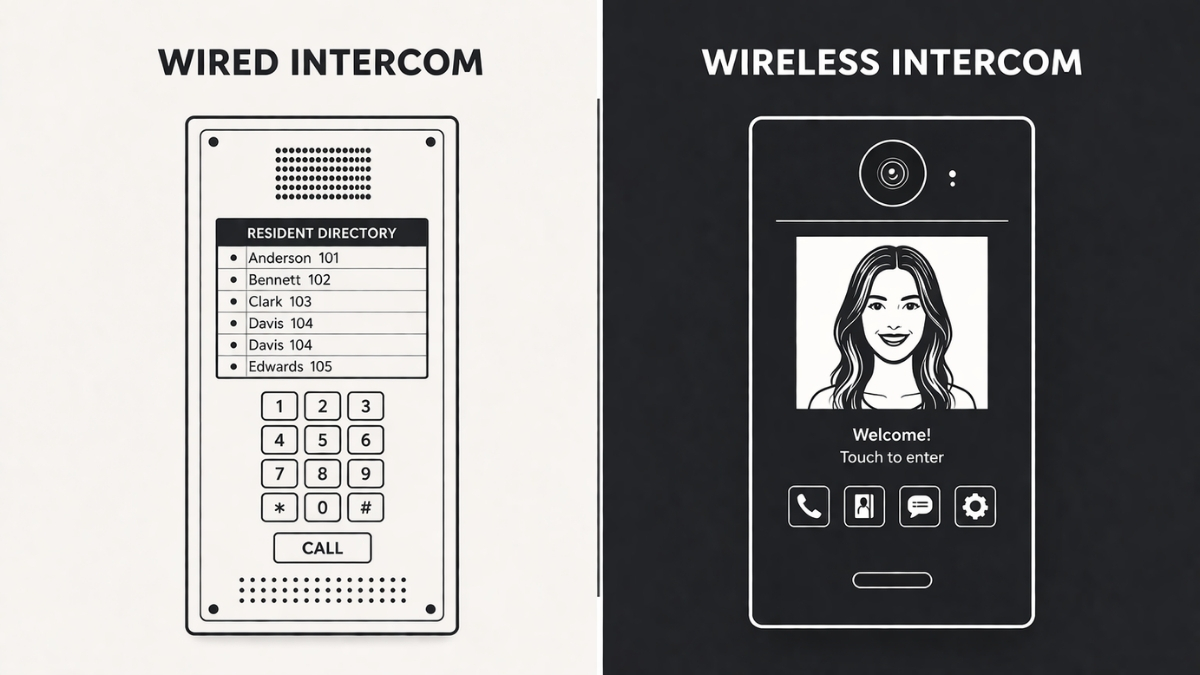
A wired intercom system requires physical hardwired lines between intercom panels and each in-unit device, which significantly drives costs.
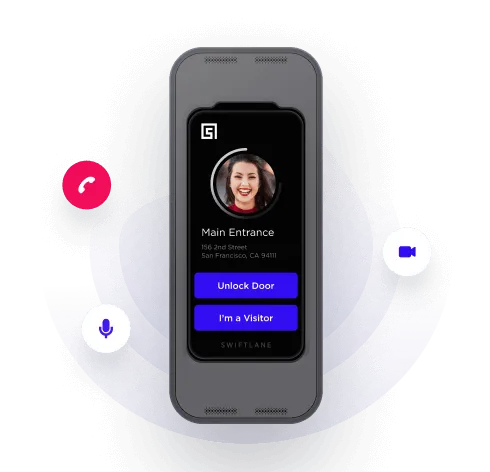
A wireless intercom system does not need the same physical hardwired connections to in-unit devices. Instead, it uses network connectivity via Power over Ethernet, Wi-Fi, or cellular to connect directly to resident devices, such as wall substations, VoIP desk phones, or smartphones.
Although this kind of intercom is called “wireless”, it may retain wired connections for power and network. Since it does not use physical wires to in-unit devices, its infrastructure significantly changes the cost outcomes of intercom deployments.
It also affects how entry is granted: in addition to the usual call to a resident, visitors can enter with temporary credentials.
How Do Wired and Wireless Intercom Systems Work
Wired Intercom System


- A delivery driver walks up to the intercom panel and browses the physical directory for the right resident.
- The delivery driver presses the button for the right resident, initiates a call, and speaks with the resident.
- The resident verifies the delivery driver’s identity over the phone before remotely granting access to the apartment building.
Wireless Intercom System (Method 1: Traditional Method)

- A visitor walks up to the intercom device and browses the digital directory for the right resident.
- The visitor initiates an audio or video call to the resident, who verifies the visitor’s identity.
- The resident grants remote entry by pressing a button in the mobile application.
Wireless Intercom System (Method 2: Hands-Free Method)

- A resident creates a temporary mobile credential for a visitor.
- The visitor approaches the intercom and, instead of calling the resident, presents the temporary mobile credential.
- The intercom verifies credentials and unlocks the doors for instant entry.
Wired vs Wireless Intercom Cost Drivers
Per-unit or per-door pricing is commonly given online to help property managers understand the cost considerations. However, this narrow interpretation of prices fails to account for the primary cost drivers for each intercom type.
Wired Intercoms
Wired intercom systems are mainly driven by infrastructure, installation, and maintenance costs. For example, the installation cost for an apartment intercom or an office intercom is usually very high. Technicians have to painstakingly install the physical wiring behind walls or ceilings. Overall costs can be reduced to some level if a property has existing reusable physical wiring.
The cost of maintaining physical lines and calling on-site service also builds up over time. A wired intercom device may appear more affordable, but its ongoing fees can add up significantly.
Wireless Intercoms
In contrast, wireless intercom costs are mainly driven by technology and smart features. Because wireless intercoms do not require physical hardwiring and in-unit devices, property managers need only pay for the smart intercom capabilities.
Smart features usually come at a premium, making wireless intercom hardware more expensive than wired intercom panels. However, high upfront prices for hardware and features are offset by the lack of physical lines, the ease of installation, and very minimal ongoing fees.
The lack of physical lines makes installation also fairly easy for installers or integrators. These fast deployments decrease labor costs, and manufacturers usually provide online training to property managers for operating their intercoms.
One important factor is that wireless intercom systems typically require software subscription fees to ensure continued service. This is accompanied by ongoing technical support that can update firmware or troubleshoot issues remotely.
Despite the high upfront investment in wireless intercoms, the previous factors help reduce total long-term costs compared to maintaining wired intercoms, resulting in greater NOI (Net Operating Income) over time.
Cost Differences of Wired and Wireless Intercom Systems
Based on Swiftlane’s intercom expertise, here is a more detailed, factor-by-factor breakdown between wired and wireless intercom system costs.
As a minimum standard, for easier vertical predictability, the following rough estimates are based on a projection for a multifamily residential apartment building with 30 units and one main entrance, with no pre-existing physical wiring.
However, for accurate, building-specific pricing, requests should always be directed to a manufacturer’s tech team.
Hardware
Hardware prices for wired intercoms depend heavily on every in-unit device and accompanying physical telephone or copper wiring. Scaling upwards with a wired intercom entails more in-unit device and wiring costs. Based on set parameters, wired intercom hardware can cost roughly around $2,000 to $8,000.
Meanwhile, hardware prices for wireless intercoms depend on the extent of smart features included or added to the intercom device. Some manufacturers offer all-in-one products that come with preset features, while others offer modular installations for extended functionality. With this in mind, and without physical wiring or in-unit devices, wireless intercom hardware is approximately $1,500 to $4,000.
At a glance:
Wired = $2,000 – $8,000 (intercom panel, in-unit devices, physical wiring)
Wireless = $1,500 – $4,000 (intercom device only)
Installation and Labor
For installation and labor, retrofit installation can bring costs down for wired intercom systems, but new construction with no pre-existing wiring requires heavy labor for a two-man tech team. Timelines can take 5 to 10 days or more, depending on building conditions and installer expertise. Rough estimates can place installation and labor costs at around $6,000 to $10,000.
Meanwhile, wireless intercom systems only need power and network connections. Electronic locks can be included if necessary. With this, total installation and labor fees can reach around $1,000 to $3,500.
At a glance:
Wired = $6,000 – $10,000 (new construction, heavy labor, longer timeline)
Wireless = $1,000 – $3,500 (power and network only, electronic locks, shorter timeline)
Tech Support and Software Subscription
Although wired intercoms don’t charge any software subscription fees, property managers need service agreements with intercom installers or security integrators. Wired intercoms require manual management and maintenance for any issues or system adjustments.
So, on-site service calls are very common, and tech teams have to configure each panel and in-unit device. Because of these, labor fees can stack up from $20 to $50 per month per door. Applying to the set parameters, costs can be between $200 and $500 per month.
On the other hand, wireless intercoms charge software subscription fees but rarely need on-site service calls. Subscription charges usually include online tech support for firmware updates and remote troubleshooting. With this, ongoing apartment intercom installation costs can roughly range from $30 to $300 per month.
At a glance:
Wired = $200 – $500 per month (on-site service calls for maintenance, troubleshooting, and credential management)
Wireless = $30 – $300 per month (software subscription & online tech support, zero to minimal on-site servicing)
Swiftlane: A Property Manager’s Long-Term, Cost-Effective Intercom System

Swiftlane offers innovative wireless intercom systems that are designed for multifamily residential apartment buildings, providing a powerful combination of enhanced security and seamless communication.
These state-of-the-art systems eliminate the need for complex wiring, resulting in time and cost savings during installation while simultaneously minimizing long-term maintenance expenses.
Investing in Swiftlane’s intercom solutions not only improves operational efficiency but also enhances tenant satisfaction and retention, ultimately increasing the property’s overall value.
Smart features to take advantage of include:
- Two-way video calling
- Temporary (one-time use or schedule-based) credentials
- Robust security audit trail
- Extensive integrations with property management software, smart locks, CCTV & surveillance
- Inclusive of white-glove onboarding and 24/7 technical support
Get in touch with Swiftlane’s support team and request instant pricing now.
For any questions, you can also contact Swiftlane at 833-607-9438.