An apartment intercom system for property managers can be the solution to the multitude of building challenges managers face daily, from staffing shortages to rising security expectations and after-hours access; these issues often plague buildings across a portfolio.
Multifamily professionals can feel overworked, overwhelmed, and exhausted because of the operational challenges they face daily. An apartment intercom system can address these problems, reduce their workload, and make multi-property access management safer and easier.
Drawing on insights from industry reports, customer feedback, and experience supporting thousands of properties nationwide, the following guide outlines common operational challenges and how modern intercom systems address them.
Key Takeaways
- Property managers commonly face staffing, security, and access challenges.
- Staffing issues can be addressed by scalability and centralized access management.
- Security threats can be mitigated through remote access controls, resident management, and access logs.
- Access delays can be streamlined with mobile access and integration with access control systems.
- To choose the right intercom system, property managers need to consider building layout, resident experience, technology fit, and portfolio scalability.
Table of Contents: Quick Navigation
- What is an Apartment Intercom System for Property Managers?
- Key Apartment Intercom Features that Solve Common Property Manager Issues
- Top Considerations Before Buying an Apartment Intercom System
- Swiftlane: A Modern Apartment Intercom System for Property Managers
What is an Apartment Intercom System for Property Managers?


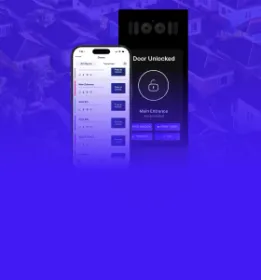
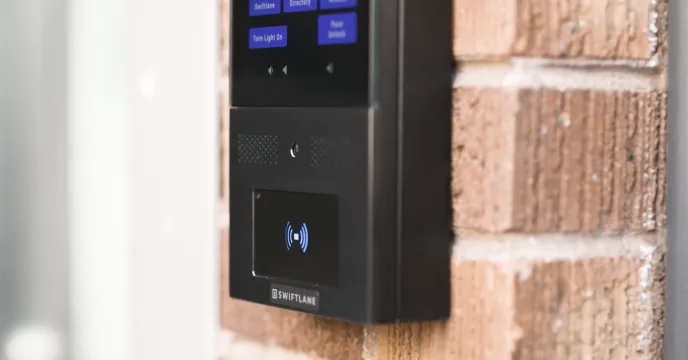
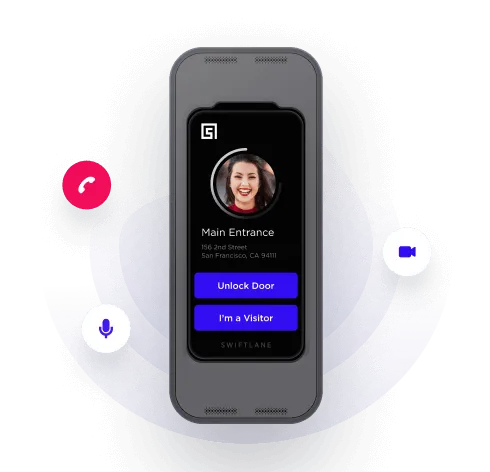
An apartment intercom system combines communication and access control into a single solution: visitors use an entry panel to contact residents, who can confirm the visitor’s identity through audio or video and grant remote access.
Modern systems support multiple credentials, including mobile apps, PIN codes, and key fobs. Keyless entry has largely replaced traditional keys in modern apartment buildings. Residents use a key fob — a compact, encrypted device — to gain entry, and the entry is verified in seconds by a credential reader at the door.
This approach not only improves convenience but also enhances security, as access credentials can be instantly issued, revoked, or modified without replacing the physical locks.
How a Modern Apartment Intercom System Works
If a delivery driver approaches a video intercom, he can browse the directory and initiate a video call to the resident he is delivering to. The resident then receives the call, verifies the delivery driver’s identity, and remotely gives access.
Modern intercom systems also provide different access features for different people. Resident can use multiple credentials—from high-tech face recognition to physical key fobs. Property managers or owners can check the recorded access logs and review for any security breaches. Finally, one-time PINs can be set to provide easier access for frequent visitors.
Types of Apartment Intercom Systems
Apartment intercom system options in the market today can be categorized into 4 major types.
1. Wireless Intercom Systems
Wireless intercoms are systems that do not require fixed wiring to in-unit devices for communication. Instead, they rely on internet connectivity via Power over Ethernet (PoE), Wi-Fi, or cellular networks. Regardless of the “wireless” categorization of these intercoms, they still need wiring for power and internet.
2. Wired Intercom Systems
Wired intercoms are systems that require fixed telephone or copper wiring to in-unit devices or regular telephones. They don’t work without these physical lines and rely on plain old telephone lines (POTS) for communication.
3. Video Intercom Systems
Video intercoms are systems that provide video feedback to residents and property managers, allowing them to visually verify visitors before granting access. These intercoms can be wired or wireless systems with 2-wire or internet connections.
4. Audio-Only Intercom Systems
Audio-only intercoms refer to legacy buzzer systems that provide basic communication and access control features. They rely on wired connections to in-unit devices and physical buttons on the main entry panel. Visitors buzz residents, who speak with them through audio-only stations and “buzz” the visitors in.
Quick Overview


Key Apartment Intercom Features that Solve Common Property Manager Issues
Apartment intercom systems for property managers, particularly wireless and video intercoms, bring several features and benefits. These advantages work together to solve common issues when managing multifamily residential apartments.
Streamlined or Automated Operations to Combat Staffing Challenges


Scalability & Centralized Access Management
Wired or audio-only intercom systems often require manual configuration for resident onboarding, removal, or adjustments. This manual configuration can result in delays that drive resident happiness and satisfaction down, while adding to staff workloads. And heavy workloads lead to fewer hires and lower retention rates in property teams.
According to the National Apartment Association’s Property Management Industry Pulse report, the top staffing challenge for property managers is attracting new staff because of fewer qualified candidates. At the same time, 18% of property managers consider employee turnover as a top threat heading into 2026, based on AppFolio’s Property Management Benchmark Report.
As staffing solutions, wireless and video intercoms are designed to scale and change. Property managers and their teams can stay in one place, managing access, resident information, credentials, and more across entire portfolios using a single interface.
This centralization makes administrative management easier and lighter for lean property teams.
Automated Verification, Temporary Credentials, & Scheduled Access
Due to staffing constraints, 40% of property managers found it challenging to free up their lean teams from labor-intensive tasks. The few busy personnel are struggling to keep up with their tasks across multi-property portfolios.
So, modern intercom systems have automated door-entry verification methods without requiring on-site staff. Residents can also set temporary credentials or scheduled access for visitors, like visiting family members or package deliveries.
These streamlined mechanisms for daily access operations free up property managers’ time, which they can spend on other, more significant tasks and concerns.
Remote Entry, Management, and Logs for Security Challenges


Remote Access Control
The National Apartment Association’s The Voice of the Property Manager survey states that one of the biggest challenges property managers face is after-hours disruptions. They found it hard to relax after business hours, possibly because of incidents involving after-hours access.
When residents forget or lose physical credentials and get locked out, or visitors arrive late at night, property managers have to trudge to the site and assist. These late on-site disruptions eat away at their personal time.
As a solution, because of their mobile application features, wireless and video intercoms give property managers control over property entrances, even at a distance. If visitors arrive late at night, property managers can remotely grant entry at the tap of a button without completely disrupting their personal time.
Remote Resident Management
Another benefit of a mobile application is remote resident management. Property managers can easily access resident information and credentials. If, for some reason, residents forget or lose their credentials, property managers can easily assign temporary credentials or provision new ones for the resident to use.
Remote Access Logs
Zego’s 2025 Resident Experience Management Report noted that safety is a top concern for residents, and 55% of property managers reported difficulty maintaining a safe and secure environment.
In addition, the report found that 56% of property managers recognize that their current property technologies are outdated or insufficient. These technologies can include audio-only buzzer systems, callboxes, and telephone entry systems that are no longer adequate for securing modern apartment buildings.
For security reasons, when unauthorized entry or unverified persons attempt to circumvent intercom systems, wireless and video intercoms make records in a log, often with pictures. Property managers can then remotely monitor security incidents across multiple properties and ensure residents’ safety.
Mobile Applications and Integrations for Access Challenges


Mobile Access Management
In the Zego report, 46% of property managers said that facilitating a smooth move-in or move-out is difficult, and that move-ins are crucial but labor-intensive. Among renters with extremely positive and somewhat positive move-in experiences, 66% and 62%, respectively, will renew their leases.
Leveraging this data, property managers can access the wireless or video intercom system dashboard, add new residents, and provision credentials on the spot through a mobile application. These smartphone-capable systems can make move-ins smooth and easy, secure package deliveries, and streamline visitor arrivals.
Integration with Other Access Control Readers
Survey results in the same report also show that 35% of property managers encounter problems when managing package deliveries. Meanwhile, 22% of property managers find parking management difficult.
With this, some wireless and video intercom offerings can integrate with access control readers to provide additional entry management in package rooms, parking garages, gyms, and other exclusive areas for residents.
Top Considerations Before Buying an Apartment Intercom System
Although an apartment intercom system for property managers is useful, you have to consider a few factors when purchasing or upgrading.
Building Layout and Entry Points: Avoiding One-Size-Fits-All
Common property manager mistake: Buying an intercom system without considering building conditions and multiple doors.
Property managers need to consider their building’s layout and the number of entry points. Garden-style, mid-rise, and high-rise buildings all have different access requirements, such as extra exits, secured lobbies, elevators, or amenities.
One must plan for these entry points as much as one plans for the main entrance door. The right intercom system should adapt to the unique needs of each property in a portfolio.
What to evaluate:
- Support for multiple devices at different entry points
- Centralized vs manual door-to-door management
- Integration with other access control systems
Resident and Guest Experience: Understanding Adoption Issues
Common property manager mistake: Assuming residents will immediately adapt to an intercom system.
Confusing directories, credentials, and onboarding processes often make intercom adoption difficult. Property managers should consider the ease of access to directories and the streamlining of onboarding flows. They should ensure that the intercom system supports multiple credentials to accommodate resident preferences for mobile or physical options.
What to evaluate:
- Intuitive intercom interface and easy learning curve
- Support for multiple mobile and physical credentials
- Easily accessible directory
- Quick addition or removal of resident information
Technology Fit and Infrastructure: Noting Network Requirements
Common property manager mistake: Overlooking network reliability, wiring constraints, or retrofit complexity.
Property managers of older buildings have to check whether or not their existing infrastructure can support their next intercom upgrade. The infrastructure of wired intercom systems and that of wireless types are vastly different.
If wireless intercoms are chosen, property managers must plan for stable network connectivity across all access points. They must also prepare for power or internet outages and ensure the intercom system can reliably function offline.
Because of outages, wireless and video intercoms can usually be configured for fail-safe (doors unlock for safe exit) or fail-secure (doors lock to prevent unauthorized entry).
What to evaluate:
- Wired vs wireless network requirements at each entry point
- Internet reliability options
- Compatibility with existing building infrastructure
- Power and backup behavior during outages
- Fail-safe and fail-secure capabilities
Portfolio Scalability: Avoiding Point Solutions
Common property manager mistake: Selecting an intercom that works for one building but not a growing portfolio.
Lastly, property managers need to consider future developments in their portfolio. Although choosing an intercom system based on a building’s unique requirements is important, they also have to keep in mind that they manage several different properties that need intercom systems.
So, property managers should evaluate which intercom offerings are flexible enough to adjust to unique building conditions yet accommodating enough for new property additions. Centralized cloud-based management, as opposed to on-premises systems, enables managing a multi-property portfolio from a single device.
What to evaluate:
- Scalability in terms of additional apartment buildings
- Cloud-based management
Swiftlane: A Modern Apartment Intercom System for Property Managers


Swiftlane offers an all-in-one apartment intercom system for property managers, providing end-to-end solutions to common operational problems.
Our intercom systems:
- Streamline and automate operational processes through mobile-first verification and time-based entry.
- Beef up security protections with support for various credentials and remote access control, and record unauthorized entry attempts in logs.
- Support mobile applications and integrate access control for easier visitor, package, and parking management
- Easily upgradeable retrofitting using existing physical wiring and a 2-wire to Ethernet converter
- Rate for IP65 (weather resistance) and IK10 (vandal resistance)
Want to see how Swiftlane works? Request a live demo now or connect with our sales team at 833-607-9438.