The best access control systems with visitor management for office buildings in 2026 combine credential management, visitor pre-registration, and audit logging in a single platform, so property teams aren’t stitching together separate tools for employees, tenants, and guests.
For most commercial office buildings, the top options are Swiftlane (best overall for multi-tenant offices), Kisi (best for cloud-first IT teams), Brivo (best for established enterprise deployments), Genea (best for multi-tenant towers with tenant self-service), and Kastle Systems (best for managed, white-glove commercial office security).
According to ASIS International’s 2023 Access Control Research Report, adoption of cloud-based access control has grown significantly among commercial property managers, driven by the need for remote credential management and identity automation.
The right system depends on your building type, visitor volume, identity stack, and whether you’re starting fresh or retrofitting existing infrastructure. This guide covers evaluation criteria, a full comparison, and a demo checklist to help you choose confidently.
Key takeaways
- The best office access control systems manage employees, tenants, visitors, and vendors with clear permissions and audit visibility.
- Visitor management only matters if it aligns with actual access.
- Multi-tenant administration is a make-or-break requirement for shared buildings.
- Integrations decide long-term success.
- Prioritize identity (SSO + provisioning/deprovisioning), security/video systems, and workplace/property tooling to reduce manual admin work.
- Plan for real-world constraints, especially in older properties. Hardware, wiring, and offline behavior can determine whether a rollout succeeds or fails.
- Don’t buy on feature lists. Use a phased rollout and confirm pricing structure before committing.
Table of Contents
- What Property Access Management Means for Commercial Office Buildings
- What to Compare (Buying Criteria)
- How We Evaluated These Systems
- Top Office Visitor Management Systems for Office Buildings (2026)
- Quick Compare: Which System Fits Your Use Case
- How to Choose the Right System
- Implementation Checklist
- Common Pitfalls When Choosing an Access Control System
- What to Ask in the Demo
- Final Thoughts
- FAQs
What Property Access Management Means for Commercial Office Buildings


Property access management refers to the system used to control and monitor who can enter, where they can go, and when they can go there, across an entire office building.
In commercial settings, this typically includes:
- Access control: doors, elevators, and restricted areas
- Credentials: mobile access, keycards, PINs, or biometrics
- Permissions: role-based access for employees, tenants, and vendors
- Audit logs: records of entry events and activity
- Admin controls: adding users, updating access, managing sites
What makes it different today is built-in visitor management. Instead of using a separate system, platforms now handle:
- Guest pre-registration and approvals
- Check-in (front desk or self-service)
- Temporary credentials (QR codes, mobile passes, badges)
- Visitor logs tied to access records
What to Compare (Buying Criteria)
To identify the right access control system with visitor management, you need to look beyond feature lists. What matters is how the system performs in day-to-day operations, in building complexity, and in long-term scalability.
Deployment Model
Consider how the system is delivered and managed. Cloud-based platforms typically offer easier multi-site control and remote access, while on-prem setups may appeal to teams with stricter internal requirements. It’s also important to understand how the system behaves during outages (e.g., support for offline access).
Credentials and Entry Experience
Look at the types of credentials supported, mobile, PIN, keycards, or biometrics, and how easy they are to issue, revoke, and manage. The entry should be fast, reliable, and accessible to both visitors and staff.
Visitor and Contractor Workflows
Evaluate how visitors are handled from start to finish: pre-registration, check-in, host notifications, and temporary access. For office buildings, this should also cover recurring visitors, vendors, and delivery or loading dock workflows.
Multi-Tenant and Role-Based Administration
For shared office environments, the system should support clear separation between building management and tenant-level control. Role-based permissions help the right people manage access without overexposing controls.
Integrations
This is often where decisions are made. Look for compatibility with identity providers like SSO, communication tools, video systems, and other building operations software. The goal is to reduce manual work and keep systems connected.
Compliance, Security, and Privacy
Strong systems provide detailed audit logs, configurable data retention, and clear handling of sensitive information. This becomes especially important for incident reviews, compliance requirements, and internal security policies.
Platforms that hold SOC 2 Type II certification have undergone independent third-party audits of their security controls. Ask any vendor for their audit report before purchasing.
Implementation and Ongoing Support
Assess what’s required to get the system live: site surveys, wiring, network readiness, and post-deployment support. Training, responsiveness, and long-term reliability all matter.
Total Cost and ROI
Look beyond upfront costs. Consider installation, licensing, admin time, and operational efficiency. A system that reduces manual work and errors can deliver long-term value even if initial costs are higher.
How We Evaluated These Systems
This list isn’t based on surface-level feature comparisons. We evaluated each platform against the criteria above (multi-tenant administration, visitor-to-access mapping, audit logs, integrations, infrastructure fit) through hands-on workflow testing and a review of publicly available vendor documentation, not just spec sheets.
What This Looks Like in Practice
A commercial property management team overseeing a 12-story mixed-use office building was running access control and visitor management as two completely separate systems. A legacy keycard platform for employees and a paper-based visitor log at the front desk. Visitor credentials were unrelated to door permissions, so the front desk had to escort or call up tenants for every guest arrival manually.
After deploying a unified cloud access control platform with native visitor management, the front desk workflow changed significantly. Tenants now pre-register guests through a web portal. Visitors receive a time-limited QR code before they arrive that grants access to the lobby, elevator, and the relevant tenant floor and expires automatically. The front desk still handles exceptions, but routine guest check-ins no longer require manual intervention.
The property team’s biggest reported gain wasn’t security. It was eliminating the phone-call loop between the front desk and individual tenant offices whenever a visitor arrived.
Top Office Visitor Management Systems for Office Buildings (2026)


Below is a shortlist of platforms that support both access control and visitor workflows in commercial office environments. Each is evaluated against the criteria above so you can compare them in real-world use.
Quick verdicts (at a glance)
- Best overall for modern multi-tenant offices: Swiftlane
- Best for cloud-first + fast IT workflows: Kisi
- Best for established enterprise access control: Brivo
- Best for multi-tenant towers with tenant self-service: Genea
- Best for managed, white-glove commercial office security: Kastle Systems
1. Kisi
Best for: Kisi is recommended for cloud-first offices that prioritize remote admin and IdP/workplace integrations.
What’s Meaningfully Different
- Cloud-first multi-site admin: Kisi’s dashboard is designed for IT teams managing multiple locations. Access rules, user groups, and door schedules can be configured and replicated across sites without per-location setup.
- Identity automation: Kisi integrates natively with Okta, Azure AD, and Google Workspace for automated provisioning and deprovisioning. When an employee is removed from your IdP, their building access is revoked automatically.
- Visitor workflows: Native visitor management is available, but lighter than fully dedicated platforms. For complex visitor workflows, Kisi typically connects to a third-party visitor management tool.
- Offline behavior: Kisi supports cached credential mode at the reader level, allowing access to continue during internet outages.
Limitations
- Visitor management may rely on integrations, depending on setup
- May require additional tools for more complex workflows
Critical Integrations to Check in Demo
- Google Workspace, Okta, Azure AD
- Workplace tools (Slack, Teams)
- Visitor management add-ons, if needed
Demo Checklist
- Offboarding a user (does access revoke automatically?)
- Visitor workflow end-to-end (native vs integrated)
- Offline mode behavior
Pricing Model
Subscription-based, typically per door or user. Kisi doesn’t publish fixed rates; list pricing is generally estimated at $30–$80 per door per month depending on deployment size and tier, plus a one-time hardware cost (around $900 for the controller). Request a quote for your door count.
2. Swiftlane
Best for: Multi-tenant office buildings that need unified access control and visitor management in a single cloud-managed platform.
What’s Meaningfully Different
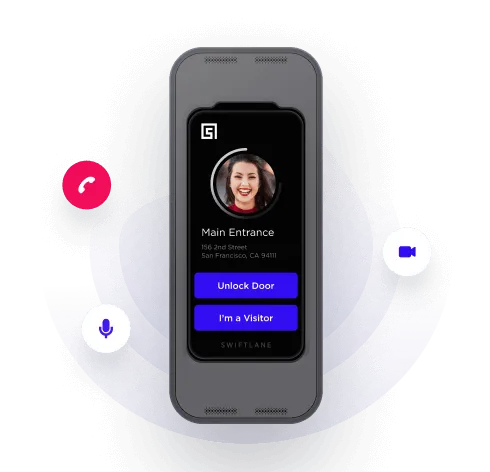
Visitor workflows (native): Swiftlane handles visitor access natively — no third-party add-on required. Property managers or tenants can issue time-limited PINs or QR codes to guests before they arrive. Access automatically expires at the end of the visit window. Visitor events are logged alongside regular access events in the same audit trail, giving a unified view of all building activity.
Multi-tenant admin: Building admins and tenant admins operate in separate permission scopes. A tenant admin can manage their own employees’ access without visibility into other tenants’ users or doors. Building-level changes (shared lobbies, elevators, loading dock) stay under building admin control. This separation is configurable per deployment.
Credentials: Swiftlane supports mobile apps (BLE + cellular), face recognition, PIN codes, and key fobs/cards, enabling mixed credential populations across user types. Visitors typically receive PINs or QR codes; employees and residents use mobile or face recognition. Enrollment is handled through the web dashboard or resident app.
Audit logs: Every entry event is logged with timestamp, user identity, credential type, and door location. Logs are searchable and exportable by date range, door, or user, suitable for incident reviews, compliance requests, and insurance documentation.
Retrofit reality: Swiftlane’s SwiftReader X is designed for surface-mount installation and works with standard door strikes and magnetic locks. Most commercial office doors are compatible without structural changes. Older buildings with non-standard wiring may require an infrastructure review before deployment. Swiftlane’s installation team conducts site surveys for this.
Limitations
- Requires reliable network connectivity at each reader location
- Advanced PMS integrations (Yardi, RealPage) are primarily designed for multifamily — confirm compatibility for commercial office deployments
- Face recognition enrollment requires resident/employee opt-in and clear policy documentation before rollout
Critical Integrations to Check in Demo
- SSO / identity providers (Okta, Azure AD, Google Workspace)
- Property management software
- Video intercom (Swiftlane’s own video intercom integrates natively)
Demo Checklist
- Tenant admin role separation: create a tenant admin, confirm they can’t see other tenants’ users
- Visitor flow end-to-end: pre-register a guest → issue PIN → check-in → confirm auto-expiry
- Export audit log for a 30-day date range
Pricing
Hardware and software pricing vary by building size, number of doors, and credential types. Swiftlane typically quotes per-door hardware plus a monthly SaaS fee. Third-party estimates put hardware at around $1,300 per door and monthly software at around $40 per unit, though actual quotes vary by configuration. Request an itemized quote for your specific setup.
3. Brivo
Best for: Brivo is for larger offices seeking a mature, established access control platform with robust reporting.
What’s Meaningfully Different
- Mature admin + reporting: Brivo has been in the commercial access control market for over 20 years. Its reporting suite is one of the more developed in the category; access summaries, user activity, and door-level reporting are available out of the box.
- Audit log depth: Logs include timestamps, user identity, credential type, and door location with export options for compliance and incident review.
- Visitor capabilities: Brivo’s visitor management is available as a module; confirm whether it’s native or an add-on in your specific configuration.
- Multi-site scaling: Brivo supports large portfolios with consistent permission management across properties.
Limitations
- Cloud-only: Brivo offers no on-premises or hybrid deployment options, so migrating from an existing on-premises system requires a full replacement rather than a phased upgrade.
- Headline per-door pricing doesn’t include hardware, installation, mobile credential fees, or integration costs, which can add up meaningfully beyond the subscription price.
- Visitor management is a separate module in some configurations; confirm in the demo whether it’s native or an add-on for your specific plan.
- User reviews cite occasional platform instability (sync issues, app crashes) and inconsistent support response times.
Critical Integrations to Check in Demo
- IdP/SSO + provisioning
- Security/video systems
- Visitor workflow tooling (if not native)
Demo Checklist
- Show audit logs + export
- Show permission design for building vs tenants
- Show visitor workflow (and what product/module powers it)
Pricing Model
Subscription + hardware/integration costs vary. Brivo’s Standard edition starts at around $13.50/door/month for the first two doors, then drops to $3.50/door after 10 doors. Professional and Enterprise tiers add a base platform fee ($250–$580/month) plus $9–$16/door/month depending on features. Hardware/installation typically runs $1,500–$2,000 per door for new installs.
4. Genea
Best for: Genea is recommended for multi-tenant office towers that want tenant self-service alongside native visitor management.
What’s Meaningfully Different
Visitor workflows (native): Genea’s visitor management is a native module of the platform, not a bolt-on. Guests are pre-registered, receive a QR code or mobile credential before arrival, and check in via a kiosk or self-service flow. Visitor activity logs alongside regular access events in the same dashboard.
Tenant self-service: Genea’s Building Sync lets tenants manage their own employees’ access, additions, removals, and permission changes, without filing a ticket with the property manager. When a tenant removes someone at the suite level, Building Sync automatically removes them at the building level too.
Hardware flexibility: Genea runs on non-proprietary hardware and supports existing Mercury and HID controllers, which matters for buildings that don’t want a full hardware rip-and-replace.
Limitations
- Visitor management and tenant portals are strong for office/CRE; less purpose-built for high-security or industrial-grade deployments
- Confirm current biometric/face recognition capabilities directly with Genea; public documentation is unclear on this point
- Advanced video integrations depend on which VMS partner (Avigilon, Milestone, etc.) the building already uses
Critical Integrations to Check in Demo
- SSO / identity providers (Okta, Azure AD, Google Workspace, OneLogin)
- Property management and tenant engagement platforms
- Video management system compatibility for your building’s existing cameras
Demo Checklist
- Tenant self-service: have a tenant admin add and remove an employee, confirm building-level sync
- Visitor flow end-to-end: pre-register a guest, issue QR code, confirm check-in and audit log entry
- Confirm which VMS platforms integrate natively. vs. require a partner integrator
Pricing
Pricing is quote-based and depends on building size, door count, and hardware reuse. No published per-door SaaS rate is available; general industry benchmarks for installed access control systems run roughly $3,000–$5,000 per door, though this figure isn’t Genea-specific. Request an itemized quote.
5. Kastle Systems
Best for: Kastle Systems is recommended for commercial office buildings that want security managed as a service rather than self-administered.
What’s Meaningfully Different
Visitor workflows (native): KastleVisitor is built into the platform. Employees schedule visits through Outlook or Google Calendar; the visitor receives a QR code by email; and check-in happens at a kiosk or front desk, with no receptionist required. Visitor history is tracked in the same system as access control.
Managed security model: Unlike self-administered platforms, Kastle positions itself as security-as-a-service: Kastle’s own technicians handle installation, 24/7 monitoring, and ongoing maintenance rather than leaving the building’s team to run the system.
Legacy system takeovers: Kastle explicitly supports taking over existing access control and video hardware without a full replacement, which lowers switching costs for buildings with sunk hardware investments.
Limitations
- The managed-service model means less day-to-day control for buildings that want to self-administer
- Confirm SSO/identity-provider integration depth directly with Kastle; public documentation references HR directory sync but doesn’t specify supported IdPs
- Confirm offline/cached access behavior for your specific deployment
Critical Integrations to Check in Demo
- HR/identity directory sync
- Property management platforms
- Existing camera/video hardware compatibility for legacy takeover scenarios
Demo Checklist
- Visitor flow end-to-end: schedule via calendar integration, confirm QR delivery and kiosk check-in
- Ask what’s included in the managed service vs. billed separately (monitoring, maintenance, technician visits)
- Confirm legacy hardware takeover process if retrofitting
Pricing
Pricing is service-based (bundled monitoring, maintenance, and technician support) rather than a flat SaaS fee, and Kastle negotiates commercial rates per deployment. The only public reference point is Kastle’s GSA federal contract schedule, listing $47.48/month for the first reader/alarm door and $22.89/month per additional door; commercial rates may differ. Request a quote scoped to your building.
This shortlist offers a range of approaches, from fully unified platforms to systems that rely more on integrations, so you can evaluate which best fits your building and operations.
Quick Compare: Which System Fits Your Use Case
Feature claims are based on publicly available vendor documentation as of May 2026. Verify current capabilities directly with each provider before purchasing.
| Swiftlane | Kisi | Brivo | Genea | Kastle Systems | |
| Cloud-native | ✓ | ✓ | ✓ | ✓ | ✓ |
| Native visitor management | ✓ | Partial | Partial | ✓ | ✓ |
| Mobile credentials | ✓ | ✓ | ✓ | ✓ | ✓ |
| Face recognition | ✓ | ✕ | ✕ | Verify | ✕ |
| Multi-tenant admin | ✓ | ✓ | ✓ | ✓ | ✓ |
| SSO/IdP integration | ✓ | ✓ | ✓ | ✓ | Verify |
| Offline/cached access | ✓ | ✓ | Partial | Verify | Verify |
| Audit log export | ✓ | ✓ | ✓ | ✓ | ✓ |
| Retrofit-friendly | Moderate | Moderate | Moderate | Moderate | Moderate |
| Best for | Multi-tenant offices | Cloud-first IT | Enterprise | Tenant self-service | Managed/white-glove |
How to Choose the Right System
The right systems depend on how your building operates. Use this as a quick decision guide:
- If you manage a multi-tenant building → Prioritize strong role-based permissions and tenant-level control so access can be managed without overlap
- If you handle high visitor volume → Look for built-in visitor workflows (pre-registration, fast check-in, temporary credentials) to reduce front desk load
- If you have a national or multi-site portfolio → Focus on centralized, cloud-based management with consistent configurations across locations.
- If you operate in a regulated or security-sensitive environment → Prioritize detailed audit logs, data retention controls, and secure identity integrations.
- If you’re upgrading a legacy system → Evaluate how the platforms fit your existing wiring, doors, and infrastructure to avoid costly rework.
- If your team is small → Choose a system that minimizes admin work with simple user management and automation.
Most teams don’t choose based solely on features. They choose based on how well the system fits their building, workflows, and team capacity.
Implementation Checklist
A robust system can still fail if the rollout isn’t properly planned. This checklist helps you avoid common gaps during deployment.
Pre-Deployment
- Map all entry points (doors, gates, restricted areas)
- Define access policies (who gets access to what, and when)
- Identify stakeholders (IT, security, facilities, tenants)
- Check network and wiring readiness
Pilot Phase
- Start with a limited rollout (e.g., main entrance + one secondary door)
- Test employee and visitor workflows end-to-end
- Validate access permissions, check-ins, and notifications
- Gather feedback from admins and users
Rollout
- Train admins and front desk/security teams
- Communicate changes to tenants and employees
- Set up support channels for issues during transition
Verification
- Review access logs and visitor records for accuracy
- Run basic incident scenarios (e.g., revoked access, denied entry)
- Audit admin permissions to avoid over-access
A phased rollout reduces risk and gives you time to catch issues before the entire building.
Common Pitfalls When Choosing an Access Control System


Even robust systems can fail in real-world office environments if key details are overlooked during evaluation or rollout. These are the issues that come up most often:
Multi-Tenant Permission Overlap
Tenants can end up seeing or managing access outside their own space.
What to check: Tenant isolation and admin boundaries.
Visitor Access that Doesn’t Map to Doors
Check-in works, but the credential doesn’t actually open the right doors, creating manual work at the front desk.
What to check: Whether visitor credentials connect directly to door permissions.
Weak or Limited Audit Logs
Logs show that someone entered, but not enough detail to support an investigation or compliance review.
What to check: Timestamp accuracy, user identity, door-level data, and export options.
Integration Gaps with Identity Systems
“SSO support” doesn’t always mean automated provisioning and deactivation; some platforms still need manual updates.
What to check: Automated sync with tools like Okta or directory systems, including access removal.
Offline Access Limitations
Some systems fail badly during outages: doors won’t unlock, or credentials stop working without internet access.
What to check: Local credential storage and expected behavior during network downtime.
Elevator and Shared Space Access Gaps
Access control may cover doors but stop short of elevators, parking, or shared amenities.
What to check: Coverage across all entry points, not just main doors.
Underestimating Infrastructure Constraints
Older buildings often have wiring, power, or network limits that only surface once installation starts.
What to check: Hardware requirements, cabling needs, and retrofit compatibility.
Catching these early can save time, reduce costs, and avoid operational issues later. Most problems don’t come from missing features. They come from gaps between how the system is designed and how the building actually runs.
What to Ask in the Demo
Before committing to a system, use these questions to validate how it performs in real conditions.
Identity and Access Provisioning
- Does the system support automated user provisioning and deactivation through SSO or directory sync?
- What happens to access when a user is removed from the identity system?
Visitor Access and Credentials
- How are visitor credentials issued? QR code, mobile pass, or badge?
- Can visitor access be restricted to specific doors and time windows?
Audit Logs and Reporting
- What data is captured in the audit logs (user, timestamp, door, activity)?
- Can logs be exported for compliance or incident reviews?
Multi-Tenant Administration
- How are permissions separated between building admins and tenants?
- Can tenants manage their own users without affecting others?
Offline Access Behavior
- What happens during a network outage?
- Will credentials still work, and how is access validated locally?
Integrations and System Behavior
- Which integrations are native, and which require additional setup?
- Are integrations real-time, or do they rely on scheduled sync?
Infrastructure and Deployment
- What wiring, hardware, or network requirements should we plan for?
- How does the system handle retrofits in older buildings?
Final Thoughts
Most access control systems look similar on the surface. The differences show up during implementation and daily use.
That’s where teams run into issues. Visitor credentials don’t map to the right doors. Tenant permissions overlap. Access doesn’t sync properly with identity systems. These gaps don’t come from missing features. They come from how the system fits your building and workflows.
This guide is based on how these platforms perform in real office environments. We looked at vendor documentation, integration capabilities, and how teams manage access across tenants, visitors, and multiple entry points. The goal is to help you avoid common failure points and choose a system that works in practice.
If you’re evaluating options, use the criteria and checklist in this guide during your demos. It will help you validate how each system handles access, visitors, and day-to-day operations before you commit.
If you want to see how a unified platform handles access control and visitor management in one system, consider booking a demo with Swiftlane. It’s a practical way to compare workflows, test integrations, and see how the system fits your building setup.
FAQs
What’s the difference between access control and visitor management?
Access control determines who can enter specific areas and when, using credentials such as mobile passes, cards, or PINs. Visitor management focuses on how guests are registered, approved, and tracked during their time in the building. In modern office setups, these two are closely connected. A visitor check-in should automatically trigger access permissions, so guests can move through approved areas without manual intervention.
When both are handled in a single system, it reduces administrative work and keeps activity fully visible in audit logs.
Do I need a separate visitor management system?
It depends on how your building operates. Many access control platforms now include built-in visitor workflows that are often sufficient for standard office use. A separate system may make sense if you have high visitor volume, complex front desk processes, or specific compliance requirements.
In those cases, the key is to ensure that visitor actions directly map to access permissions. If they don’t, your team will end up managing access manually, which defeats the purpose.
How does visitor management work with mobile credentials?
Most systems allow visitors to receive a temporary credential, such as a QR code or mobile pass, before they arrive. This can be tied to a time window and specific entry points. When they check in, access is activated based on those rules.
The benefit is speed and control. Visitors can enter without waiting for manual approval, and access automatically expires at the end of their visit. This works well for recurring guests, vendors, and scheduled appointments.
What integrations matter most for office buildings?
Identity systems, communication tools, and security platforms tend to have the biggest impact. Integrations with identity providers help automate user access, so employees are added or removed based on their status. Communication tools support notifications and approvals, especially for visitor workflows.
Security integrations, such as cameras and monitoring systems, help provide context during incidents. The goal is to reduce manual updates and keep systems aligned.