Modern buildings are no longer secured solely by keys.
From multifamily apartments to commercial office towers, property owners are rethinking how access is granted, monitored, and controlled. Lost keys, employee turnover, package deliveries, vendor access, and after-hours entry all create operational complexity that traditional locks simply can’t manage.
That’s why building access control systems has become a foundational layer of modern property security.
But not all systems are built the same.
Some are designed for small properties with a limited number of doors. Others are cloud-based, scalable platforms capable of managing multiple buildings and thousands of users. Choosing the right solution means understanding how these systems work, what features matter, and how requirements differ between multifamily and commercial environments.
This guide breaks down everything you need to know about building access control systems, including how they work, the types available, and the features that matter most for most modern properties. Drawing on industry best practices and the evolving needs of multifamily and commercial buildings, it provides practical insights to help property owners and managers evaluate solutions, understand modern access technologies, and make confident security decisions.
How We Researched This
To produce this guide, we reviewed current access control industry research from HID Global and the Security Industry Association, installer pricing data from multifamily deployments, NIST physical security standards, and input from property managers and building operators across multifamily and commercial real estate. Cost ranges reflect commonly reported market pricing and vary based on building size, infrastructure, and local labor rates.
Key Takeaways
- A building access control system manages entry across multiple doors and users using digital credentials instead of traditional keys.
- Modern systems are cloud-based, allowing property managers to grant, revoke, and monitor access remotely from any device.
- Common credential types include mobile apps, key fobs, PIN codes, face recognition, and access cards. The right mix depends on building type and security requirements.
- Cloud-based systems scale across multiple doors and buildings without on-site servers or manual updates.
- Costs range from roughly $1,500 to $6,000 per door installed, depending on building size, credential type, and wiring complexity.
- The best system for multifamily buildings combines mobile credentials, video intercom, and a cloud dashboard. Commercial properties typically add role-based permissions and visitor management.
Table of Contents
- What Is a Building Access Control System?
- How Building Access Control Systems Work
- Remote Management and Audit Logging for Property Managers
- Types of Building Access Control Systems
- How Much Does a Building Access Control System Cost?
- Key Features to Look for in 2026
- Multifamily vs. Commercial Access Control Requirements
- Security and Compliance Considerations
- Buyer Checklist: How to Evaluate a Building Access Control System
- Which Building Access Control System Is Right for You?
- Swiftlane Building Access Control System
- FAQs
- Sources and Citations
What Is a Building Access Control System?


A building access control system is a centralized security platform that manages who can enter specific doors, floors, or restricted areas within a property. Unlike a traditional lock, which secures a single entry point with a physical key, access control systems for buildings are designed to manage multiple doors, users, and permission levels throughout a structure.
Instead of distributing physical keys, administrators issue digital credentials and control access through software. When a resident taps a fob, a staff member unlocks a door from their phone, or a visitor is buzzed in remotely, the system logs the event, verifies the credential, and grants or denies entry in under a second.
The result is a security layer that scales with the building, adapts to turnover, and gives property managers visibility that traditional locks simply cannot provide.
Core Components of a Building Access Control System
Most modern systems include four primary elements:
- Credentials: Key fobs, access cards, mobile apps, PIN codes, or biometric identifiers used to request entry.
- Readers: Devices installed at doors that scan and validate credentials.
- Controllers: Hardware that processes authentication and determines whether to unlock the door.
- Management Software: A cloud-based or on-premise platform used to assign permissions, monitor activity, and manage users.
Together, these components create a scalable solution for managing building-wide access from a single interface.
How Building Access Control Systems Work
Most modern access control systems operate on cloud-based infrastructure, allowing administrators to manage entry remotely from a web dashboard or mobile app.
In a typical building access control system, the process works like this:
- A user presents a credential at the door, such as a key fob, mobile app, or PIN code.
- The reader captures the credential and sends it to the system controller.
- The controller verifies whether the credential has permission to access that door.
- If the permission matches, the door unlocks.
- The event is logged in the system’s activity record with a timestamp and credential ID.
This process takes under a second. The underlying technology varies depending on whether the system is cloud-based or on-premises.
Cloud-Based vs. On-Premise Access Control
Older access control systems relied on local servers installed on-site. These on-premise systems require dedicated IT infrastructure, on-site management, and manual updates.
Cloud-based access control systems allow administrators to manage doors, users, and permissions from anywhere. Credentials can be issued or revoked instantly, and the system updates automatically without requiring an on-site technician.
| Cloud-Based Systems | On-Premise Systems | |
| Management | Remote, from any device | Limited to on-site server access |
| Updates | Automatic | Manual |
| Scalability | Across multiple buildings | Limited to a single installation |
| Integration | Easier with other building systems | Often requires custom configuration |
| Best For | Modern multifamily and commercial | Legacy environments with existing infrastructure |
Because of these advantages, cloud-based platforms have become the preferred choice for most new multifamily and commercial installations.
Mobile Credentials vs. Key Fobs
Traditional systems rely on key fobs or access cards, which must be distributed, tracked, and replaced when lost. Mobile credentials allow users to unlock doors using their smartphones through Bluetooth, NFC, or a secure app.
Mobile access offers several practical advantages for property managers:
- Credentials can be issued instantly without physical distribution.
- Lost or stolen phones can be disabled remotely.
- Temporary access can be granted to guests, vendors, or contractors without issuing a physical credential.
- Touchless entry reduces friction for residents and staff.
According to HID Global’s 2024 State of Physical Access Control Report, nearly two in five organizations (39%) now actively use mobile credentials. A separate survey, HID’s 2024 State of the Security Industry Report, found that 64% of organizations report some level of mobile ID deployment today, with that figure expected to reach 79% within five years.
Real-Time Access Management
Modern cloud-based access control systems allow property managers to control building entry without being on-site. Common real-time management tasks include:
- Granting temporary access to contractors or service providers
- Revoking credentials immediately when a tenant moves out, or an employee is terminated
- Unlocking doors remotely for deliveries or authorized guests
- Setting access schedules that restrict entry to specific hours or days
This level of control makes cloud-based systems significantly more operationally flexible than traditional lock-and-key infrastructure.
Activity Logs and Remote Monitoring
Every entry event is recorded and stored in the system’s audit log. Administrators can view who accessed a door, when the entry occurred, which credential was used, and whether the attempt was successful or denied.
These logs support security reviews, incident investigations, and compliance documentation. For a deeper look at how audit logging works in practice, see the next section.
Remote Management and Audit Logging for Property Managers
For property managers overseeing multifamily or commercial buildings, two capabilities matter more than almost anything else in an access control system: the ability to manage doors remotely and a reliable record of who entered and when.
These are not advanced features. They are operational necessities for any building with more than a handful of users.
Remote Unlock and Credential Management
A cloud-based access control system allows property managers to handle entry events from any device, without traveling to the property. Practical applications include:
- Unlocking a door for a delivery when no staff are on-site
- Issuing a temporary PIN or mobile credential to a contractor arriving after hours
- Revoking a former tenant’s access the moment a lease ends, rather than waiting until the next business day
- Granting a maintenance worker access to a specific floor or amenity space for a defined window of time
With mobile access control, property managers can perform all of these tasks from a smartphone. Swiftlane’s cloud dashboard supports remote unlocking, credential provisioning, and access scheduling from both mobile and desktop, with changes taking effect in real time across all connected doors.
Audit Logs and Access History
Every attempt to access a cloud-based system generates a timestamped log entry. A complete audit trail typically records:
- The credential used and the user it is assigned to
- The specific door or access point
- The date and time of the attempt
- Whether access was granted or denied
For multifamily properties, audit logs help resolve disputes, support move-out documentation, and provide evidence in the event of a security incident. For commercial buildings, they support internal security reviews and can be exported for compliance reporting.
Swiftlane stores access logs in the cloud, making them accessible from the admin dashboard at any time without requiring an on-site visit or manual data export.
Alerts and Notifications
Beyond passive logging, modern systems can send real-time alerts when specific events occur. Common alert configurations include:
- Notification when a door is held open beyond a defined time threshold
- Alert when an unrecognized or revoked credential attempts entry
- Summary reports delivered on a daily or weekly schedule
These features give property managers a proactive view of building security rather than a reactive one, reducing the time between an incident and a response.
Types of Building Access Control Systems


Not all building access control systems use the same authentication method. Different credential types offer different levels of convenience, security, and operational overhead. Understanding your options helps narrow down which system fits your building’s size, user base, and security requirements.
| System Type | How It Works | Best For | Cost Tier | Cloud-Native |
| Key Fob / Card | RFID or NFC tap at reader | Multifamily, offices, HOAs | Low to mid | Optional |
| PIN / Keypad | Numeric code entry | Secondary doors, service areas | Low | Optional |
| Mobile App | Bluetooth or NFC via smartphone | Modern apartments, smart offices | Mid | Yes |
| Face Recognition | Camera-based biometric verification | High-traffic multifamily, enterprise | Mid to high | Yes |
| Intercom-Integrated | Visitor calls resident or staff for remote unlock | Multifamily, gated properties | Mid | Yes |
Key Fob and Card-Based Access Systems
Key fob and card-based systems use RFID or NFC credentials that unlock a door when tapped near a reader. They are widely deployed and easy to implement, but physical credentials can be lost, shared, or cloned. Upgrading to encrypted 13.56 MHz hardware significantly reduces that risk.
Best for: Multifamily buildings, offices, and properties transitioning away from traditional keys.
Keypad and PIN-Based Access Systems
Keypad systems grant entry via a numeric PIN, eliminating the need for physical credential distribution. Codes can be set to expire automatically, making them practical for vendor or temporary access. PIN sharing between users can reduce accountability if access policies are not actively enforced.
Best for: Secondary entrances, service areas, and short-term vendor access.
Mobile-Based Access Systems
Mobile access control systems let users unlock doors through a secure smartphone app via Bluetooth or NFC. Credentials are issued and revoked digitally, with no physical distribution required. This is increasingly the default for newer multifamily and smart office buildings.
Best for: Modern apartment buildings and properties prioritizing touchless access management.
Biometric Access Control Systems
Biometric systems verify identity using facial recognition or fingerprints, offering a higher level of authentication than credential-based methods. Face recognition access control is well-suited to high-traffic entrances where hands-free entry improves resident experience.
Biometric data collection is regulated most strictly in three states: Illinois’ BIPA requires written consent and a retention schedule, and is the only law allowing individuals to sue directly. Texas’ CUBI and Washington’s biometric law impose similar consent requirements but are enforced only by the state attorney general. About twenty other states, including California and Colorado, treat biometric data as “sensitive” under broader privacy laws.
Best for: High-traffic multifamily entrances, enterprise facilities, and high-security commercial environments where compliance has been reviewed for the applicable state.
Intercom-Integrated Access Systems
Intercom-integrated systems combine access control with two-way video, letting residents or staff visually verify visitors before granting remote entry. Most modern platforms pair video intercom functionality with cloud-based access control in a single interface.
Best for: Multifamily buildings, gated communities, and properties that regularly receive guests or deliveries.
How Much Does a Building Access Control System Cost?
Cost is one of the first questions property managers ask, and one of the last things most vendors answer clearly. The honest answer is that the cost of building an access control system depends on door count, credential type, wiring complexity, and whether the building is a new installation or a retrofit.
Here are realistic planning ranges based on current installer pricing and multifamily deployment data.
Per-Door Hardware and Installation
The most reliable way to budget for access control is on a per-door basis. For most commercial and multifamily installations, expect:
| Installation Type | Estimated Cost Per Door |
| Basic retrofit, existing wiring | $1,500 to $2,500 |
| Standard cloud-based installation | $3,000 to $5,000 |
| Complex or fully integrated system | $5,000 to $6,000+ |
These figures include hardware, installation labor, wiring or retrofit work, controllers, and commissioning. They do not include ongoing software fees.
Cloud Software and Subscription Fees
Most modern cloud-based platforms charge a recurring software fee in addition to hardware costs. Typical ranges:
| Property Size | Estimated Monthly Software Fee |
| Small building, up to 20 units (2–5 doors) | $50 to $150 per month |
| Mid-size building, 20–100 units (6–20 doors) | $150 to $400 per month |
| Large building, 100+ units (20+ doors) | $400 to $800+ per month |
Some platforms price per door, others per user. Confirm the pricing model before comparing vendors, as per-user pricing can scale unexpectedly in high-turnover multifamily buildings.
Installation Estimates by Building Size
| Building Size | Access Points | Estimated Year-One Cost |
| Small building, up to 20 units | 2 to 5 doors | $5,000 to $15,000 |
| Mid-size building, 20–100 units | 6 to 20 doors | $20,000 to $60,000 |
| Large building, 100+ units | 20+ doors | $60,000 to $150,000+ |
These are planning ranges, not vendor quotes. Figures are synthesized from commonly reported installer pricing across multifamily and commercial deployments rather than a single source, and actual costs vary based on local labor rates, existing infrastructure, and system complexity. Older buildings with limited conduit or outdated wiring typically fall at the higher end of each range. Get a quote for your specific property to confirm pricing.
Key Features to Look for in 2026
The access control market is shifting rapidly. According to the Security Industry Association’s annual Security Megatrends report, AI, cloud integration, and mobile credentials are among the top forces reshaping how buildings manage entry. HID Global’s 2024 State of Physical Access Control Report found that nearly two in five organizations (39%) now actively use mobile credentials. Separately, HID’s 2024 State of the Security Industry Report found that 64% of organizations currently deploy some form of mobile ID, with adoption expected to reach 79% within five years.
Genetec’s 2026 State of Physical Security report, based on a survey of more than 7,300 physical security professionals, found that 80 percent of end users plan to add biometric capabilities to their access control systems in 2026, split roughly evenly between cloud and on-premise deployments.
For property managers evaluating systems today, the features below separate platforms built for modern operations from legacy solutions that add administrative burden over time.
| Feature | Why It Matters |
| Cloud-based management | Manage doors and users remotely without on-site servers |
| Remote credential provisioning | Grant or revoke access instantly without replacing keys or fobs |
| Multi-door and multi-building scalability | Supports growing properties and multiple locations |
| Mobile-first or touchless access | Enables convenient smartphone-based entry |
| Real-time activity tracking | Monitor access events and security instantly |
| Offline failover capabilities | Doors continue working even during internet outages |
| Cybersecurity protections | Protects the system from unauthorized digital access |
| Visitor and delivery management | Handles guest access without issuing permanent credentials |
Two features deserve particular attention in 2026. First, offline failover. A system that goes offline during an internet outage creates both a security gap and an operational headache. Look for platforms that cache access decisions locally on door controllers, allowing authorized users to still enter during connectivity disruptions.
Second, cybersecurity. As access control platforms move to the cloud, they become targets for the same threats as any networked system. NIST SP 800-82 provides security guidance for operational technology, including physical access control systems, and recommends encrypted data transmission, secure authentication protocols, and detailed audit trails as baseline requirements for any connected access system.
Multifamily vs Commercial Access Control Requirements
Building access control systems support both residential and commercial environments, but the operational priorities differ significantly. Choosing a system that matches how your building actually operates matters more than choosing the one with the most features.
Multifamily Building Needs
Multifamily access control centers on resident turnover, visitor management, and convenience. Property managers need to issue and revoke credentials quickly during move-ins and move-outs, grant temporary access to guests and delivery carriers, and allow residents to remotely unlock the front door through a video intercom or mobile app. High-turnover buildings benefit most from cloud-based systems, where credential changes take effect immediately across all connected doors.
Resident expectations reinforce this shift. The 2024 NMHC and Grace Hill Renter Preferences Survey, based on responses from over 172,000 renters nationwide, found that mobile connectivity and seamless building technology are increasingly central to leasing decisions, with a majority of remote-working renters citing reliable connectivity as a must-have.
Commercial Office Building Needs
Commercial buildings require more structured access policies tied to employee roles, schedules, and security clearances. Administrators need to control entry to restricted areas, manage time-limited visitor access, and generate after-hours activity reports. For multi-building portfolios, a cloud-based platform that manages all locations from a single dashboard reduces the overhead of maintaining separate systems at each site.
Security and Compliance Considerations
Modern access control systems are a networked infrastructure. That means physical security and digital security are no longer separate concerns. A system with strong door hardware but weak software protections creates vulnerabilities that traditional lock-and-key setups never had.
Research published by BOMA International, in partnership with the ASIS Foundation and SIA, identifies a significant disconnect between how building operators perceive their security risks and the actual vulnerabilities in connected building systems, including access control infrastructure.
For commercial property managers, this gap is worth taking seriously when evaluating platforms. When evaluating building access control solutions, prioritize the following:
- Data encryption: Credential information and access records should be encrypted in transit and at rest. HID Global’s overview of the Open Supervised Device Protocol notes that OSDP is currently the only protocol that is both secure and open for communication between readers and controllers, and recommends it as the baseline standard for new installations.
- Secure authentication protocols: Administrator access to the management platform should require multi-factor authentication.
- Audit trails: Every entry attempt should be logged with a timestamp, credential ID, and access point for security reviews and incident investigation.
- Offline failover: Door controllers should cache access decisions locally so that the system continues to operate during internet outages.
- Cybersecurity standards alignment: NIST SP 800-82 provides baseline security guidance for physical access control systems, covering encrypted communication, access logging, and system integrity monitoring.
For commercial buildings that handle sensitive data or operate in regulated industries, access logs may also need to meet internal audit requirements or industry-specific compliance standards. Cloud-based platforms that store logs off-site and make them exportable simplify this process considerably compared to on-premise systems that require manual data retrieval.
Fire and Life-Safety Code Compliance
Electrified locking hardware on egress doors is governed by the International Building Code (IBC) and NFPA 101, the Life Safety Code, not just cybersecurity standards. In nearly all cases, doors must allow free and immediate egress independent of the access control system, meaning the credential reader can restrict entry but can never block someone from exiting.
Locks are classified as fail-safe (unlocked on power loss) or fail-secure (locked on power loss), and the required type depends on the door’s location and occupancy. Because code editions and local amendments vary by jurisdiction, egress hardware should always be verified with the local Authority Having Jurisdiction (AHJ) before installation, not assumed from a general code reference.
Buyer Checklist: How to Evaluate a Building Access Control System
Choosing the right building access control system involves more than comparing product specifications. Use the following checklist when evaluating options for your property.
- Can administrators manage doors and users remotely? Remote management allows property teams to control access without being on-site.
- Does the system support mobile credentials as well as traditional options? Flexible credential types accommodate different user preferences and reduce physical distribution overhead.
- Can access be granted or revoked instantly? Fast credential management is critical during tenant move-outs, employee terminations, and vendor access windows.
- Does the system scale across multiple doors or properties? A scalable platform grows with the building without requiring a full system replacement.
- Are activity logs and audit trails available and exportable? Access records support security reviews, incident investigations, and compliance documentation.
- Does the system operate during internet outages? Offline failover ensures doors continue working when connectivity is disrupted.
- Does the system integrate with other building technologies? Integration with video intercoms, visitor management platforms, and HR directories improves operational efficiency.
- What is the total cost of ownership? Factor in hardware, installation, software subscriptions, and ongoing credential management, not just upfront equipment cost.
Which Building Access Control System Is Right for You?
The best building access control system is the one that matches your property type, user volume, and operational workflow. Here is a straightforward breakdown by building type.
| Property Type | Recommended Setup | Key Priority |
| Small multifamily, up to 20 units | Cloud-based system with mobile and fob credentials, video intercom at main entrance | Resident convenience, fast turnover management |
| Mid-size multifamily, 20 to 100 units | Cloud platform with face recognition, mobile access, and video intercom | Touchless entry, remote management, visitor access |
| Large multifamily, 100+ units | Multi-door cloud platform with face recognition, mobile credentials, and amenity access control | Scalability, audit logging, package and delivery management |
| Small commercial office | Cloud-based keypad or mobile access system with basic audit logging | Low overhead, easy credential management |
| Multi-tenant commercial building | Cloud platform with role-based permissions, visitor management, and multi-floor access control | Structured permissions, restricted area control |
| Enterprise or multi-site portfolio | Centralized cloud platform managing multiple buildings from a single dashboard | Portfolio-wide visibility, integrated reporting |
Swiftlane’s Recommendation by Property Type
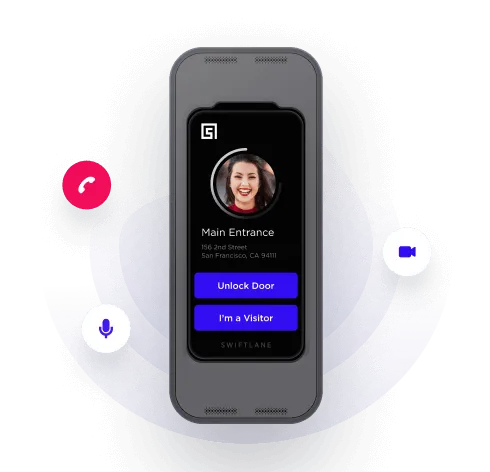
For multifamily properties of any size, Swiftlane’s SwiftReader X combines video intercom, face recognition, mobile access, key fob, and PIN entry into a single device managed through a cloud dashboard. Residents get touchless, hands-free entry. Property managers get real-time logs, remote unlock, and instant credential management from any device.
For commercial buildings and multi-site portfolios, Swiftlane’s cloud platform supports role-based access permissions, visitor management, elevator access control, and centralized reporting across multiple locations. All credential types, including mobile, fob, PIN, and face recognition, are managed from a single dashboard, eliminating the need for separate systems for each door or building.
Swiftlane Building Access Control System

The right building access control system should do three things well: secure every entry point, simplify daily management for property teams, and deliver a consistent experience for residents and employees. Most legacy systems handle the first requirement reasonably well. Modern cloud-based platforms are designed to handle all three.
Swiftlane is a cloud-native access control platform deployed across more than 3,000 multifamily and commercial properties, combining video intercom, face recognition, mobile access, key fob, and PIN entry into a single system managed from a single dashboard.
Key capabilities include:
- SwiftReader X: An all-in-one device supporting face recognition, mobile unlock, key fob, PIN, and QR code access at a single entry point.
- Cloud dashboard: Remote credential provisioning, access scheduling, real-time activity logs, and door unlock from any device.
- Video intercom: Two-way audio and video calling with remote unlock, allowing residents and staff to verify and admit visitors from anywhere.
- Mobile access: Residents and employees unlock doors using the Swiftlane app via Bluetooth or remote unlock, with no physical credentials required.
- Multi-site management: Commercial and portfolio operators manage multiple buildings, floors, and access points from a single centralized platform.
- Offline failover: Access decisions are cached locally on every door controller, so authorized users continue to enter even during internet outages.
For property owners evaluating modern access control systems, Swiftlane’s integrated approach reduces operational complexity while maintaining strong security controls across every entry point.
Talk to the Swiftlane team to find the right configuration for your property.
FAQs
Can building access control systems operate without an internet connection?
Yes. Most modern cloud-based systems include offline failover capabilities that keep doors operating during internet outages. Access decisions are cached locally on door controllers, so authorized users can still enter using their credentials. Once connectivity is restored, the system automatically syncs logs and updates permissions.
What types of credentials can building access control systems support?
Most modern systems support multiple credential types, including key fobs, access cards, PIN codes, mobile apps, and biometric authentication such as face recognition. Many platforms allow properties to use a combination of credential types depending on security requirements and user preferences.
How much does a building access control system cost?
Cost depends on door count, credential type, and wiring complexity. Most installations fall between $1,500 and $6,000 per door, including hardware, labor, and commissioning. Cloud software fees typically range from $50 to $800 per month, depending on building size. See the cost section above for a full breakdown by property size.
What is the difference between cloud-based and on-premise access control?
Cloud-based systems allow administrators to manage doors, users, and permissions remotely from any device, with automatic software updates and multi-site scalability. On-premise systems store data locally and require manual updates and on-site management. Most new multifamily and commercial installations use cloud-based platforms.
How do I manage access for a high-turnover multifamily building?
Cloud-based systems handle turnover most efficiently. Credentials can be issued to new residents before move-in day and revoked instantly upon lease end, without requiring an on-site visit or a physical key exchange. Some platforms also support automated credential workflows that integrate with property management software.
What access control features matter most for commercial office buildings?
Commercial buildings typically prioritize role-based access permissions, time-based scheduling, restricted area control, and visitor management. Integration with HR directories or identity providers such as Okta or Azure AD allows credentials to be automatically activated and deactivated as employees join or leave.
How long does it take to install a building access control system?
Installation time varies by building size and wiring complexity. A small property with two to four doors can typically be commissioned in a single day. Larger buildings with extensive wiring or retrofit requirements may take a week or more to complete. Cloud-based systems generally deploy faster than on-premises installations because no local server setup is required.
What security standards apply to building access control systems?
NIST SP 800-82 provides baseline security guidance for physical access control systems, covering encrypted communication, access logging, and system integrity monitoring. Commercial organizations in regulated industries may also need to align access control practices with internal audit requirements or industry-specific compliance frameworks.
Sources and Citations
- NIST SP 800-82 Rev. 3, Guide to Operational Technology Security. National Institute of Standards and Technology. https://csrc.nist.gov/News/2023/nist-publishes-sp-800-82-revision-3
- HID Global, 2024 State of Physical Access Control Report. https://blog.hidglobal.com/2024-state-physical-access-control
- HID Global, 2024 State of the Security Industry Report. https://newsroom.hidglobal.com/2024-state-security-report-hid-mobile-ids-mfa-and-sustainability-emerge-top-trends
- Security Industry Association, Security Megatrends Report. https://www.securityindustry.org/report/security-megatrends/
- BOMA International, Intelligent Building Management Systems: Guidance for Protecting Organizations. https://www.boma.org/BOMA/Research-Resources/Trends/Cybersecurity.aspx
- HID Global, Why OSDP Has Become Access Control’s International Communication Standard. https://blog.hidglobal.com/why-osdp-has-become-access-controls-international-communication-standard
- National Multifamily Housing Council & Grace Hill, 2024 Renter Preferences Survey Report. https://www.nmhc.org/research-insight/research-report/nmhc-grace-hill-renter-preferences-survey-report/
- Genetec, 2026 State of Physical Security Report. https://www.genetec.com/a/physical-security-report
- Illinois Biometric Information Privacy Act (740 ILCS 14). https://law.justia.com/codes/illinois/chapter-740/act-740-ilcs-14/
- Texas Capture or Use of Biometric Identifier Act (Business & Commerce Code, Chapter 503). https://statutes.capitol.texas.gov/Docs/BC/htm/BC.503.htm
- Washington Biometric Identifiers Law, RCW 19.375. https://app.leg.wa.gov/rcw/default.aspx?cite=19.375
- International Code Council, 2024 International Building Code. https://codes.iccsafe.org/content/IBC2024P1
- National Fire Protection Association, NFPA 101: Life Safety Code. https://www.nfpa.org/codes-and-standards/nfpa-101-life-safety-code/free-access