Gate key fobs remain one of the most widely used access methods for vehicle gates, especially in residential communities, commercial lots, and employee-only entries. They’re familiar, fast, and operationally simple for properties that need consistent access for known users.
That said, access needs have evolved. Property managers today weigh security, admin overhead, and visitor access alongside convenience. Understanding where key fobs fit and where they fall short helps properties make smarter, longer-lasting access decisions.
This guide draws on industry credential standards, common multifamily access-control deployment patterns, and the operational realities that property managers encounter in gated residential and commercial properties.
Swiftlane manages access for more than 3,000 buildings across multifamily and commercial properties, and our access patterns consistently show that properties with the smoothest operations are those that have moved beyond single-credential systems.
How We Researched This
This guide is based on deployment data from more than 3,000 properties managed through Swiftlane’s access control platform, analysis of LF and HF credential standards including ISO/IEC 18000-2 and ISO/IEC 14443, and review of installer and property manager feedback from multifamily and commercial deployments. Credential security claims were corroborated against published industry standards. System cost ranges reflect typical deployment pricing as of 2026 and vary by region, installer, and system tier.
Key Takeaways
- A gate key fob is an RFID-based credential commonly used for vehicle gate access in residential and commercial properties.
- Gate key fobs work best for repeat users, such as residents and employees, with predictable access needs.
- Security depends on the credential type. Encrypted smart credentials provide stronger protection than legacy proximity fobs.
- Physical fobs require ongoing management, especially in high-turnover properties.
- Fob-only systems can create limitations for visitors and delivery access.
- Many properties now combine gate key fobs with mobile credentials and cloud-based management for greater flexibility.
Table of Contents
- What is a Gate Key Fob?
- How Secure Are Gate Key Fobs?
- When Gate Key Fobs Make Sense for Your Property
- Common Limitations of Fob-Based Gate Access
- Signs Your Gate Key Fob System Needs an Upgrade
- Gate Key Fob vs Other Access Methods
- Modern Alternatives to Gate Key Fobs
- Modern Gate Access Systems: Multi-Credential and Cloud Options
- How to Choose the Right Gate Access Control System
- Are Gate Key Fobs Right For Your Property?
- FAQs
What Is a Gate Key Fob?


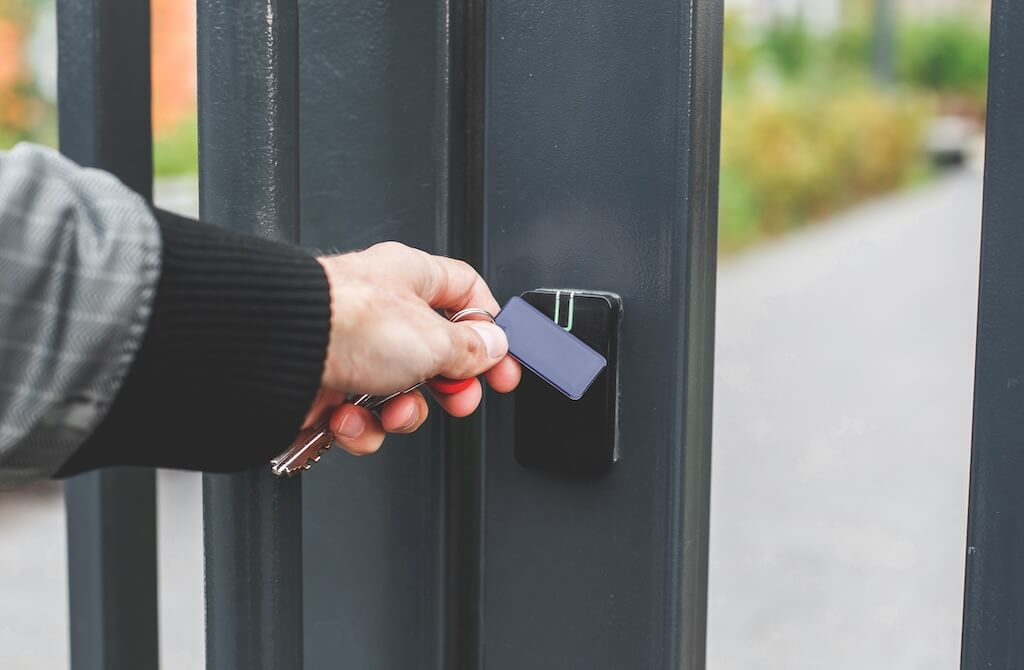
A gate key fob is a small RFID-based credential used to grant authorized access through a secured gate, typically in residential communities, commercial properties, or controlled parking areas. Instead of entering a PIN or calling a directory, users simply tap or hold the fob near a reader at the gate.
When the reader detects a valid credential, it signals the access controller, which then triggers the gate operator to actuate the gate. The entire process usually takes less than a second, making key fobs a fast, frictionless access method for frequent users such as residents, employers, or tenants.
For residential deployments, learn how these systems work in our guide to residential gate access control.
How Secure Are Gate Key Fobs?
Gate key fob security depends less on the physical fob and more on the underlying credential type and system configuration. Some deployments are quite secure, while others rely on older, easier-to-copy credentials.
- RFID frequency matters: Low-frequency (125 kHz) proximity credentials, governed by ISO/IEC 18000-2, typically transmit a static ID without encryption. High-frequency (13.56 MHz) smart credentials, governed by ISO/IEC 14443, support mutual authentication and encrypted communication depending on system configuration.
- Cloning risks exist with legacy fobs: Many legacy 125 kHz proximity credentials transmit a static, unencrypted facility code and card number with each read. This means someone with a compatible RFID reader positioned within a few inches of the fob can capture the data and write it to a blank credential. The attack requires physical proximity and basic hardware, which makes it a realistic risk in high-traffic entry areas rather than a theoretical one.
- Revocation and audit trails are key: Systems that enable instant deactivation and maintain usage logs offer stronger control. This makes it easier to respond quickly when a fob is lost or unreturned.
- Encrypted vs unencrypted credentials: Encrypted fobs add a layer of protection during transmission, while basic unencrypted fobs are simpler but more vulnerable. For higher-security properties, this distinction has real operational impact.
When Gate Key Fobs Make Sense for Your Property
Gate key fobs perform extremely well in environments with predictable users and repeat access patterns. When the same group of people enters daily, fobs offer a reliable, low-friction access method that’s easy to manage operationally.
Gated Residential Communities
In gated neighborhoods and HOAs, key fobs allow residents to quickly enter their vehicles without stopping, calling, or entering a PIN. This keeps traffic flowing smoothly during peak hours while maintaining controlled access to the property.
They’re especially effective in communities with a relatively stable resident base and a primary need for convenient daily access rather than complex visitor management.
Commercial Parking Lots
For office buildings and mixed-use properties, fobs work well for assigned tenant parking and long-term permit holders. They allow consistent access for authorized vehicles while keeping the gate restricted to approved users.
This is operationally useful for properties that need structured access control without requiring active monitoring at entry points.
Employee-Only Vehicles
Facilities, warehouses, and staff-only entrances often benefit from key fobs, which enable fast employee authentication for frequent daily entries. Instead of using shared codes or manual gate controls, each credential is individually assigned and trackable.
In these controlled-use scenarios, fobs strike a practical balance between convenience and accountability, especially when paired with a system that can easily issue, deactivate, and audit credentials as staffing changes.
Common Limitations of Fob-Based Gate Access
Gate key fobs are dependable, but they do come with operational overhead. The issue usually isn’t access itself, but the day-to-day management of physical credentials.
Lost, Stolen, or Shared Fobs
Credentials are frequently lost, unreturned, or shared. When that happens, access control shifts from user-specific to credential-specific, potentially creating visibility gaps.
That means managers often need to deactivate and reissue fobs to maintain basic control over who actually has access.
Managing High Resident Turnover
In properties with frequent move-ins and move-outs, fob management becomes a constant cycle. New residents need credentials, and old ones must be removed quickly to avoid lingering access.
If revocation isn’t handled promptly, inactive users may still be able to enter. This adds both security risk and additional administrative work.
Visitor and Delivery Access Limitations
Fobs are built for repeat users, not short-term visitors. Guests, vendors, and delivery drivers typically can’t use them, leading to workarounds such as shared fobs, manual gate openings, or staff intervention.
Over time, this creates friction at the gate and interrupts the otherwise smooth flow of access.
Replacement and Administrative Costs
Individual fobs aren’t expensive, but operational costs add up. Replacements, reprogramming, tracking inventory, and handling requests all take time.
For larger communities, the real cost isn’t the fob itself. It’s the ongoing effort required to manage them accurately and consistently.
These limitations don’t disqualify fobs as an access method, but they do define the conditions where fobs alone are no longer the most practical solution. The comparison below outlines how fobs stack up against other gate access methods across the factors that matter most operationally.
Signs Your Gate Key Fob System Needs an Upgrade
Gate key fobs can serve a property well for years, but certain operational patterns signal that the current system is creating more friction than it solves.
Fob Loss and Replacement Requests Are Frequent
If your team regularly fields requests for replacements or issues more fobs per unit than expected, that volume indicates the system lacks the flexibility residents need. Properties with high replacement rates often benefit from adding mobile credentials, which eliminate the physical credential problem entirely for users who prefer it.
You Have No Way to Audit Gate Activity
If your current system doesn’t log credential use, you have no visibility into who entered, when, or how often. This matters most when a security incident occurs or when a former resident’s access needs to be confirmed as revoked. Cloud-managed systems with audit trail support address this directly.
Visitor and Delivery Access Requires Manual Intervention
When staff regularly open the gate for guests, delivery drivers, or vendors, the fob system creates a gap it was never designed to fill. If this is a daily occurrence, adding a video intercom with remote unlocking resolves it without replacing the existing fob infrastructure.
Move-Outs Don’t Trigger Immediate Deactivation
In properties without cloud-based credential management, deactivating a fob after move-out depends on someone remembering to do it manually. If there’s any lag in that process, former residents may retain access.
Instant remote deactivation is a standard feature in modern cloud-managed systems, removing that risk.
You’re Managing Multiple Entry Systems Separately
If your gate fob system, building intercom, and parking access all run on separate platforms with separate admin logins, the overhead compounds quickly. A unified system that manages all credentials from one dashboard reduces both administrative burden and the risk of permissions falling out of sync across entry points.
Gate Key Fob vs Other Access Methods
Key fobs are just one way to manage gate access. The right choice often depends on how your property balances convenience, security, and day-to-day operational workload.
| Access Method | Best For | Operational Effort | Security Control | Flexibility for Visitors |
| Key Fobs | Residents, employees, repeat users | Moderate (issuance and tracking) | Moderate (depends on credential type) | Low |
| Keypads | Small properties, basic access | Low upfront, higher over time (code resets) | Low-Moderate | Moderate |
| Long-Range RF Remotes | Vehicle gates, long-range entry | Moderate (device management) | Moderate | Low |
| Mobile Credentials | Modern residential and mixed-use properties | Low (digital management) | High (instant revocation and tracking) | High |
| Video Intercoms | Visitors, deliveries, vendors | Low-Moderate | High (visual verification and event logging) | Very High |
| Fob + Mobile + Intercom (Swiftlane) | All user types | Low (cloud-managed) | Very High | Very High |
This is why many newer properties move toward multi-credential setups. Across the 3,000+ buildings Swiftlane serves, the properties with the lowest credential management overhead consistently use fobs for daily residents alongside mobile access and intercom for guests and deliveries.
Modern Alternatives to Gate Key Fobs
Key fobs remain a practical option for many properties, but they’re no longer the only one. Several access methods have matured to the point where they serve as direct alternatives, either replacing fobs entirely or filling the gaps left by fob-only systems.
Mobile Credentials
Mobile credentials use a smartphone as the access credential, typically via Bluetooth or NFC. For residents and employees, the experience is similar to a fob tap but without the physical token. The operational difference is significant: credentials can be issued, updated, or revoked remotely, and there’s no physical inventory to track.
Mobile access works best in properties where residents are comfortable using a smartphone app for building functions and where turnover is high enough that physical credential management has become a burden.
Keypads and PIN Access
Keypads are a simpler alternative for low-traffic gates or secondary entry points. They eliminate the need to issue physical credentials, but the tradeoff is security: shared codes can spread beyond authorized users and require periodic resets to remain effective. Keypads work best as a backup method alongside a primary credential system rather than as a standalone solution for larger properties.
Long-Range RF Remotes
Common in residential communities and parking structures, long-range RF remotes allow vehicle gate activation from a distance, typically 50 to 300 feet. They function similarly to fobs but are designed specifically for drive-through entry without stopping. The limitations are similar to fobs: physical device management, no visitor access, and limited audit capability.
Video Intercom with Remote Access
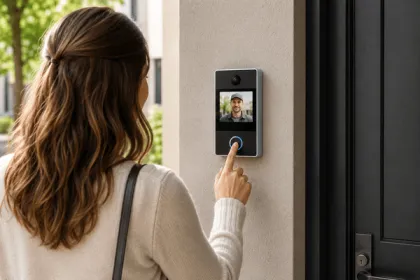
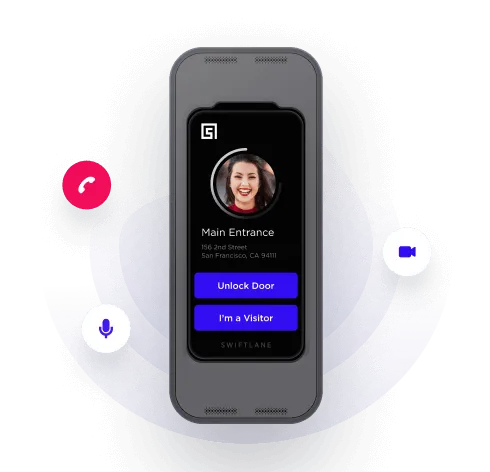
A video intercom doesn’t replace fob access for residents, but it directly addresses the visitor and delivery gap that fob-only systems can’t solve. Residents or property managers can verify and admit guests remotely via smartphone, and some systems support QR- or PIN-based temporary access for one-time visitors.
For properties where guest and delivery friction is the primary complaint, a video intercom often solves more of the day-to-day access problem than switching credential types would.
Multi-Credential Systems
The most flexible approach for larger or mixed-use properties is a system that supports multiple credential types simultaneously. Rather than choosing between fobs, mobile access, or intercoms, a multi-credential platform allows each user type to access the property in the way that works for them, while all permissions are managed from a single dashboard.
This approach preserves existing fob infrastructure while adding the flexibility and visibility that modern properties need.
Modern Gate Access Systems: Multi-Credential and Cloud Options
The comparison above shows why a single access method rarely serves every user type equally well. Modern properties aren’t replacing key fobs outright. Instead, they’re expanding into multi-credential systems that let fobs, mobile access, and visitor management work together on a single platform.
This approach reduces operational friction while giving managers more control over how different user groups enter the property.
Combining Fobs with Mobile Access
Fobs still work well for residents and employees who prefer a simple, tap-based experience. But pairing them with mobile access adds flexibility without disrupting existing workflows.
Residents can use their phones as backup credentials, while properties avoid over-issuing physical fobs for every user or vehicle.
Cloud-Based Credential Management
Cloud-based systems make credential management significantly more scalable compared to legacy on-site databases. Instead of programming credentials locally at the controller or reader, managers can update permissions from a dashboard.
This is especially useful for larger communities where access lists can change frequently.
Remote Issuance and Instant Deactivation
With modern systems, credentials can be activated, deactivated, or permissioned remotely in the system database, though physical fobs must still be distributed to users. Lost fobs can be deactivated instantly, and new access can be issued without requiring an on-site visit.
Operationally, this reduces delays, security gaps, and the administrative burden of handling physical credentials.
Visitor Passes and Temporary Access
One of the biggest gaps in fob-only systems is the lack of short-term access. Multi-credential platforms address this by allowing temporary passes for guests, vendors, and deliveries.
Instead of sharing a fob or manually opening the gate, properties can grant time-bound access that expires automatically, which improves both security and day-to-day gate operations.
How to Choose the Right Gate Access Control System

Not all gate key fob systems are equal, and the right fit depends more on operational realities than on hardware specs alone. For property managers and HOAs, the goal is to choose a system that stays manageable as the property grows and access needs evolve.
Property Size and Resident Count
Smaller properties with a stable resident base can often manage fobs with minimal overhead. But as the number of users increases, credential tracking, replacements, and updates become more time-consuming.
Larger communities benefit from systems that make it easier to issue, organize, and revoke credentials without manual reprogramming at the gate.
Frequency of Turnover
High-turnover properties, such as apartments, mixed-use buildings, or rental communities, should prioritize systems that allow fast credential updates. If move-ins and move-outs happen regularly, delayed deactivation of old fobs can quickly create access control gaps.
A system that supports instant revocation helps keep permissions accurate without constant manual intervention.
Security Requirements
Security needs vary by property type. A small gated lot may require only basic credential validation, while larger residential or commercial properties may require audit trails, encrypted credentials, and stronger access controls.
Evaluating how credentials are stored, verified, and revoked is just as important as the fob itself.
Budgeting and Long-Term Costs
Gate key fob systems are relatively affordable upfront, but total costs depend on the system type, credential tier, and ongoing management needs. Costs vary by system tier, installer, and region. The ranges below reflect typical deployments as of 2026.
- System cost: $1,200–$2,500+ per entry point (hardware and installation)
- Individual fob cost: $25–$100 per fob (basic). $50–$400 (encrypted smart fobs)
- Annual management cost: $200–$800/year for replacements and admin time (estimated for a 50-unit property)
- Upgrade to cloud-managed system: $500–$1,500 in setup plus $20–$80/month SaaS
Over time, costs are driven less by hardware and more by replacements, administrative time, and system upkeep. Managing lost fobs, reassignments, and inventory can add to operational expenses, especially in larger or high-turnover properties.
Integration with Existing Systems
The best gate key fob systems don’t operate in isolation. They should integrate smoothly with gate operators, access control platforms, and any existing entry systems on the property.
This ensures consistent access management across gates, doors, and other entry points, without forcing teams to juggle multiple disconnected systems.
If you’re comparing options, this guide on what a fob system is and how to choose one can help clarify key differences.
Retrofitting vs. Starting From Scratch
Many properties evaluating a gate key fob system already have a gate operator in place. In those cases, the decision isn’t about installing a gate from scratch. It’s about whether the existing operator is compatible with the credential system being considered.
Most modern RFID readers connect to gate operators through a Wiegand or OSDP interface. Most residential and commercial gate operators manufactured in the last decade support one or both of these interfaces, but compatibility should be confirmed with your installer before purchasing a credential system. If the existing operator doesn’t support the required interface, additional hardware or a full operator replacement may be needed.
For properties upgrading from a legacy fob system, the credential reader is usually the component that changes. The gate operator itself often stays in place as long as the interface is compatible.
Are Gate Key Fobs Right For Your Property?
Gate key fobs make the most sense for properties with a stable user base, vehicle-heavy entry, and predictable daily access patterns. They’re fast, reliable, and operationally simple when the credential population isn’t changing frequently.
A fob-only system becomes harder to justify when any of the following are true: turnover is high enough that deactivation lag creates real access risk, visitors and deliveries require frequent manual gate intervention, or your team has no visibility into who entered and when.
In those cases, the more practical path is keeping fobs as one option within a multi-credential system. Residents who prefer a tap-based experience keep their fobs. Properties add mobile credentials for flexibility, a video intercom for visitor access, and cloud management for oversight. The result is a system that handles every user type without requiring a full infrastructure replacement.
Swiftlane is built for exactly that transition, and already manages access for more than 3,000 multifamily and commercial buildings
FAQs
Here are answers to the most common questions about gate key fob systems for residential and commercial properties.
Can gate key fobs be hacked or cloned?
Some older, unencrypted fobs (especially low-frequency ones) can be cloned with the right tools. Newer encrypted credentials and systems with instant revocation and audit logs significantly reduce the risk.
How much does a gate key fob system cost?
Gate key fob systems typically cost $1,200–$2,500+ per entry point, including hardware and installation. Individual fobs range from $25–$100 (basic) to $50–$400 (encrypted smart fobs). Annual management costs, covering replacements and admin time, run $200–$800/year for a 50-unit property.
Upgrading to a cloud-managed system adds $500–$1,500 in setup costs plus $20–$80/month in SaaS fees.
What is the difference between a gate key fob and a gate intercom?
A gate key fob grants access to residents and staff who have a physical credential. A gate intercom allows visitors, delivery drivers, and guests to request access and be verified visually before entry. Many modern properties use both together, fobs for residents and an intercom for visitors.
Are key fobs better than mobile access?
It depends on the property. Fobs are the better choice for properties with a stable user base where residents prefer a simple, tap-based credential and turnover is low enough that physical credential management isn’t a burden.
Mobile access is the better choice when turnover is high, remote credential management is a priority, or the property needs to reduce physical inventory overhead. Many properties use both, with fobs for residents who prefer them and mobile credentials available as an alternative.
How long do key fobs last?
Most passive RFID key fobs last for years since they don’t use batteries. Their lifespan usually depends more on physical wear and tear than on electronic failure.
Sources & Citations
ISO/IEC 18000-2 — Parameters for air interface communications below 135 kHz: https://www.iso.org/standard/73599.html
ISO/IEC 14443 — Identification cards, contactless integrated circuit cards, proximity cards: https://www.iso.org/standard/80725.html
SIA OSDP — Open Supervised Device Protocol: https://www.securityindustry.org/industry-standards/open-supervised-device-protocol-osdp/