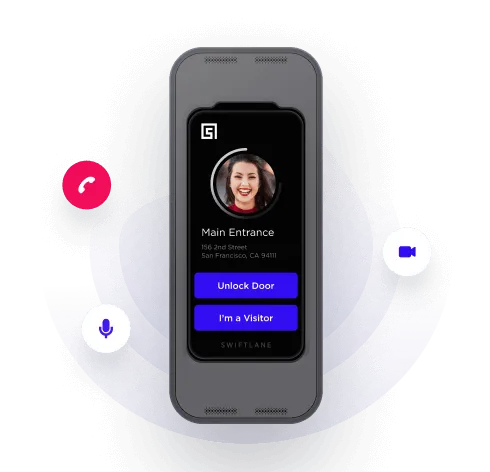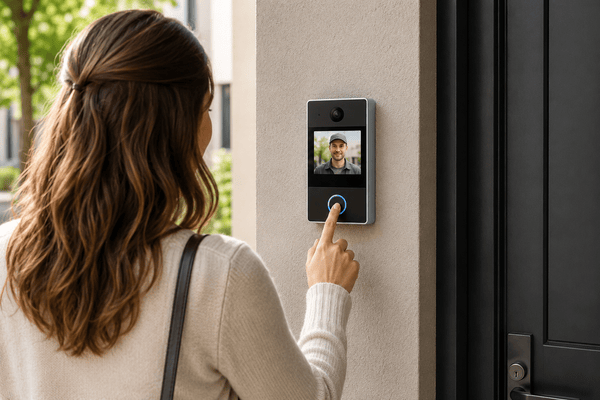
Upgrading your intercoms is like opening a can of worms, especially in older buildings, and a 2 wire video intercom is often the first solution property managers look at. You’ll run into expensive rewiring concerns, tenant disruption, and the logistical headache of coordinating installation across multiple units.
That’s where 2-wire video intercom systems come in. They’re designed to deliver modern video entry capabilities while using minimal wiring infrastructure, often working with existing building cabling. That means lower installation costs and a faster path to improving tenant security and convenience without major construction work.
In this guide, we’ll walk through everything you need to know about 2-wire video intercom systems, based on the Swiftlane team’s firsthand experience running surveys and deploying systems across thousands of U.S. properties annually.
We’ll cover how they work, where they make the most sense, their advantages and limitations, and how they compare to newer IP-based intercom technologies.
Research methodology: This guide is based on Swiftlane’s direct experience across more than 3,000 video intercom and access control deployments yearly in the U.S., including apartment buildings and condominiums. Cost ranges reflect actual project data from retrofit installations. System comparison claims are sourced from published technical specifications and market research cited inline.
Key Takeaways
- A 2 wire video intercom allows buildings to upgrade to video entry using existing wiring.
- These systems are ideal for retrofits in older apartment and condo properties.
- Property managers should weigh installation convenience against long-term scalability and integrations.
Table of Contents
- What is a 2 Wire Video Intercom?
- How a 2 Wire Video Intercom System Works
- Why Choose 2 Wire Intercom Systems
- 2-Wire Video Intercom Cost: 2026 Ranges + What Changes Price
- When a 2 Wire Video Intercom Makes the Most Sense
- Limitations of 2 Wire Video Intercom Systems
- 2-Wire vs 4-Wire vs IP vs Cellular Intercom Systems
- When a 2-Wire Video Intercom Is the Wrong Choice
- What to Look for When Choosing a 2 Wire Video Intercom
- Retrofit Readiness Checklist Before You Choose 2-Wire
- How Modern Access Control Platforms Compare
- Is a 2 Wire Video Intercom Right for Your Building?
- Frequently Asked Questions
Related Posts
- Best Video Intercom Systems for Multifamily & Commercial Buildings
- PoE Intercom Systems for Buildings
- Intercom vs Access Control System: A Complete Guide
What is a 2 Wire Video Intercom?
A 2 wire video intercom is a building entry system that uses just two wires to transmit power, audio, and video between the entrance panel and indoor devices.
In a regular setup, a visitor arrives at the entrance and presses a call button or selects a unit from a directory.
The system then sends a video and audio call to the resident’s indoor monitor, functioning as a 2-way intercom system that lets them see and talk to the visitor before allowing access.
The “two wire” part refers to the communication backbone connecting the system components. A single pair of wires is used, instead of separate cables for power, data, and video.
Many legacy analog intercoms were installed using simple two-wire connections. A modern 2-wire video intercom can often reuse those same lines, making upgrades easier.
You’ll most commonly see 2-wire systems in:
- Apartment buildings
- Condominium complexes
- Multi-unit residential properties
- Older buildings undergoing modernization
How a 2 Wire Video Intercom System Works
Although the wiring is simple, the system itself includes several components working together to manage communication and access control.
Here’s what a typical 2 wire video intercom system looks like.
Entry Panel
The entry panel sits at the building entrance. It’s the first point of contact for visitors and may include:
- A camera
- Microphone and speaker
- Call buttons or a digital directory
- Access control integration for unlocking doors
When a visitor makes a call, the panel sends a video and audio signal to the unit.
Modern entry panels now come with wide-angle cameras and improved night visibility, which means residents can now clearly see who’s knocking even in low-light conditions.
Indoor Monitors
Inside each apartment or unit, residents have an indoor monitor mounted on a wall.
These monitors display the video feed from the entrance panel and allow residents to:
- Speak with visitors
- View the camera feed
- Unlock the door remotely
Some systems support touchscreen monitors, while others use simpler hardware interfaces.
Power Supply and Controller
The system relies on a centralized power supply and controller. These two regulate communication between the entry panel and all indoor units.
They also manage signal distribution along the two-wire bus connecting the devices.
Door Release Mechanism
The intercom is connected to a door strike or gate controller. When a resident presses the unlock button on their monitor, the system sends a signal to release the lock.
Two-Wire Bus
The most distinctive feature of this system is the two-wire bus, which connects all devices along a shared wiring path.
Through digital signalling, the system can transmit video, audio, control commands, and power, all through a single pair of wires.
2-wire intercom systems use a shared bus that carries power plus digitally encoded audio/video/control on a single pair (Trudian).
This is why they’re popular for retrofits when existing low-voltage runs are intact.
This approach dramatically simplifies installation compared to traditional systems that require separate wiring for each function.
2-Wire vs. PoE Intercom: Not the Same Thing
2-wire systems are sometimes confused with Power over Ethernet (PoE) intercom setups, but the two aren’t the same.
A PoE intercom runs over standard Ethernet cabling and needs a structured network with a PoE switch. It’s ideal for new construction where you’re already running Cat6.
A 2-wire system reuses existing low-voltage wiring, which is why it’s the more common retrofit choice in buildings that don’t have Ethernet drops at every entrance.
Why Choose 2 Wire Intercom Systems
In the wired vs wireless intercom debate, 2-wire systems remain a popular wired choice for residential buildings. For many property managers, the benefits align closely with real operational needs.
Let’s look at some of the biggest reasons buildings choose a 2-wire intercom setup.
Easier Retrofits in Older Buildings
You can’t expect older properties to have modern networking infrastructure built into their walls. Running new cables throughout the building can become expensive quickly.
Because 2-wire intercoms can often use existing wiring, they serve as a budget-friendly option for upgrading legacy systems.
Installers can just reuse the same cable pathways already connecting units to the entrance.
This reduces construction work and helps avoid invasive installations inside occupied units.
Cheaper Installation Costs
Labor and cabling costs are a major factor when upgrading building technology. If your system needs new cables in every unit, your running costs could grow quickly.
A 2-wire system helps keep installation simpler and upfront costs lower. If you’re managing properties with dozens or hundreds of units, your savings could be substantial.
Quicker Installation
Less wiring also means faster installation timelines. You won’t need to open walls and run new cabling. Technicians will just connect the new equipment to your existing lines.
More importantly, that translates to fewer disruptions for residents and a quicker path to getting the system operational.
Extra Security With Video
Many older intercom systems are audio-only. Residents have to rely solely on voice communication to decide whether to grant access.
Video adds another layer of security. Being able to see a visitor at the door helps residents verify deliveries and visitor identities before unlocking the door.
It also reduces the chances of letting in someone who shouldn’t have access to your building.
Good for Multi-Unit Buildings
2-wire systems are designed to support multiple units connected along the same wiring bus.
That makes them well-suited for apartment buildings and condo properties where dozens of residents need access to the same entry system.
2-Wire Video Intercom Cost: 2026 Ranges + What Changes Price
2-wire systems often reduce rewiring labor, but total cost still depends on building size, wiring condition, entry hardware, and whether you’re installing indoor monitors in every unit.
Typical cost ranges (real-world retrofit planning numbers):
- Small building (10 to 30 units): $8,000 to $25,000 total
- Mid-size (30 to 100 units): $25,000 to $90,000 total
- Large (100 to 300 units): $90,000 to $250,000+ total
Cost drivers (what makes the quote swing):
- Indoor monitors per unit: the biggest line item in many installs (hardware + unit entry)
- Wiring condition: old, damaged, or poorly shielded wiring can force partial rewiring anyway
- Door release hardware: strike vs maglock, and whether you need a controller upgrade
- Directory type: simple call buttons vs touchscreen directory
- Multiple entrances: each entry point adds hardware + install
Rule of thumb budgeting (use for planning):
- Entry panel + controller + power (per entrance): $2,500 to $10,000 installed
- Indoor monitor (per unit): $150 to $600 hardware + $75 to $250 install labor per unit
- Install labor + commissioning: they can run from 25% to 45% of the total project cost in retrofit buildings
- Contingency for old buildings: add 10% to 20% contingency for wiring surprises
Installer cost guides suggest labor can be a meaningful share of total intercom replacement cost, especially in retrofit scenarios where access, wiring condition, and wall work drive hours (NetworksnSecurity; 365 Security Solution).
The cost variable most property managers underestimate: indoor monitors. Entry panel and controller hardware are the first line item quoted. But in most 2-wire retrofits, unit-by-unit monitor hardware plus installation labor may account for roughly 40% to 55% of total project cost (Swiftlane internal project estimate based on U.S. deployment data). For a 100-unit building, that’s a significant number to leave out of an early-stage budget estimate. We build this into every project assessment we run.
Pro tip: If your building needs smartphone calling, remote management, or integrations (property management software or access logs), a pure 2-wire system may not deliver those without additional hardware or a hybrid approach.
When a 2 Wire Video Intercom Makes the Most Sense


Not every building has the same needs. In some situations, a 2-wire intercom system is a particularly strong fit.
Retrofitting Older Apartments
Older residential buildings are often the best candidates for 2-wire systems. Many were built with simple analog intercom wiring that can be reused when upgrading.
Instead of tearing open walls and installing network infrastructure, the new system can leverage the existing cable runs.
Replacing Outdated Analog Intercoms
When legacy intercom systems fail or become difficult to maintain, upgrading to a video system can improve both functionality and reliability. With 2-wire options, you can do that without starting from scratch.
Budget-Friendly Upgrades
You need to improve your building security while staying within budget. Because installation is simpler, a 2-wire system can be a cost-effective way to modernize access control.
Buildings With Limited Infrastructure
Some properties simply don’t have the infrastructure required for fully IP-based systems. In those cases, a 2-wire intercom offers an alternative that still delivers video entry capabilities.
Limitations of 2 Wire Video Intercom Systems
While 2-wire intercom systems solve many retrofit challenges, they’re not without trade-offs. Understanding the limitations can help you choose the right solution for your long-term needs.
Video Quality Depends on Wiring Condition
Older buildings sometimes have aging or degraded wiring. If the cables running between units are damaged or poorly shielded, signal quality may be affected. In those cases, installers may need to replace portions of the wiring anyway.
In our experience across older building retrofits, buildings constructed before 2000 may have roughly a 25% to 30% chance of needing at least partial rewiring (Swiftlane internal project estimate based on U.S. deployment data).
The most common issues are signal degradation from accumulated splices, moisture damage near entry points, and cable runs that were never properly terminated. A wiring audit before selecting a system prevents mid-project change orders.
Limited Bandwidth
Because all communication travels through a two-wire bus, bandwidth is limited compared to modern network systems.
This can affect video resolution or system responsiveness in very large installations.
Hardware Dependencies
Some systems require proprietary indoor monitors that only work within the same ecosystem. If those devices become obsolete, upgrades will be more challenging down the road.
Limited Software Integration
Many traditional 2-wire systems focus on hardware functionality rather than cloud connectivity.
As a result, features like mobile access, cloud management, or integrations with other building systems may be limited.
For properties interested in advanced access control capabilities, this is something to consider early in the decision process.
We’ve worked with several properties that chose 2-wire systems for their retrofit simplicity and were satisfied with that decision. But later, they encountered friction when they wanted to connect entry events to their property management platform or pull access logs for compliance reporting.
These integrations are solvable in some 2-wire ecosystems, but they’re not native. If software integration is on your roadmap at all, ask the vendor specifically about their property management software (PMS) integrations before committing to a system architecture.
2-Wire vs 4-Wire vs IP vs Cellular Intercom Systems
Most property managers don’t just compare 2-wire and Internet Protocol (IP) systems anymore. In real-world retrofits, especially older buildings, you’ll also run into 4-wire legacy systems and newer cellular or cloud-connected intercom options.
Each one solves a slightly different problem, and the “best” choice may depend on what infrastructure you’re starting with, not just what features you want.
2-Wire Systems
2-wire video intercoms are built for one main purpose: retrofits. They use an existing two-wire bus to carry power, audio, video, and control signals. That makes them especially useful in older apartment and condo buildings where rewiring would be expensive or disruptive.
We’ve seen 2-wire systems work best when the building already has usable legacy wiring in place. They tend to be a practical upgrade path when the goal is to add video capability without opening up walls or running new Ethernet throughout the property.
The tradeoff is flexibility. Because you’re working within a closed ecosystem, advanced features like mobile access or cloud management may be limited depending on the manufacturer.
4-Wire Systems
4-wire intercom systems are an older analog standard. They can separate audio, video, power, and control across different wires, which makes them slightly more capable than basic legacy setups, but still limited by today’s standards.
4-wire systems are often found in mid-era buildings that upgraded from very basic audio-only intercoms but never moved into modern IP infrastructure.
They can still be functional, but they’re harder to scale and maintain. If parts fail, sourcing compatible replacements can become an issue, especially as manufacturers phase out older hardware lines.
IP Systems
IP intercom systems run on standard network infrastructure. Instead of dedicated wiring buses, they use Ethernet or existing building networks to transmit video, audio, and access control data.
This is where most newer developments in door phone intercoms are heading. Market research firms project steady growth in the video door phone market through the end of the decade, driven by rising demand for connected security and mobile-first building access (Research and Markets).
IP systems support higher video quality and better integration with access control platforms, security cameras, and PMS. They also make mobile access much more practical since calls and unlock events can be routed through cloud services.
The downside is infrastructure requirements. If the building isn’t already network-ready, installation can involve significant cabling and IT coordination, especially in older properties.
Cellular / Cloud-Based Systems
Cellular intercom systems bypass building wiring and local networks altogether. Instead, they use cellular connectivity to handle communication between the entry panel and residents’ devices or management platforms.
These systems can be used in situations where wiring is unreliable or too expensive to retrofit. They can also be useful for temporary installations or remote access points like vehicle entry points (via cellular gate intercom setups) or secondary entrances.
The tradeoff is dependency on cellular coverage and ongoing service costs. Performance is only as strong as the network signal, and long-term operating expenses can be higher compared to wired intercom systems.
How They Compare in Practice
Each system type solves a different constraint. 2-wire and 4-wire systems are primarily retrofit-friendly. IP systems prioritize flexibility and long-term scalability. Cellular systems prioritize deployment speed and independence from building infrastructure.
Decision Table: 2-Wire vs 4-Wire vs IP vs Cellular Intercom Systems
| Category | 2-Wire Systems | 4-Wire Systems | IP Systems | Cellular / Cloud-Based Systems |
| Best Use Case | Retrofit upgrades in older buildings with existing 2-wire infrastructure | Mid-era buildings with legacy analog upgrades already in place | New builds or major infrastructure upgrades | Sites with limited wiring or hard-to-reach locations |
| Installation Approach | Reuses existing two-wire bus, minimal rewiring | Requires multi-wire analog connections, moderate retrofit effort | Requires Ethernet or a full network setup | No building wiring required; relies on cellular connectivity |
| Infrastructure Requirement | Existing 2-wire wiring | Existing 4-wire analog wiring | Network-ready building (Ethernet / LAN) | Cellular signal coverage only |
| Video Quality | Good, but limited by bandwidth and system design | Moderate, depends on analog constraints | High-resolution, scalable video performance | Variable, depends on cellular strength |
| Mobile Access | Limited or optional, depending on vendor ecosystem | Rare or unsupported in most legacy systems | Native support for smartphone access and cloud calling | Native mobile-first experience |
| Scalability | Moderate; works well for single-building retrofits | Limited; harder to expand or modernize | High; designed for multi-building or large deployments | Moderate; scaling depends on subscription and signal coverage |
| Integration Capability | Limited ecosystem integrations | Minimal integration support | Strong integration with access control, cameras, and PMS | Varies by platform; usually cloud-dependent |
| Maintenance & Longevity | Stable if the wiring is solid, but the ecosystem may be closed | Increasingly difficult due to legacy hardware availability | Easier long-term support and updates via software/cloud | Ongoing service dependency; requires active subscription and signal reliability |
| Key Tradeoff | Retrofit simplicity vs. limited flexibility | Legacy compatibility vs. obsolescence risk | Feature-rich system vs. higher infrastructure requirement | Deployment flexibility vs. recurring cost and network dependence |
In real deployments, the decision isn’t theoretical. It comes down to what the building already has in place and how much disruption is acceptable during installation.
When a 2-Wire Video Intercom Is the Wrong Choice
A 2-wire video intercom can be a solid retrofit solution, but it’s not the right fit for every property. In some cases, trying to force it into the wrong environment actually leads to higher long-term costs, limited functionality, or repeated upgrade cycles that could have been avoided with a different system.
When your building is already network-ready
If a property already has structured Ethernet or modern low-voltage network infrastructure in place, a 2-wire system may not be the most efficient path forward. In these situations, you’re essentially adapting modern infrastructure to fit a legacy-style architecture instead of taking advantage of what’s already available.
IP-based intercom systems may make more sense here because they can run directly on existing networks and support broader integrations with access control and building management systems.
When you need strong mobile-first functionality
Some buildings are no longer just optimizing for entry convenience at the door. They’re prioritizing mobile access as the primary experience.
If residents expect to answer calls, grant access, and manage deliveries directly from their phones, 2-wire systems can start to feel limiting depending on the vendor and configuration.
In these cases, IP or cloud-based platforms tend to offer a more seamless experience since mobile access is built into the system architecture rather than layered on top.
To know more about mobile access, read our guide on the best reasons to switch to mobile access.
When the property has multiple buildings or complex entry points
Large campuses, multi-building properties, or sites with multiple gates and access points often require more flexibility than a traditional 2-wire bus can comfortably support. As system complexity increases, wiring limitations and proprietary constraints can become harder to manage.
We’ve seen that in these environments, scaling a 2-wire system can introduce operational friction over time, especially when you need centralized control across multiple entry systems.
When long-term integrations matter more than upfront cost
A 2-wire system can be cost-effective at installation, but it may not be ideal if the building has a long-term plan to integrate access control, surveillance, visitor management, and property software into a unified platform.
If those integrations are a priority, starting with a more open, IP-based ecosystem can reduce the need for future system replacements or workarounds.
When minimizing future replacement risk is a priority
What if you’re less focused on upfront savings and more focused on avoiding another full system overhaul in five to ten years? In those cases, choosing a system that aligns with modern infrastructure standards can be the more strategic decision, even if it requires more investment initially.
What a 2-Wire Retrofit Actually Looks Like in Practice
The decision to go 2-wire versus full rewire often comes down to one factor: what’s already in the walls. Here’s a scenario we see regularly across Swiftlane’s installation base:
A 100-unit condominium in the Midwest, built in the late 90s, had aging audio-only intercoms that were failing in roughly a third of units. The initial quote from a local AV contractor: $80,000 to run new structured cabling throughout the building.
The property manager brought in a second assessment. The existing 2-wire runs that were original to the building were still intact and continuous throughout all risers. Signal testing showed acceptable quality on roughly 85% of runs, with partial replacement needed on one riser.
They went with a 2-wire video system upgrade. New touchscreen entry panel at the lobby entrance, new indoor monitors in all units, and partial rewire on the affected riser. Final project cost: approximately $40,000, which is about half the original quote.
Installation took less than a couple of weeks, driven almost entirely by scheduling unit access across occupied apartments. The building stayed fully occupied throughout.
After six months, the property manager noted that “the wiring assessment was the decision. We got a quote without one first and almost committed to unnecessary infrastructure spend. For a building like ours, 2-wire was the right call, but only because the existing runs held up.”
What this means for your evaluation: A professional wiring assessment before selecting a system isn’t optional. It’s the variable that determines whether 2-wire saves you money or costs you more in the long run.
What to Look for When Choosing a 2 Wire Video Intercom
Clear Video Quality
The primary advantage of upgrading to a video intercom is visibility.
Make sure the system provides video clarity even under different lighting conditions. Good night visibility can make a huge difference.
Wiring Compatibility
Check the condition of your building’s existing wiring. A professional assessment can confirm whether the current cables can work for a new system.
Simple Resident Directory
Entry panels should make it easy for visitors to locate and call residents. Touchscreen directories or clearly labelled buttons can improve the visitor experience.
Door Release
Residents should be able to unlock the door quickly. A responsive interface helps prevent delays and confusion during visitor calls.
Vendor Support
Always think of intercoms as your long-term infrastructure investments. Choosing a vendor with reliable technical support and available replacement parts can save a lot of headaches later.
Upgrade Potential
Consider carefully whether the system can accommodate future upgrades if your property’s needs change.
Retrofit Readiness Checklist Before You Choose 2-Wire
Before selecting a 2-wire video intercom, confirm these items. This prevents mid-project change orders and resident disruption.
- Wiring health: Are the existing 2-wire runs intact, continuous, and not heavily spliced?
- Distance limits: What’s the longest wire run from entry to farthest unit, and does the vendor support it?
- Unit count support: Can the system support your total number of units on one bus (or multiple risers)?
- Power planning: Is there adequate power supply sizing for the number of indoor monitors?
- Indoor monitor plan: Are you installing monitors in every unit, or hybridizing with mobile?
- Entry door/gate release: Do you have electric strike/maglock compatibility and a safe fire egress plan?
- Visitor experience: How will guests find residents, and what happens after hours?
- Maintenance plan: How easy is it to replace monitors and entry panels 3–5 years from now?
- Upgrade path: If you add a second entrance, package room, or gate later, does the system scale cleanly?
How Modern Access Control Platforms Compare
In newer developments, many properties are now moving toward cloud-based intercom and access platforms that can connect entry systems to building networks and mobile devices.
These modern intercoms have moved way past indoor monitors. They now allow residents to receive video calls directly on their smartphones.
They also let your team manage building access remotely through web dashboards.
These systems can come with:
- Mobile credentials
- Remote door unlock
- Cloud-based access logs
- Video call routing to smartphones
- Centralized management across multiple buildings
For properties planning long-term modernization, these capabilities can offer greater flexibility.
Platforms like Swiftlane, for example, combine video intercom hardware with cloud access management and mobile access options.
This type of system is installed as part of a network-connected access infrastructure rather than a two-wire bus.
That doesn’t necessarily mean one approach is better than the other. In many retrofit scenarios, a 2-wire system may still be the practical option.
Is a 2 Wire Video Intercom Right for Your Building?
A 2 wire video intercom can bring video entry capabilities to buildings that weren’t designed for modern access control.
Using minimal wiring, these systems are quicker to install and with less disruption than fully network-based options.
As technology continues to evolve, consider an intercom system with features like mobile access, remote management, and integration with broader security systems.
With Swiftlane’s platform, you can combine modern video intercom hardware with cloud-based access control, giving you more flexibility when upgrading your system. See how our modern video intercom system works in real-world environments.
FAQs
Can a 2-wire video intercom call a resident’s smartphone?
Some systems can, but many classic 2-wire deployments rely on indoor monitors. If smartphone calling is a requirement, confirm mobile call routing and cloud management capabilities before selecting a vendor.
Do you need to replace indoor monitors in every unit?
In most 2-wire upgrades, yes. That’s often where cost and tenant coordination concentrate, so plan unit access and scheduling early.
Is 2-wire “future-proof”?
It can be a practical retrofit path, but long-term flexibility may be better with IP-based systems (easier to expand, integrate, and manage remotely).
What’s the biggest risk in older buildings?
Wiring quality. If wiring is degraded, you may still need partial rewiring, which reduces the advantage of choosing 2-wire.
How long does installation take?
Typical timelines range from a few days (small buildings) to multiple weeks (large buildings), driven mostly by unit-by-unit monitor installation and resident access scheduling.
How much does a 2-wire video intercom cost?
Costs vary widely depending on building size, wiring condition, and hardware selection. Smaller properties may range in the low thousands, while larger multifamily installations can reach tens of thousands when labor and retrofit complexity are included.
Can a 2-wire system integrate with existing access control or security systems?
In most cases, integration is limited compared to IP-based systems. Some manufacturers offer partial integrations, but deep connections with modern access control platforms, cameras, or PMS are more common in IP ecosystems.
Can you mix 2-wire and IP systems in the same building?
Sometimes, but it depends on the architecture. Hybrid setups are possible in certain retrofit scenarios, but they often require additional gateways or system bridges, which can increase complexity and maintenance overhead.
What happens if the existing wiring can’t support a 2-wire upgrade?
If wiring is damaged, inconsistent, or non-functional, installers may need to rewire portions of the building. In more severe cases, switching to an IP or wireless/cloud-based system may be more cost-effective overall.
Who handles maintenance after installation?
Maintenance is handled either by the installer or the system vendor, depending on the agreement. You should confirm response times, replacement part availability, and whether software updates (if applicable) are included in support plans.