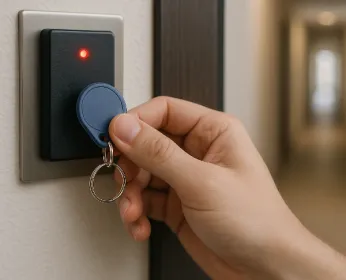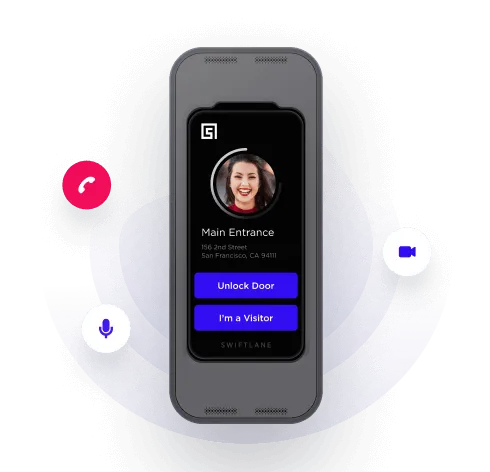
For most properties, the sticker price on a key fob system is only part of the actual cost. Estimating key fob entry system cost accurately means taking into account the operational burden that comes with managing these systems: fob replacements, staff time, on-site management requirements, and vendor lock-in. Over the life of the system, these recurring costs add up.
This guide covers the full cost structure of key fob entry systems, from per-door hardware pricing to long-term ownership costs, based on typical installer pricing and our own experience running multifamily deployments. It also addresses when a traditional fob system is still the right choice and when alternatives are likely to be more cost-effective.
Quick answer: On average in 2026, a multifamily key fob entry system costs around $1,500 to $5,000 per door installed for standard access points. High-traffic perimeter entrances that require electrified mortise locks, automatic door operators, or trenching run $5,000 to $6,000 or more per door.
2026 Upfront Cost Breakdown
| Component | Typical 2026 cost | Priced per | What drives the range |
| Reader hardware | $150 to $500 | Door | Legacy 125 kHz proximity reader (low end) vs. encrypted 13.56 MHz reader using Open Supervised Device Protocol (OSDP) (high end) |
| Locking hardware | $100 to $400 | Door | Electric strike or magnetic lock; electrified crash bar can cost beyond the cited range |
| Access controller | $200 to $800 | Door | Controller capacity and features |
| Fobs and credentials | $5 to $15 | Fob | Format and vendor (encrypted 13.56 MHz, bulk pricing) |
| Low-voltage installation labor | $1,000 to $3,000 | Door | Cabling, mounting, door prep, and commissioning |
| Cloud software subscription | $5 to $10 | Door, per month | Remote administration, audit logs, and mobile unlock |
Ranges are drawn from Swiftlane’s published 2026 cost guides. Labor runs higher in major metro markets, so expect somewhat lower costs in lower-cost-of-living regions. Electrified mortise locks, automatic door operators, and trenching aren’t itemized above; they account for the higher per-door tier.
How We Researched This
To create this guide, we reviewed installer pricing data, access control industry resources, manufacturer documentation, multifamily case studies, and the electrical and life safety codes that govern installation (NFPA 70, NFPA 101, and UL 294). We also incorporated operational insights from property managers and building operators who manage resident access, credential issuance, and system maintenance. Cost ranges reflect commonly reported market pricing, though actual costs vary based on building size, infrastructure requirements, system features, and local labor rates.
Key Takeaways
- Key fob entry system cost includes hardware, installation, software, and ongoing management, which are often not included in proposals.
- Recurring costs like fob replacement and administrative workload continue for the life of the system and belong in any budget.
- Modern alternatives like mobile and cloud-based systems can reduce operational burden, but they’re not always the best fit for every property. You can use the scenario table in this guide to understand when traditional key fob systems are the more cost-effective choice.
- Evaluate the total cost of ownership, not just the initial price, before deciding.
Table of Contents
- What Is the Average Key Fob Entry System Cost?
- The 5 Cost Drivers in Key Fob Entry Systems
- The Hidden Costs of Key Fob Entry Systems
- Key Fob Systems vs Modern Alternatives: Cost Comparison
- How to Budget for a Key Fob Entry System
- When a Key Fob System Makes Sense and When It Doesn’t
- Where Swiftlane Fits In
- Frequently Asked Questions
Related Posts
- What Is a Fob System and How to Choose One
- Commercial Key Fob Door Entry Systems: 2026 Buyer’s Guide
- Guide to Apartment Key Fob Systems
What Is the Average Key Fob Entry System Cost?
2026 Project Cost Examples
Most properties budget for a complete project, not individual parts. The three scenarios below show typical 2026 turnkey costs for common building types.
| Project type | Doors | Access points covered | Turnkey cost (2026) |
| Small commercial office | 2 | Front entrance and back or side entrance | $4,500 to $8,500 |
| Mid-rise multi-tenant building | 6 | Perimeter doors, amenity room, and parking vestibule | $14,000 to $26,000 |
| Large 100-unit multifamily property | 10+ | Exterior gates, lobby, package room, fitness center and other amenities, and roof deck, plus 200 fobs | $28,000+ |
Turnkey costs include hardware, installation, and commissioning. Cloud software subscriptions are billed separately; see the cost breakdown table above. Ranges reflect typical 2026 installer pricing, so expect somewhat lower costs in lower-cost-of-living regions.
Hardware Costs
Hardware covers three components at each door: the reader, the locking hardware, and the access controller. Fobs are priced separately because their number depends on how many residents you have, not how many doors.
Using the ranges in the cost breakdown table above, hardware alone typically runs $450 to $1,700 per door. What pushes a door toward the high end:
- Reader: Encrypted 13.56 MHz readers that support OSDP cost more than legacy 125 kHz proximity readers. Readers that also accept mobile credentials cost more still.
- Locking hardware: Electric strikes and magnetic locks fall within the cited range. Electrified crash bars and electrified mortise locks, common on high-traffic perimeter doors, cost more.
- Controller: Higher-capacity controllers with more features cost more.
For fobs, budget $5 to $15 each for encrypted 13.56 MHz fobs bought in bulk. A 100-unit property issuing 200 fobs would spend about $1,000 to $3,000..
Hardware is usually the smaller share of the per-door cost. Installation labor, covered next, often costs more than all the hardware at a door combined.
Installation Labor Costs
Installation labor is usually the largest single line item in a key fob project, at $1,000 to $3,000 per door (see the cost breakdown table above). Experienced installers typically bill $75 to $150 per hour. Much of that time goes to meeting electrical and life safety codes, not just mounting hardware.
Three standards shape most installations:
- NFPA 70, the National Electrical Code (NEC): Most access control wiring runs on Class 2 power-limited circuits. The NEC governs how those circuits are powered, cabled, and kept separate from higher-voltage wiring. Meeting those rules is part of what you pay a licensed integrator for.
- NFPA 101, the Life Safety Code: Doors along an exit route must still let people out freely, no matter what the access control system is doing. Magnetic locks on exit doors, for example, typically need a motion sensor on the egress side, a manual release button, and automatic unlocking when the fire alarm activates or power fails. Each requirement adds hardware and labor. Many jurisdictions enforce similar requirements through the International Building Code (IBC) instead.
- UL 294: This is UL’s safety and performance standard for access control system units. Building codes often require electrified locking systems on exit doors to be listed to UL 294, which can rule out cheaper unlisted hardware.
Older buildings usually cost more. The system itself isn’t the reason; the cost comes from the infrastructure work needed to bring wiring and door hardware up to code. Opening walls, running long cables, and trenching for gates or detached structures all add labor hours.
Code editions vary by jurisdiction, and the local authority having jurisdiction (AHJ) makes the final call on what’s required. Ask any integrator you’re considering which code editions apply to your building.
Software and Licensing
Cloud-based platforms typically charge a monthly fee per door (see the cost breakdown table above), but pricing models vary. Some platforms charge per door, while others charge per user or per unit. Per-user pricing can climb quickly in high-turnover buildings, so confirm the pricing model before comparing quotes.
On-premise systems work differently. They can charge a one-time license fee with no recurring subscription, but the property takes on server maintenance and manual updates.
The 5 Cost Drivers in Key Fob Entry Systems
Most budgets focus on equipment and installation. That’s a mistake.
In real deployments, cost is shaped by a few key decisions. These are the areas where budgets expand or stay under control.
1. Building Size and Door Count
More doors mean more hardware. That part is obvious.
What’s less obvious is how door count affects system complexity.
Each additional door adds:
- More wiring
- More configuration
- More points of failure
- More time spent managing access
A 20-door system isn’t just twice as expensive as a 10-door system. It’s often harder to manage.
We’ve observed that as door counts increase, property teams often spend disproportionately more time managing credentials and troubleshooting access issues.
That added complexity shows up in labor costs over time.
2. Wiring vs Wireless Infrastructure
Wired systems are common in traditional key fob setups. They’re reliable. But they’re also expensive to install and maintain.
Costs increase when:
- Walls need to be opened
- Conduits need to be installed
- Long cable runs are required
Wireless or cloud-based systems reduce this burden. They don’t eliminate cost, but they shift it away from physical infrastructure.
This is one of the biggest differences between older systems and modern ones.
3. Credential Management: Key Fobs vs Mobile Access
Key fobs seem simple. But they come with ongoing costs.
Every new resident needs a fob. Every lost fob needs to be replaced. Every deactivated fob requires manual updates.
Mobile credentials change the equation.
Instead of issuing physical devices, access is managed through an app. This reduces:
- Replacement costs
- Inventory tracking
- Administrative workload
We’ve seen that properties with higher resident turnover experience these administrative costs most acutely, as staff spend more time issuing and replacing physical credentials.
The more turnover your property has, the more this difference matters. Student housing is the clearest example, since most residents move out and in on the same academic calendar. Our guide to student housing access control covers how teams handle credential issuance at that scale.
4. Integration With Intercom and Video Systems
Many properties don’t stop at access control. They also need intercoms and video.
If your key fob system doesn’t integrate well, you end up with:
- Multiple vendors
- Separate systems
- Duplicate management workflows
This increases both cost and complexity. Integrated systems may cost more upfront. But they reduce friction in daily operations.
5. Vendor Support and Maintenance Model
Not all systems are supported the same way. Some require:
- On-site servicing for updates
- Manual troubleshooting
- Proprietary parts
Others offer remote diagnostics and updates.
The difference shows up in:
- Service call costs (typically $150 to $350 per visit, higher for emergency call-outs)
- Downtime
- Staff workload
A lower upfront cost often comes with meaningfully higher support and maintenance costs over the system’s lifetime.
The Hidden Costs of Key Fob Entry Systems
This is where budgets can break. The following costs are rarely included in proposals, but they show up quickly after deployment.
Fob Management Tax: What Lost Fobs Really Cost
Fob systems look inexpensive on paper, but the recurring labor behind them adds up. Think of it as a fob management tax: a steady annual cost that rarely appears in a vendor proposal.
Annual fob churn. Each year, 5% to 10% of fobs are lost, damaged, or not returned at move-out. In a 100-unit building with 200 active fobs, that’s 10 to 20 replacements a year.
True cost per replacement. Each lost fob event costs $35 to $50 once you add up:
- The replacement fob itself ($5 to $15)
- Staff time to program the new fob, deactivate the old one, and log the change (at roughly $25 per hour)
- Coordinating entry for a locked-out resident until the new fob is ready
The annual total. At 10 to 20 replacements × $35 to $50 each, a 100-unit building spends $350 to $1,000 a year on fob replacements. Over five years, that’s $1,750 to $5,000, and higher-turnover properties will spend more.
Fob Cloning and Unauthorized Copies
Legacy 125 kHz proximity fobs aren’t encrypted. A handheld RFID duplicator sold online can copy one in seconds, and some hardware store key-copying kiosks offer the same service.
A cloned fob carries the same credential as the original, so the access log records every entry under the original resident’s name. The property loses any reliable record of who actually came in. Once cloning is suspected, the only fix is to deactivate the affected credentials and reissue fobs. If cloning is widespread, the fix means replacing readers and credentials with encrypted technology.
Not every 13.56 MHz fob is safe, either. Older MIFARE Classic fobs rely on Crypto-1, an encryption scheme that has been broken, and can also be copied. When comparing quotes, ask for MIFARE DESFire EV2/EV3 or HID iCLASS SE credentials.
Rekeying vs Reprogramming Inefficiencies
Traditional locks require rekeying. Key fob systems use reprogramming.
But not all systems are easy to manage. Some require:
- On-site programming
- Dedicated hardware
- Manual syncing
If updates can’t be done remotely, staff must be physically present.
That adds time and cost.
On-Site Management Requirements
Many key fob systems aren’t fully cloud-based.
This means:
- Changes must be made on-site
- Access logs aren’t easily accessible remotely
- Troubleshooting requires physical presence
For property managers overseeing multiple buildings, this is a major inefficiency.
Time spent traveling is time not spent managing.
Vendor Lock-In
Some systems use proprietary hardware and software.
This limits flexibility.
You may be locked into:
- Specific vendors for parts
- Higher service costs
- Limited upgrade options
Switching systems later can mean starting from scratch. That’s a major financial consideration. Before purchasing, confirm whether the system uses standard Wiegand or OSDP protocols, which are more broadly compatible with alternative platforms.
Scalability Limitations
What works for a 50-unit building may not work for a 300-unit property.
As properties grow, limitations become clear:
- System slowdowns
- Limited user capacity
- Difficulty adding new doors or features
Upgrading later is often more expensive than choosing a scalable system from the start.
Real-World Example: Eliminating Fob Management at Scale
A 436-unit multifamily property, Gateway Park Apartments, faced ongoing challenges with a traditional key fob system.
Managing hundreds of fobs required constant staff time, while lost credentials, shared access codes, and frequent rekeying created recurring costs and security risks. Move-ins and vendor access often took hours to process.
After switching to Swiftlane, a cloud-based access control platform with mobile credentials, the property eliminated fob issuance and reduced administrative workload.
Access changes that once required on-site coordination could be handled remotely in seconds, lowering both time spent and long-term operational costs.
3- to 5-Year Total Cost Comparison: Key Fobs vs. Mobile Access
The upfront quote tells you what a system costs to install. A 3- to 5-year view tells you what it costs to run. Key fobs and mobile access differ most on the second number.
Key Fob Systems: Lower Upfront Cost, Higher Recurring Friction
Fob systems usually have the lower entry price. The readers are less expensive, and each fob costs only a few dollars. The costs show up later:
- Fob reorders: Lost, damaged, and unreturned fobs have to be replaced every year.
- On-site programming: Fobs are typically encoded at a desktop enrollment reader in the leasing office, so staff must be on-site to issue each one.
- Turnover work: Every move-in and move-out means collecting, deactivating, and issuing physical fobs.
As the fob management tax section above shows, replacements alone cost a 100-unit building roughly $350 to $1,000 a year, or $1,750 to $5,000 over five years.
Mobile-First Cloud Access: Slightly Higher Upfront Cost, Lower Recurring Cost
Mobile access usually costs slightly more upfront, because readers need Bluetooth Low Energy (BLE) or near-field communication (NFC) support. After installation, recurring costs drop:
- Near-zero credential replenishment: There’s no physical inventory to reorder.
- Remote issuance: Staff can grant or revoke access from anywhere, with no in-person handoff.
- Far fewer lost-credential service calls: When a resident loses a phone, staff revoke the credential remotely and reissue it to the new device.
| Key fob system | Mobile-first hybrid | |
| Upfront reader hardware | Lower | Slightly higher (BLE or NFC support required) |
| Credential replenishment | Recurring fob reorders | Near-zero; fobs only for backup users |
| Issuing access | In person, at an on-site programming station | Remote, from anywhere |
| Lost credential handling | Replacement fob, staff time, and lockout coordination | Remote revoke and reissue |
| Turnover workload | Collect, deactivate, and reissue fobs at every move | Revoke and issue digitally |
| 5-year fob replacement cost (100 units) | $1,750 to $5,000 | A fraction of that, limited to backup fob users |
Why the Best Setup Is Mobile-First With Fob Backup
Mobile access works for most residents, but not all of them. Some residents don’t carry smartphones or prefer not to use them for building entry. Phones also run out of battery at inconvenient times.
That’s why the most practical modern setup is mobile-first with fobs as a backup. Multi-technology readers accept both phones and encrypted fobs. The property can default every resident to mobile access and issue fobs only to those who need them. Fob inventory, replacement costs, and turnover work then shrink to a small share of residents instead of the whole building.
When comparing quotes, confirm that the readers support both mobile credentials and encrypted 13.56 MHz fobs, and ask whether the platform charges per mobile credential.
How to Budget for a Key Fob Entry System
A clear framework helps avoid surprises. Instead of focusing only on upfront cost, build a full cost model.
Step 1: Per-Door Budgeting
Start with the per-door ranges in the quick answer above: $1,500 to $5,000 for standard access points, and $5,000 to $6,000 or more for high-traffic perimeter entrances. Multiply by your total access points to set a baseline. These figures cover hardware, installation labor, wiring, controllers, and commissioning.
Step 2: Per-Unit or Per-Door Cost Estimation
Next, translate the system cost into either a per-unit or per-door figure for stakeholder discussions.
Example:
- 10-door system at $1,500 to $5,000 per door
- $15,000 to $50,000 total project cost
- For a 100-unit building: $150 to $500 per unit upfront
Properties with vehicle gates or many amenity doors will land higher; see the project cost examples above.
This framing helps owners and operators understand cost in terms of occupancy rather than infrastructure complexity.
We’ve found that per-unit budgeting is often easier for ownership groups and stakeholders to evaluate because it ties access control costs directly to the size of the property rather than the number of access points.
It also sets more accurate expectations: most mid-size apartment buildings have more access points than expected (main entrances, side doors, garages, and amenities), which drives total system cost higher than initial estimates.
Step 3: Add Operational Costs
Include ongoing expenses:
- Fob replacements
- Staff time for management
- Maintenance and service calls
- Software fees
These costs vary, but they’re real.
We’ve seen that properties frequently underestimate administrative costs because they focus on hardware and installation while overlooking the time required to issue credentials and handle access-related support requests.
Fob replacements alone run about $350 to $1,000 a year for a 100-unit building (see the fob management tax section above).
Software is another recurring cost. At $5 to $10 per door per month, a 10-door system adds about $600 to $1,200 per year.
That number increases with more doors, integrations, or premium features.
Ignoring these ongoing costs leads to underbudgeting, especially over a 3- to 5-year period.
Step 4: Project 3- to 5-Year Costs
Look beyond Year 1. See the 3- to 5-year cost comparison above for how recurring costs build over time.
Bottom line:
Numbers alone don’t tell the full story. The right system depends on how your property operates, including turnover, staffing, and how much control you need over access.
In some cases, traditional key fob systems are simple and cost-effective. In others, they create ongoing operational overhead that outweighs the upfront savings.
The next section breaks down when key fob systems make sense, and when it’s worth considering more modern alternatives.
When a Key Fob System Makes Sense and When It Doesn’t
Key fob systems still have a place. But they’re not ideal for every property.
| Scenario | Property Characteristics | Impact on Cost and Operations | Recommendation |
| Smaller Properties | Few units and limited access points | Lower hardware and installation costs. Minimal admin workload. Easier to manage fobs manually. | Good fit for key fob systems |
| Low turnover buildings | Residents stay long-term | Fewer fob replacements. Lower admin burden over time. Predictable costs. | Good fit for key fob systems |
| Limited need for integrations | No need for intercom, video, or remote access | Simple setup. Lower upfront cost. Fewer system dependencies. | Good fit for key fob systems |
| High-turnover multifamily properties | Frequent move-ins and move-outs | Constant fob issuance and replacement. Higher admin workload. Costs add up quickly. | Consider modern alternatives |
| Properties needing remote management | Multiple buildings or off-site management | On-site updates slow operations. Limited visibility. Increased staff time and travel. | Consider modern alternatives |
| Buildings upgrading to smart access ecosystems | Plans for mobile access, video intercoms, or integrations | Key fob systems create silos. Future upgrades become costly and complex. | Consider modern alternatives |
Where Swiftlane Fits In
The question isn’t just: How much does a key fob entry system cost? It’s: What will it cost to operate over time?
As outlined earlier, most multifamily properties budget $1,500 to $5,000 per door upfront, plus software fees, maintenance, and credential management for the life of the system.
In simpler scenarios like smaller buildings with low turnover and minimal integrations, key fob systems remain cost-effective and easy to manage.
But in higher-demand environments (high-turnover properties, remote management, or buildings planning for intercom and video), operational costs increase. Fob replacements, manual updates, and disconnected systems add ongoing overhead.
Swiftlane is built for these scenarios. By combining hardware, cloud-based management, mobile credentials, and video into one platform, it reduces administrative work and long-term costs.
For property managers focused on total cost of ownership, that difference becomes significant over time.
Explore how Swiftlane can streamline access management and reduce long-term costs.
FAQs
How much does a key fob entry system cost per door?
Typical hardware and installation costs range from $1,500 to $5,000 per door for standard access points, and $5,000 to $6,000 or more for high-traffic perimeter entrances.
Are there ongoing fees for key fob systems?
Yes. Some systems charge monthly software or cloud access fees, usually $5 to $10 per door. Maintenance and fob replacements are additional.
What drives the long-term cost of a key fob system?
Major cost drivers include fob replacement, administrative workload, on-site management, and vendor support. High turnover properties face the highest ongoing costs.
Can key fob systems be upgraded to mobile access?
Some systems allow retrofitting for mobile credentials. Others require replacing the full system. Compatibility should be checked before purchase.
How does building size affect cost?
More doors and units increase hardware, installation, and management costs. Larger properties also require more staff time to maintain access control.
When is a key fob system not cost-effective?
High-turnover buildings or properties needing remote management often face higher ongoing costs. In these cases, cloud-based or mobile-first systems are more efficient.
What should I ask a vendor before purchasing a key fob entry system?
Ask whether credentials can be issued and revoked remotely, whether the system uses standard protocols (Wiegand or OSDP) that preserve compatibility with future platforms, what the process is for firmware updates (remote or on-site), and what emergency support response time looks like. Also, confirm whether software fees are included in the quoted price or billed separately.
Can I install a key fob entry system in an older building?
Yes, but installation costs are often higher. Older properties may require electrical upgrades, new wiring, door hardware replacements, or other infrastructure work before the system can be installed.
How long do key fob entry systems typically last?
Most readers, controllers, and door hardware last 7 to 15 years with proper maintenance. However, software platforms, credentials, and security requirements may require upgrades before the hardware reaches end of life.
Are mobile access systems more expensive than key fob systems?
Not always. Mobile access systems often have software subscription fees, but they can reduce costs associated with issuing, replacing, and managing physical credentials. For high-turnover properties, the total cost of ownership may be lower over time.