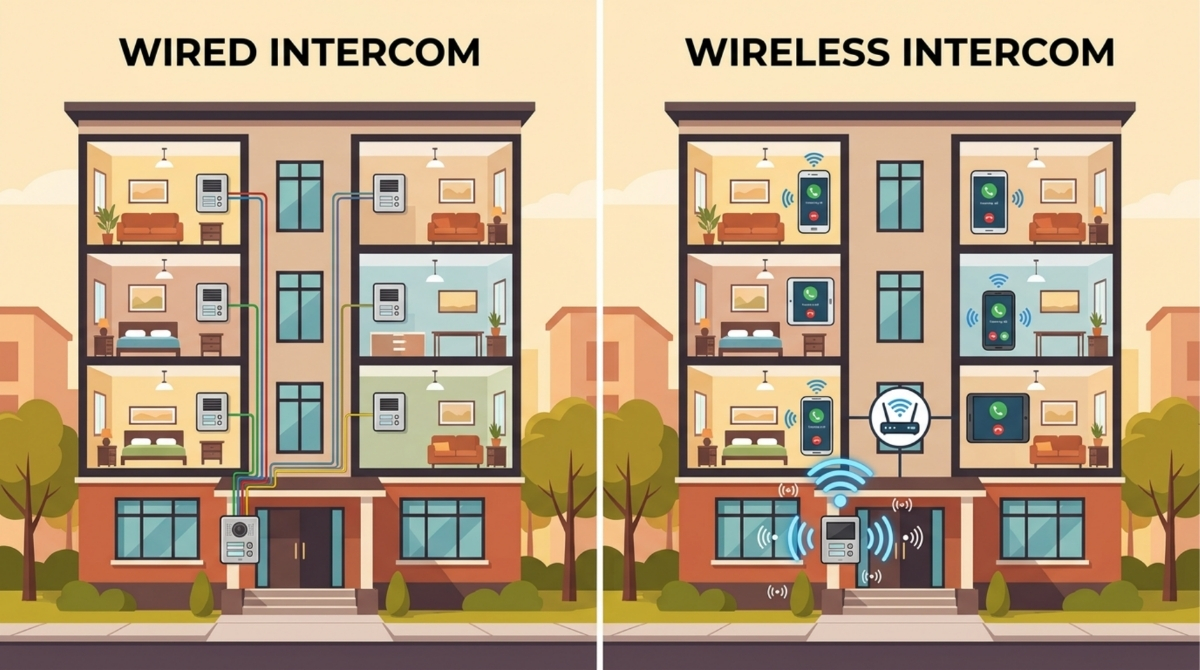
Choosing between a wired and wireless intercom system becomes a challenge when you don’t understand their distinctions. They are both reliable intercom designs for communication and access control today. But when do you use each of them?
Wired and wireless systems are intercom systems that help property managers and owners control access to their properties and allow tenants to speak with visitors.
Drawing from Swiftlane’s firsthand experience supporting thousands of residential and commercial properties, the simple explainer below is aimed to help property managers and owners differentiate between a wired and wireless intercom. Once you have a better understanding of how these systems compare, you can start determining which intercom type is best for your property.
Key Takeaways
- Wired intercom systems require fixed telephone or dedicated copper lines going from the main intercom devices to in-unit intercom devices. This requirement impacts installation times, tenant disruptions, and costs.
- Wireless intercom systems do not require fixed wiring for communication, relying instead on internet connections via PoE, Wi-Fi, or cellular. This lack of fixed wiring results in fast deployments, minimal tenant disruptions, and lower overall prices over time.
- Property managers and owners should choose between a wired and wireless intercom based on their building conditions, operational needs, and deployment expectations. Wired and wireless intercoms work best when their designs match the requirements of the places where they deploy.
Table of Contents: Quick Navigation
- What Makes an Intercom “Wired” or “Wireless”?
- 8 Key Differences Explained: Wired vs Wireless Intercom System
- Choosing between Wired and Wireless Intercom Systems
- Where They Work Best
- Swiftlane: Your Wireless Intercom Systems Provider
What Makes an Intercom “Wired” or “Wireless”?
The terms “wired” and “wireless” when describing intercoms refer only to how in-unit devices connect to the main intercom device. It does not mean the intercom uses no wires at all—power wiring may still be required.
At a glance:
- Wired intercoms use physical telephone or copper lines that connect the central intercom panel to in-unit devices in a residential or commercial property.
- Wireless intercoms do not use any fixed wiring to connect with in-unit devices, instead relying on Wi-Fi, cellular, or Power over Ethernet for internet connectivity.
Wired Intercom System
Wired intercom systems consist of main intercom devices at entrances. Each of these main devices connects with every in-unit device in a residential or commercial building using fixed copper wiring.
The copper wiring can be traditional telephone lines or dedicated low-voltage cabling. When visitors call, either in-unit devices or regular landline telephones receive the call and ring.
Wireless Intercom System
In contrast, wireless intercom systems still have intercom devices at entrances, but without the fixed wiring to in-unit devices. They still require wiring for power, and some systems may also require Ethernet cabling.
Wireless intercoms instead use internet connections via Power over Ethernet (PoE), Wi-Fi, or cellular to facilitate direct calls to wireless in-unit devices or smartphones. Because of this kind of connectivity, some wireless offerings support video calling.
8 Key Differences Explained: Wired vs Wireless Intercom System
At the very core, wired and wireless intercom systems both support communication and access control. However, they differ in their underlying architecture and operational characteristics. Here are eight differences between wired and wireless intercom systems.
Infrastructure Requirements
The primary difference between a wired and wireless intercom system is the wiring between in-unit devices and intercom devices. This means that the infrastructure that needs to be installed for a wired intercom is vastly different from that of a wireless intercom.
Wired systems require fixed wiring pathways throughout the building. These wires can be installed behind walls or ceilings, or through conduits.
Wireless systems eliminate the need for such extensive wiring. A wireless intercom needs a power supply and an internet connection. Apart from those, it doesn’t need any other wiring.
In sum:
- Wired intercoms = fixed wiring building-wide
- Wireless intercoms = minimal wiring only for power and internet connections
Installation Complexity and Disruption
The wiring infrastructure of an intercom is crucial because it impacts installation complexity. The more complex an installation is, the more tenant disruptions can be expected.
Due to the fixed wiring of wired intercoms, they typically require more invasive installations, resulting in opening walls or ceilings. If you pass the lines through conduits, the conduits still need to be fixed on the ceiling. At the same time, tenant and visitor activity are heavily disrupted because entry points may be closed for some time.
However, if you go with wireless intercoms, they tend to be faster to install with zero to minimal tenant disruptions. They don’t need extensive installation within walls, except where the intercom devices are supposed to be.
In sum:
- Wired intercoms = longer deployment times, more tenant disruptions
- Wireless intercoms = faster deployments, minimal tenant disruptions
Connectivity
Connectivity refers to the kinds of connections used by intercoms to facilitate communication between tenants and visitors.
Wired intercoms rely on traditional telephone lines or dedicated copper wiring to send signals to regular telephones or in-unit devices.
Wireless intercoms use internet connections—via Wi-Fi, PoE, or cellular—to call tenants’ smartphones directly.
In sum:
- Wired intercoms = telephone or dedicated copper lines
- Wireless intercoms = cellular, PoE, or Wi-Fi connections
Performance Consistency
The kind of connectivity that wired or wireless intercom systems have affects the reliability of communication through these systems.
Wired systems have very consistent performance because communication travels over fixed physical wiring. Audio quality is loud and clear, unless the physical lines are damaged or the intercom needs repairs.
On the other hand, the performance of wireless systems vary depending on what kind of internet connectivity they use. Wi-Fi-based systems can be affected by internet outages, whereas wireless intercoms with PoE or cellular connectivity work seamlessly, even during power and internet losses.
In sum:
- Wired intercoms = consistent communication performance, except during power outages
- Wireless intercoms = PoE and cellular systems work during power and internet losses, while Wi-Fi systems are vulnerable to internet outages
Device Durability
Intercom systems can be damaged by the weather or vandalism. In these cases, the damage can affect connectivity and performance.
Although main intercom panels for wired systems can be protected against weather and vandalism, the fixed wiring throughout the building can be severed or damaged. Weather, vandalism, or accidents can damage or cut wiring, reducing communication capabilities.
Intercom devices of wireless systems can similarly come with IP (weather resistance) and IK (vandalism resistance) ratings, but no wiring is vulnerable. Because wireless systems don’t need physical lines, communication issues will not be affected by external damage.
In sum:
- Wired intercoms = durable main panels but vulnerable wiring
- Wireless intercoms = IP- and IK-rated intercom devices, no vulnerable wiring
Maintenance and Long-Term Support
Whether or not an intercom system uses fixed wiring also ties into maintenance and ongoing support expectations.
Wired intercoms usually require frequent on-site service calls for system configuration or damage to their main panels or telephone lines, which means response and repair times. These can delay intercom usage and leave tenants open to security threats.
Wireless intercoms usually require only software updates, which are provided via remote support. Property managers or owners can also troubleshoot intercom issues with remote support. If on-site service calls are needed, they are done only very occasionally.
In sum:
- Wired intercoms = frequent on-site service calls, response and repair times delay intercom usage
- Wireless intercoms = software updates and troubleshooting can be done remotely with support teams, rare on-site servicing
Flexibility and Ease of Expansion
If you plan to add more doors, reduce accessible entry points, or make any other changes to your building, the kind of intercom system in your building affects the possibility of those changes.
Wired intercoms are often difficult to modify once installed. Adding or reducing entry points means installation projects that disrupt tenant activities and restrict access points again.
Wireless intercoms are more flexible to future changes, making them expansion-ready. You only have to install or remove intercom devices from doors, and then you can connect or disconnect such devices to the overall system.
The flexibility of wireless intercoms even works across properties in a portfolio. Many wireless intercoms allow you to manage several properties and devices from a single interface on your laptop or smartphone.
In sum:
- Wired intercoms = difficult to modify for future access changes
- Wireless intercoms = easy to modify with a single interface for future changes and portfolio expansions
Pricing and Ongoing Costs
All of the differences outlined above affect the upfront prices and ongoing costs of wired and wireless intercom systems.
Wired intercom systems require fixed wiring and frequent on-site service calls. So, upfront prices increase as more main intercom and in-unit devices are installed.
For example, based on apartment intercom installation cost estimates, a wired intercom will be priced around $800 to $3,000 for the hardware, $1,000 to $3,000 for installation, and $20 to $50 per month for ongoing maintenance.
Meanwhile, wireless intercom systems require no fixed wiring, have faster deployment times, are less invasive, and need minimal on-site maintenance. So, these systems may have quite high upfront prices for their hardware due to advanced features, but total cost of ownership is reasonable.
Again, drawing from the same estimates, a wireless intercom can cost around $1,000 to $2,500 for the hardware, $1,000 to $2,000 for installation, and $30 to $300 for monthly software subscription fees, but no maintenance.
Quick Overview: Key Differences


Choosing between Wired and Wireless Intercom Systems
Choosing between a wired and wireless intercom is about which system fits your building’s needs—not which option is “better,” since wired systems are still viable for certain use cases. So, you have to look at the practical considerations of an intercom offering in relation to your property.
Here are ways you can decide which system fits better.
Consider Building Conditions
Think about the size of your building, and take note if you are upgrading from a wired intercom system.
Smaller buildings with a limited budget can do well with a new wired intercom. Installation can make use of old wiring, where appropriate, to drive down costs and deployment times.
However, wireless intercoms can also be good for small residential or commercial properties, as well as large properties. Wireless intercoms offer faster deployment times and smaller overall costs over a long period of time due to no maintenance fees.
Map Out the Deployment
Imagine and project what the installation will be like with a wired or wireless intercom. Wired intercom systems bring the risk of heavy tenant disruptions and access restrictions. Meanwhile, wireless intercom systems mean minimal disruptions due to fast installation times.
Both residential and commercial properties prioritize minimal installation impact, unless your building is a completely new construction with empty units for now.
Expect Future Changes
Buildings change as time passes, so you have to expect future renovations, unit reconfigurations, and operational adjustments based on tenant behavior.
Wired intercoms are largely fixed once installed. You will have little room for changes, unless you upgrade to a wireless system.
Wireless intercom systems adapt easily to changes. Regardless of any future renovations you undergo, wireless systems change with you.
Think about Daily Operations and Ongoing Maintenance
Daily workflows will be based on the kind of intercom system you deploy. So, you have to think about the welfare of your tenants.
Wired intercom systems are largely reliable in small properties, but what do you do when you need to troubleshoot the system or make repairs? On-site servicing can bring disruptions to the building again.
Wireless intercom systems make it easier for property managers or owners by offering remote support for software updates and troubleshooting. Tenants can continue with their daily activities with no building restrictions.
Where They Work Best
If the right kind of intercom system is not yet clear to you, then you can check out our list of properties where wired and wireless intercoms work best. From my direct experience working with the Swiftlane team, which supports thousands of residential and commercial buildings, we’ve identified which properties benefit most from each type of intercom.
Wired Intercoms
Small and old multifamily apartment buildings with existing telephone or copper wiring can sufficiently operate with a retrofitted wired intercom system.
Small single-family houses can also save on costs while gaining basic intercom communication with wired intercom systems.
Wireless Intercoms
Small to large multi-unit residential, commercial, or office buildings work best with wireless intercom systems. Whether you have a new unoccupied construction or an occupied building, installing a wireless intercom minimizes the disruption impact. You also keep yourself open to any future changes with a future-ready wireless intercom.
Swiftlane: Your Wireless Intercom Systems Provider


Swiftlane offers a wireless intercom system that justifies the shift from a wired intercom system. Aside from the differences mentioned above, Swiftlane provides a wide array of security and verification features for small to large apartment buildings and businesses.
Residents have various frictionless entry options, such as mobile credentials and top-of-class face recognition. Residents can also speak with visitors via their smartphone through stable video calling.
Wired and wireless intercoms have very contrasting differences that make them useful for very specific applications. The fixed wiring of wired systems is often too expensive to install and maintain, and restrictive as buildings evolve. However, you can save on cost and time, and foster more satisfied tenants with wireless intercoms.
Give us a call at 833-607-9438, and our team will be happy to assist you with any intercom questions you have or provide you with a quick quote for your building. We’re here to help!