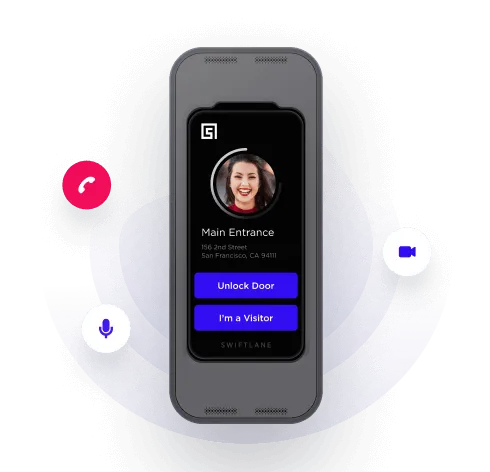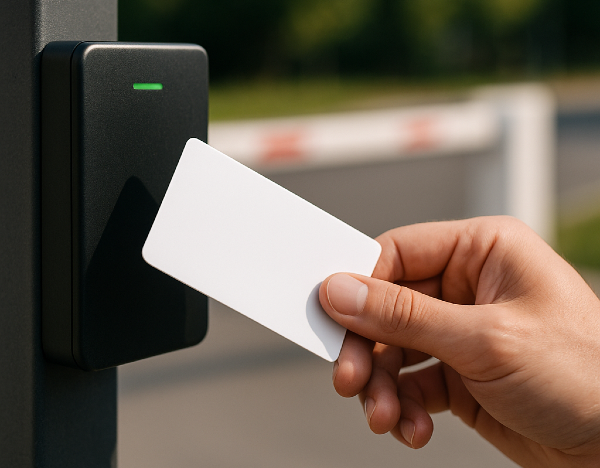
An RFID gate access control system is a security solution that uses radio frequency identification (RFID) technology to automatically verify credentials and grant or deny access at gated entry points. Users can carry RFID-enabled cards, key fobs, or vehicle tags that are scanned by a reader when approaching the gate. If the credential is authorized, the system triggers the gate to open without manual intervention.
The gate at the entrance is both a security checkpoint and a bottleneck. In many residential and commercial properties, outdated lock-and-key or manual gate systems are creating friction for residents, staff, and visitors.
That’s why many property managers are upgrading to automated access systems that improve flow without sacrificing control.
These systems can grant access to residents, employees, or delivery drivers without requiring staff to manually approve every entry. They reduce administrative workload while improving consistency and visibility across the property.
Through numerous deployments and collaborations with property managers, Swiftlane has seen how RFID gate systems perform in real-world environments and where they tend to succeed or fall short. This guide walks through use cases, benefits, and key considerations before implementation.
How We Researched This
This guide is based on Swiftlane’s experience deploying and supporting access control systems across 3,000+ multifamily, commercial, and mixed-use properties annually. It also draws on common implementation challenges we’ve seen with property managers, including credential management, gate operations, visitor access, and system scalability.
Rather than focusing only on product features, we emphasize the operational considerations that matter when evaluating an RFID gate access control system for real-world use.
Key Takeaways
- An RFID gate access control system allows people or their cars to enter gated areas automatically without using traditional keys.
- RFID systems can integrate with cameras or intercoms to allow visual verification of visitors.
- By automating gate systems, you can reduce staffing for gatehouses and make your operations more efficient.
- Using a cloud-based platform, you can access entry logs in real time and issue or disable credentials remotely.
- Easy to scale, RFID systems can integrate with emerging technologies such as mobile access and multi-factor authentication.
Table of Contents
- What Is an RFID Gate Access Control System?
- How RFID Works in Gate Entry Systems
- Benefits of RFID Gate Access Control Systems
- RFID Gate Systems to Consider
- Compatible Gates Types for RFID Integration
- Implementation and Maintenance Tips
- Real-World Use Cases
- Cost Considerations
- Integrating RFID with a Centralized Access Control Platform
- RFID Gate Access Control System Comparison
- Consider Swiftlane When Upgrading Your RFID Gate Entry System
- FAQs
Related Posts
- What Is an RFID Access Control System?
- Gate Security Systems: A Complete Guide
- Residential Gate Access Control Systems
What Is an RFID Gate Access Control System?
An RFID gate access control system is a type of automated entry solution that uses radio frequency identification (RFID) technology to control who can enter or exit a property.
Instead of relying on physical keys, gate attendants, or manual checks, access is granted through secure digital credentials.
These credentials can take several forms, including key fobs, access cards, or vehicle-mounted tags. The system verifies the credentials and allows approved individuals or vehicles to pass through the gate.
RFID gate systems are commonly used in gated communities, commercial properties, office parks, industrial sites, and parking facilities where controlled, efficient entry is essential.
Active vs. Passive RFID Tags
Property managers will encounter two types of RFID tags.
- Passive tags don’t have their own power source and work at close range, such as tapping a fob or key card near a reader. They’re cost-effective and commonly used for pedestrian access.
- Active tags contain a small battery and transmit over a longer range, making them ideal for hands-free vehicle entry in higher-traffic environments.
The right option depends on your property’s traffic flow, security priorities, and operational goals.
How RFID Works in Gate Entry Systems


Every RFID system consists of tags, cards, or fobs, and readers. The tag carries a unique electronic identifier, which a reader detects within a certain range. When the system verifies the ID as authorized, it tells the gate to unlock.
One important consideration in RFID gate systems is the difference between legacy low-frequency credentials and modern encrypted systems.
Older 125kHz RFID technologies, such as basic HID Prox cards, are more vulnerable to cloning because they transmit a static identifier that can be copied with inexpensive tools.
In contrast, modern encrypted credentials, such as MIFARE DESFire, use encrypted communication and mutual authentication, making them harder to replicate or spoof.
Not every 13.56MHz credential offers the same level of protection, so it’s important to evaluate the credential technology rather than the operating frequency alone.
For property managers, this distinction has a direct impact on real-world security, especially in high-traffic environments where credential loss or cloning risk is higher.
When evaluating an RFID gate system, don’t focus on the reader alone. Credential security, support for modern encrypted credentials, and a clear migration path away from legacy technologies are often just as important for long-term security and flexibility. HID Global’s guidance on credential modernization emphasizes upgrading from legacy, unencrypted credentials to secure smart card and mobile credential technologies rather than simply replacing reader hardware.
RFID can work for both people and vehicles. Some systems use handheld key fobs or cards, while others integrate with windshield tags for hands-free vehicle access.
Most modern RFID entry systems also connect to a cloud-based platform that allows property managers to activate or deactivate access remotely.
RFID combines security and convenience in a way that older systems can’t match. Residents no longer need to fumble with physical keys, and staff no longer have to manually approve each visitor at the gate. Instead, you get a centralized view of who’s entering and exiting the property.
Benefits of RFID Gate Access Control Systems

RFID gate entry systems can help solve real-world challenges that property management offices face daily. Here are the biggest advantages:
1. Streamlined Access
RFID tech makes access automatic and quick. No more long lines at the gate entrance. No more waiting for the security guard to verify a visitor’s ID.
Users can just tap or present their key fobs or experience quick vehicle access via RFID-enabled tags.
As for deliveries and contractors, they can be granted temporary access remotely without having to wait for staff to manually give them access at the gate.
2. Enhanced Security
With RFID systems, you can ensure that only authorized credentials can open the gate. Lost or stolen key fobs or cards can be revoked instantly.
Many systems can also integrate with video intercoms or cameras. You can visually verify visitors and grant them access without leaving your office.
Modern access control systems also need to account for data privacy and credential security as part of their design. Industry guidance from the Security Industry Association (SIA) emphasizes principles such as encryption, multi-factor authentication, role-based access control, and audit logging as foundational elements of secure access systems. It also highlights the importance of limiting access to sensitive data and maintaining visibility into who’s entering a facility and when, especially in systems that manage identity credentials at scale.
3. Efficiency in Operations
It’s time-consuming, not to mention labor-intensive, to manage access manually. It’s not easy manning gatehouses 24 hours a day, seven days a week.
But with an automated RFID gate system, you can eliminate the need for your staff to manually check credentials. This efficiency is particularly valuable when managing multiple properties or sites with more than one gate entrance.
The Real Estate Technology Alliance (RETA) Access Control and Credentials Workgroup notes that next-generation access solutions (including keyless entry, biometric authentication, and cloud-based access management) can reduce the administrative burden of managing keys and locks, improve the experience for residents and visitors, and provide more transparent audit trails.
4. Audit Trails
Because RFID systems automatically log entries and exits, they create an audit trail you can reference when resolving disputes or investigating security incidents. You can see who accessed which entrance and when, without relying on traditional logbooks.
5. Scalability
You can add or remove users quickly. Plus, the system can accommodate different access levels for residents, staff, visitors, and vendors. You can even integrate vehicle and pedestrian access into the same platform.
RFID Gate Systems to Consider
Not all RFID gate access systems are built the same. The right solution depends on your property’s gate hardware, traffic patterns, and how you plan to manage access across one or more entrances.
1. Standalone RFID Gate Systems
These systems control a single gate using a local controller and RFID reader. They work well for smaller properties with basic access requirements but may offer limited remote management and reporting capabilities.
2. RFID Systems Integrated with Automated Gate Operators
Many properties pair RFID readers with automated gate operators, such as sliding gates, swing gates, or barrier arms. This allows authorized vehicles or pedestrians to enter automatically while maintaining reliable control over gate movement and access permissions.
3. Cloud-Managed RFID Gate Systems
Cloud-managed systems connect gate hardware to a centralized management platform. Property managers can remotely issue or revoke credentials, monitor access activity in real time, generate audit reports, and manage multiple gates or properties from a single dashboard.
Compatible Gate Types for RFID Integration
The physical gate itself still plays a key role. Here’s a quick guide on the different gate types and their best use cases:
| Gate Type | Best Use Case | Benefits |
| Swinging Gates | Multifamily properties with low traffic | Provides easy access for people or cars with minimal setup |
| Sliding Gates | Commercial complexes, especially high-traffic ones | Works seamlessly with RFID readers for vehicles and pedestrians |
| Barrier Arms | Parking lots or campuses | Automatically opens for authorized users, controlling vehicle flow efficiently |
| Vertical Lift or Crash-Rated Gates | High-security areas (government buildings, industrial sites, or VIP estates) | Combining the convenience of RFID with high security |
| Pedestrian Gates (ADA-compliant) | Properties where residents or visitors have mobility challenges | Grants automated entry while meeting accessibility standards |
Gate Safety and Emergency Access
Installing an RFID reader is only one part of an automated gate system. Property managers should also verify that the gate complies with applicable safety standards and local building and fire codes, including requirements for entrapment protection and emergency egress.
It’s equally important to plan for emergency access and power outages. Depending on the property’s requirements and local code, the gate may need battery backup, emergency override devices, or fail-safe/fail-secure operation so authorized personnel and first responders can access the property when needed.
Pro tip: Before selecting an RFID gate system, ask your installer how the gate behaves during a power outage, how emergency responders access the property, and which safety standards and local fire codes apply to your installation. These considerations are often overlooked during purchasing but can affect both compliance and long-term operation.
Implementation and Maintenance Tips
Implementation is not just about mounting readers. You also need to account for the software setup and ongoing maintenance.
- Professional installation. You should choose providers with experience in both gates and RFID systems. If you’re planning to integrate with video intercoms, cloud platforms, and other building controls, get somebody with specialized expertise.
- Remote management. Choose systems with cloud-based platforms to be able to manage credentials, monitor activity, and troubleshoot issues remotely. This is particularly important when you’re managing multiple sites.
- Maintenance. Regularly inspect gate motors, sensors, and RFID readers to prevent downtime. With cloud-based systems, you can get alerts for technical issues.
- User education. Provide instructions to residents, staff, and vendors on how to use RFID credentials properly.
Real-World Use Cases
Residential Communities
Residential properties often deal with visitor traffic, delivery drivers, and unauthorized entry. RFID streamlines access for residents while giving you control over temporary visitor credentials. When you integrate it with video intercom systems, your residents can visually verify visitors for you.
Example: At Aviara Apartments in San Jose, a legacy gate and entry system relied on shared access codes that could be passed from one person to another, limiting visibility into who was entering the property. After upgrading to a modern access platform with vehicle gate access and one-time visitor credentials, the property team gained detailed access logs and better control over guest entry while simplifying access for residents.
Commercial Properties

Multiple gates are common among offices, mixed-use buildings, and warehouses. With RFID, you can streamline and manage access for employees, clients, and delivery trucks. You can take it a step further with cloud-based dashboards, which allow real-time tracking of entry and exit activity.
High-Security Facilities
You can pair RFID with video verification or biometrics for high-security buildings. This adds an extra layer of identity confirmation before access is granted, especially in environments where unauthorized entry carries a higher risk. In many cases, RFID is used for convenience at the gate, while secondary authentication handles higher-security checkpoints or restricted areas.
Cost Considerations
RFID Gate Access Control System Cost by Property Size
Note: The estimates below assume a complete RFID gate access control project, including access control hardware, professional installation, and software where applicable. Costs can be lower when upgrading an existing automated gate rather than installing new gate hardware.
| Property Type | Typical Setup | Estimated Total Cost Range | What’s Included | Key Cost Drivers |
| Small Residential Community (1 to 50 units) | Single gate, basic RFID fob or card system | $6,000 to $12,000 | RFID reader, basic gate hardware, fobs or cards, simple controller | Gate type, installation complexity, number of users |
| Mid-Size Multifamily / HOA (50 to 300 units) | Multiple gates, mixed pedestrian + vehicle access | $10,000 to $50,000 | Cloud-based access control, RFID + vehicle tags, optional video intercom integration | Number of access points, wiring or trenching, cloud software features |
| Large Residential / Mixed-Use Property | Multi-gate system with centralized management | $50,000 to $150,000+ | Full cloud platform, RFID + mobile credentials, visitor management, audit logs, integrations | System scale, integrations, and multi-building coordination |
| Commercial Campus / Industrial Site | High-traffic, layered access control | $100,000 to $500,000+ | Enterprise-grade access control, advanced authentication, multi-site management, and security integrations | Security level, compliance requirements, enterprise integration complexity |
These ranges vary depending on gate hardware, number of entry points, and whether the system is standalone or part of a centralized cloud platform.
Cost considerations shouldn’t only apply to hardware costs. You should also look into installation, software, and even long-term management.
- Gate hardware. If you’re installing a new automated gate, the gate itself often represents one of the largest project costs. Automated sliding, swing, or ornamental gates commonly range from $3,000 to more than $10,000, depending on size, materials, and operator requirements.
- RFID readers and tags. RFID readers typically range from $300 to $1,500 depending on their capabilities and credential technology. RFID key cards and fobs are generally inexpensive, while long-range vehicle tags often cost $50 to $200 per tag.
- Advanced systems. Smartphone-based access, cloud integration, and video intercoms generally cost $1,500 to over $10,000. The total pricing can vary depending on scale and features.
- Installation. Professional installation typically adds $500 to $5,000, depending on wiring, trenching, and gate integration.
- Maintenance and software. Cloud platforms often charge $10 to $100 a month, with annual maintenance ranging from $200 to $2,000.
Remember, costs may vary depending on how many gates you’re maintaining or how big your property is (the bigger, the more wiring is needed). If you want higher security, you may need to pay more for premium features or additional capabilities.
Integrating RFID with a Centralized Access Control Platform
RFID technology is highly effective for gate entry, but it becomes even more powerful when integrated into a centralized access control platform.
Here are the benefits:
- Support for multiple credentials. You get a system that can handle RFID cards, key fobs, mobile apps, and biometric systems, including those with facial recognition.
- Scalability. It will be easier for you to expand access control as your properties grow without replacing hardware.
- Cloud-based management. Using a single centralized dashboard, you can monitor traffic patterns, generate detailed reports, and update access rights remotely.
- Future-proofing. By integrating RFID with a unified access control solution, you can make sure your property stays flexible as access trends evolve.
RFID Gate Access Control System Comparison
Different RFID gate access control systems vary in how they handle credentials, cloud management, and gate hardware integration. Here’s a side-by-side comparison to help property managers evaluate options.
| System / Vendor | Best Fit Use Case | Core Strength | Limitations | Cloud / Remote Management | Mobile Credentials | RFID Gate Support | Typical Buyer Profile |
| HID Global | Enterprise security systems, corporate campuses, government facilities | Strong credential technology and secure identity management infrastructure | Requires integration with third-party gate hardware / software | Limited (depends on partner ecosystem) | Yes (via ecosystem apps) | Yes (via integrations) | Enterprise IT / security teams managing complex identity systems |
| LiftMaster (myQ Access) | Residential communities and gated properties focused on vehicle access | Strong gate operator hardware and vehicle gate automation | More hardware-centric; limited unified access control across doors + gates | Yes (cloud for gate operators) | Limited (varies by setup) | Yes (strong focus on gates) | HOAs, residential communities, parking-focused properties |
| Swiftlane | Multifamily, mixed-use, commercial properties needing unified access control | Combines RFID, mobile access, video intercom, and centralized cloud management in one platform | Requires full system adoption for maximum value | Yes (full cloud platform) | Yes | Yes (integrated) | Property managers are modernizing across multiple entry points |
| DoorKing (DKS) | Traditional gated communities and commercial gate systems | Reliable gate hardware and long-standing presence in access control | Legacy-first system; less modern cloud-native functionality | Limited (on-premise or hybrid, depending on setup) | Limited | Yes (hardware strong) | Properties with existing DoorKing infrastructure |
| Legacy RFID Standalone Systems | Small sites or simple gated entries | Low upfront cost and simple installation | No centralized management, weak audit trails, and limited scalability | No / minimal | Rare | Yes (basic) | Small properties with a single gate need |
Consider Swiftlane When Upgrading Your RFID Gate Entry System
To maximise the benefits of RFID gate entry systems, integrate them with Swiftlane’s modern, centralized access control platform:
- Swiftlane’s platform can support RFID, mobile apps, and key fobs
- You can monitor all gates, doors, and entry points from one cloud-based dashboard
- With remote management, you can easily manage access across one or multiple properties
- Your residents can enjoy a secure, user-friendly access experience, which can increase tenant retention
If you’re ready to upgrade your current gate access setup, connect with the Swiftlane team to see how a centralized access control platform can enhance security while simplifying property management.
FAQs
What is an RFID gate access control system?
An RFID gate access control system uses radio frequency identification technology to verify credentials and automatically open a gate for authorized users. Depending on the setup, credentials may include key fobs, access cards, or vehicle tags.
Can RFID gate systems work for both vehicles and pedestrians?
Yes. Many properties use RFID readers at vehicle entrances while also installing readers at pedestrian gates or doors. Both can be managed through the same access control platform.
Are RFID gate systems secure?
When properly configured, RFID systems provide strong control over who can enter a property. Security can be improved further by using encrypted credentials and integrating the system with cameras, video intercoms, or other verification methods.
What’s the difference between active and passive RFID tags?
Passive tags don’t have their own power source and require close-range scanning. Active tags contain a battery and can be detected from much farther away, making them a good fit for hands-free vehicle entry.
Can I deactivate a lost or stolen RFID credential?
In most modern systems, yes. Administrators can disable a lost credential without replacing readers or changing locks, then issue a new credential to the user.
Can RFID gate access be managed remotely?
Many cloud-based systems allow administrators to add users, revoke credentials, review activity logs, and monitor access events from a web dashboard or mobile device. This can be especially useful for organizations managing multiple locations.
How much does an RFID gate access control system cost?
The total cost depends on factors such as the gate hardware, RFID readers, credentials, installation complexity, and software features. Larger properties or those with multiple entry points may require a bigger investment.
Can RFID integrate with other security systems?
Yes. RFID gate access is often combined with video intercoms, surveillance cameras, mobile credentials, visitor management tools, and centralized access control platforms to create a more complete security solution.
Is RFID a good choice for apartment communities and HOAs?
For many residential properties, RFID offers a convenient way to manage resident and vehicle access while reducing manual gate operations. It can also simplify credential updates when tenants move in or out.
How long does it take to install an RFID gate access control system?
The timeline varies based on the property’s existing infrastructure and the complexity of the project. A straightforward upgrade may be completed relatively quickly, while new construction or multi-gate deployments often take longer due to wiring, integration, and testing.