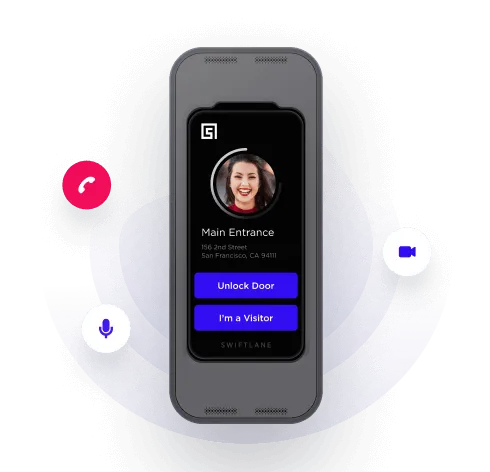
The best wireless intercom system for apartment buildings is a cloud-based video intercom with mobile app unlock, remote management, visitor PINs, and backup connectivity. For multifamily portfolios, Swiftlane is the best fit when you need intercom, mobile access, and centralized access control in one platform. For other properties, the right choice depends on building size, retrofit constraints, resident experience, and total cost of ownership (TCO).
Wireless apartment intercom systems can replace legacy call boxes and in-unit intercom stations with mobile-first access, video calling, and centralized management. But “wireless” doesn’t necessarily mean the entrance device needs no wiring: many systems still require power and may use Ethernet, Wi-Fi, or cellular connectivity.
This guide compares nine apartment intercom vendors based on connectivity and reliability, credential management, installation requirements, resident experience, security and compliance, cloud management, visitor access, backup connectivity, and pricing. We also consider how each system fits different property types and retrofit conditions so property managers can narrow their options based on their building’s specific requirements.
How We Evaluated These Systems
We evaluated these wireless intercom systems based on the factors that most directly affect apartment property managers and residents: connectivity and reliability, mobile and physical credential options, installation and retrofit requirements, resident and visitor experience, security controls, cloud management, backup connectivity, and TCO. We also considered the types of properties each system is best suited for, including multifamily communities, condos, high-rises, and smaller residential buildings. Where capabilities vary by model, configuration, or software plan, readers should confirm the specifications for the exact system being quoted.
Key Takeaways
- Wireless intercom systems are usually the best choice for apartment buildings because of their ease of installation, tighter management controls, and fewer long-term operational issues.
- Determining the best wireless intercom involves evaluating connectivity, reliability, credential management, installation complexity, resident experience, security and compliance, and total cost of ownership.
- Three of the top wireless intercom systems for apartments in 2026 include Swiftlane, 2N, and DoorBird.
- What is a Wireless Intercom System?
- Best Wireless Intercom System for Apartment Building Retrofits
- Which Apartment Intercom Systems Are Easiest to Install?
- Wireless vs Wired Apartment Intercom: When Wireless is Actually Better
- How to Evaluate Wireless Intercom Systems for Your Property
- Wireless Apartment Intercom System Cost
- Top Wireless Intercom Systems for Apartments in 2026
- Best Wireless Intercom for Condos, Flats, and Small Buildings
- Choose the Best Wireless Intercom Based on Your Property Needs
- FAQs
What is a Wireless Intercom System?
A wireless intercom system is a communication and access control device that uses Internet connections (via Power over Ethernet cables, Wi-Fi, or cellular data) to allow residents to speak with guests and verify visitor identities before granting remote entry.
It’s a modern solution that contrasts with a wired intercom system, which relies on physical telephone lines that connect to in-unit devices. Wireless intercoms use Internet connectivity, eliminating the need for physical hardwired conduits. It may still require power wires, though.
How Does a Wireless Intercom Work?
A regular wireless intercom works similarly to any other intercom. If you opt for advanced models, mobile applications and video calling are embedded features. Here’s how an advanced wireless intercom system works for apartments:
- A visitor approaches the wireless intercom at an entrance.
- They browse the intercom directory and initiate a call to the resident they will visit.
- The resident answers the call and verifies the visitor’s identity before using the smartphone application to remotely unlock the entrance door.
This flow gives residents remote management capabilities even when they are not home.
Why Choose a Wireless Intercom System for Apartments?


Although wired intercoms remain applicable in certain conditions, wireless intercom systems offer clear advantages that make them the best choice for many properties.
For multifamily properties, best means easier installation, simpler management, and fewer long-term operational issues. Wireless intercom systems have these advantages and others:
- Minimal disruption to resident life. Plug-and-play installation at entry points, allowing residents to continue daily activities without disruption.
- Lower installation and retrofit costs. No physical wiring and in-unit devices mean lower professional installation fees. Retrofits can further reduce costs if existing power and network connectivity are available.
- Centralized and remote management. Add or revoke credentials, update directories, and manage access using a centralized system. More advanced wireless intercoms offer a cloud-based dashboard for access control across multiple entry points and properties, all from a single interface.
- Mobile, on-the-go access. Residents use smartphones instead of dedicated intercom stations, reducing on-site service tickets.
- Support for mobile credentials. Popular access methods for residents include Bluetooth Low Energy (BLE), Near Field Communication (NFC), PIN codes, and temporary guest access. Available access methods vary by brand, so check the intercom specifications for supported options.
- Improved delivery and guest workflows. Residents can receive video calls and remotely unlock doors from anywhere.
- Scale across multiple properties. Property managers or owners can utilize portfolio-wide access management and centralized audit logs.
Best Wireless Intercom System for Apartment Building Retrofits
Apartment building retrofits have different requirements from new construction. Existing wiring, door hardware, network infrastructure, and mounting locations can all affect installation time and cost.
For retrofit projects, the best wireless intercom system should minimize changes to existing building infrastructure while still providing reliable connectivity and access control. Property managers should look for systems that can work with existing electronic locks, support flexible mounting options, and use available network or cellular connectivity.
A retrofit-friendly system should also make it possible to avoid installing dedicated intercom stations inside every apartment. With mobile-based intercoms, residents can receive calls and manage access through their smartphones instead of relying on new in-unit hardware.
Before choosing a system, confirm:
- Existing door hardware: Check whether the intercom can connect to the building’s current electric strike, magnetic lock, or access control system.
- Power availability: Wireless communication doesn’t necessarily mean wireless power. The entrance device will still need a reliable power source.
- Network connectivity: Determine whether Ethernet, Wi-Fi, or cellular connectivity is available at each entrance.
- Mounting requirements: Confirm whether the device supports surface or flush mounting and whether the existing entry structure can accommodate it.
- Resident hardware: Check whether residents can use smartphones instead of requiring new in-unit stations.
- Backup behavior: Ask what happens if the internet, cellular connection, or building power fails.
For older apartment buildings, a wireless or mobile-first intercom can be particularly useful when installing new wiring to every unit would be disruptive or expensive.
Which Apartment Intercom Systems Are Easiest to Install?
Installation complexity depends less on whether an intercom is marketed as “wireless” and more on what infrastructure the system requires at the entrance and inside each apartment.
The easiest systems to install reduce the need for new in-unit hardware, use existing network infrastructure where possible, and support straightforward connections to the property’s door hardware.
For apartment properties, consider these installation factors:
- No new in-unit wiring: Mobile apps can eliminate the need to run wiring from the entrance to individual apartments.
- Flexible mounting: Surface-mount options can simplify installation when cutting into walls or columns is impractical.
- Existing door compatibility: Compatibility with the property’s existing lock and access control hardware can reduce replacement work.
- Simple network requirements: Ethernet with Power over Ethernet (PoE) can provide both connectivity and power through a single cable where network infrastructure is available.
- Cellular connectivity: Cellular options can provide an alternative when running network cabling to an entrance is difficult.
- Configuration and onboarding: The installation process should include device configuration, resident enrollment, directory setup, and access-control testing.
Among the systems in this guide, Swiftlane is particularly suited to multifamily retrofits where property teams want to combine entrance communication and mobile access without installing dedicated intercom stations in every unit. 2N and DoorBird can also work well for retrofit projects, but installation requirements vary by model and by the infrastructure already available at the property.
The right choice ultimately depends on the building. Before requesting quotes, have each vendor confirm the required power, network connection, door hardware, mounting method, and any additional equipment needed for the specific entrances.
Wireless vs Wired Apartment Intercom: When Wireless is Actually Better
The choice between wireless and wired intercom technology should depend on the building’s infrastructure and operating requirements, not simply on which technology is newer.
A wireless or mobile-first system can be the better option when:
- The building has limited existing intercom wiring.
- Running new cables to individual apartments would require significant construction work.
- Property teams want residents to use smartphones instead of dedicated in-unit stations.
- The property has multiple entrances that need centralized management.
- The building can provide reliable Ethernet, Wi-Fi, or cellular connectivity at the entrance.
- The property wants to support mobile credentials and remote access management.
A wired system can still make sense when a property already has suitable wiring and in-unit stations, has reliable infrastructure that can be reused, or has requirements that make a traditional dedicated intercom setup preferable.
It’s also important to clarify what “wireless” means. An apartment intercom can use wireless communication while still requiring a physical power connection. Some systems may also use Ethernet and PoE at the entrance while eliminating wiring to individual apartments.
The best choice is therefore the system that fits the property’s existing infrastructure and desired resident experience. For many retrofit projects, eliminating new in-unit wiring is one of the strongest reasons to consider a wireless or mobile-first intercom.
How to Evaluate Wireless Intercom Systems for Your Property
Connectivity and Reliability


A wireless intercom system should have reliable connectivity and service availability at all times, including during failures. When residents miss calls and deliveries are blocked, frustration can rise, eventually leading to terminated leases.
A good wireless intercom will have a strong internet connection at every entry point for uninterrupted service, with fallback options such as cellular backup in case of power disruptions.
Check For: Strong connectivity, backup plans
Credential Management
Although mobile credentials are useful, especially for the tech-forward demographic, physical credentials still have a place today, so the best intercom would support multiple mobile and physical credentials.
When issuing these credentials, the best system should also support remote management and instant provisioning to ensure a smooth resident experience. Temporary credentials, time-based access, and audit trails also contribute to the security of an intercom system.
Check For: Multiple credentials, remote management, temporary credentials or access, security logs
Installation Complexity, Especially for Retrofits
Wireless intercom systems are generally easier to install because they don’t require physical hardwired conduits to in-unit stations. But wireless systems should also be flexible enough to handle a wide range of unique building conditions.
The best wireless intercom should offer both flush-mount and surface-mount installations. Power and network connectivity should be available. And the intercom should be compatible with any existing infrastructure in a building, such as electronic door locks or access control systems.
Check For: Flexibility for all unique building conditions, alternative mounting options, power and network availability, and compatibility with existing building systems
Resident Experience


Resident experience is crucial in an intercom deployment. If residents are confused about how to use an intercom, this can lead to more service tickets and disgruntled residents. Many residents are also increasingly expecting a mobile-first intercom service.
The best wireless intercom delivers a smooth entry experience for residents and visitors, with a mobile-first approach to communication and access control. Resident preferences may also include smartphone-based call routing, video intercom capability, and temporary delivery credentials.
Check For: Mobile-first experience, video capability, and temporary credentials
Security and Compliance
Beyond the door lock integration, security and compliance in wireless intercoms also mean proper data handling, device protection, and encryption. The best wireless intercom systems will provide such security to data, information, and hardware, not just access.
When evaluating options, check whether communication and data storage are encrypted, whether there’s SOC 2 (Service Organization Control 2) compliance, and whether the privacy policy for data usage is solid.
In terms of access, does the intercom have two-factor authentication (2FA) for high-security areas, visual verification, and tailgating detection? For the intercom device, does it have Ingress Protection (IP) and Impact Protection (IK) ratings for weather resistance and vandal resistance?
Check For: Secure data handling, high-security measures, and device protection
Which Wireless Intercom Systems Have the Best Security Features?
A wireless apartment intercom should protect more than the physical entrance. Property teams should also evaluate how the system protects credentials, communications, resident information, and administrative access.
Key security features to compare include:
- Encrypted communications and data: Check how data is protected while it’s transmitted and stored.
- Role-based administration: Property teams should be able to give staff different levels of access based on their responsibilities.
- Multi-factor authentication: MFA can provide an additional layer of protection for administrator accounts.
- Audit logs: Access and administrative activity should be recorded so property teams can investigate unusual events.
- Credential controls: Managers should be able to revoke lost credentials and issue temporary or time-limited access without replacing physical hardware.
- Video verification: Video calling can let residents see visitors before remotely releasing the door.
- Device protection: Outdoor intercoms should have appropriate Ingress Protection and IK ratings for the installation environment.
- Privacy controls: Properties using video or biometric features should understand what information is collected, how it’s stored, and how long it’s retained.
Security needs vary by property. A small building may prioritize secure mobile access and simple credential management, while a larger multifamily property may also need centralized administration, audit trails, video verification, and stronger administrative controls.
Of the systems compared in this guide, Swiftlane stands out for combining video intercom, mobile credentials, access control, and additional security features in one platform. 2N offers strong Internet Protocol intercom and credential-security capabilities, while DoorBird provides IP-based intercom functionality and third-party integrations.
Property managers should verify specific security features against the exact model and software plan they’re considering rather than assuming that every feature is available across a manufacturer’s entire product range.
Total Cost of Ownership (TCO)
When evaluating wireless intercom systems, property managers or owners should consider the total cost of ownership over time rather than hardware prices alone.
Manufacturers offer varying prices, especially for software subscription fees and ongoing technical support.
Do the features and functionality justify the costs? Does the manufacturer offer bundled pricing to reduce overall costs?
Take the cost pricing you can get and weigh it against the criteria given above. If the pricing is reasonable given the criteria, then that intercom option would be the most suitable for apartment building managers or owners.
Wireless Apartment Intercom System Cost
The cost of a wireless apartment intercom depends on the number of entrances, door hardware, network or cellular requirements, installation work, and whether the system includes recurring software or cloud fees.
A property manager should separate the initial project cost into several components:
| Cost component | What can affect the price |
| Intercom hardware | Device model, camera, display, credential readers, and other features |
| Door hardware | Electric locks, strikes, request-to-exit devices, and related components |
| Installation | Labor, mounting, wiring, configuration, and testing |
| Network infrastructure | Ethernet cabling, switches, Wi-Fi, or other connectivity work |
| Cellular connectivity | Cellular hardware and recurring service where required |
| Software | Cloud management, mobile access, video, and other subscription features |
| In-unit equipment | Required only when the system uses dedicated resident stations |
| Ongoing support | Technical support, maintenance, replacement hardware, and service plans |
“Wireless” doesn’t automatically mean a project won’t have installation costs. The entrance device still needs power, and some properties may need network cabling, door hardware changes, or other infrastructure work.
For that reason, compare total installed cost and recurring fees, rather than comparing the advertised price of the intercom device alone. Ask vendors to itemize hardware, installation, door hardware, infrastructure work, software, cellular service, and ongoing support separately.
For larger properties, also calculate the cost across every entrance and consider the five-year TCO. A system with a higher upfront price may still be more economical if it reduces in-unit hardware, simplifies administration, or avoids major recurring service costs.
Top Wireless Intercom Systems for Apartments in 2026
The following three systems stand out for different apartment-building needs. Swiftlane is best suited to multifamily properties seeking an integrated video intercom and access-control platform, while 2N and DoorBird offer different approaches to IP-based apartment entry and integrations.
2N

2N offers IP-based intercom systems with modular hardware and SIP-based communication, making the platform adaptable to different apartment and commercial entry requirements.
Key features
- BLE, RFID, key fob / card, QR, PIN, and biometric credentials on supported configurations
- PoE connectivity
- Modular readers, keypads, displays, and other components
- IP65-rated hardware on supported models
- IK08 or higher impact protection depending on the model
- SIP/SIPS and other network-security features on supported models
Best for: Properties that need a configurable IP intercom platform and want to select hardware modules based on their access requirements.
Potential limitation: Adding readers, keypads, or other modules can increase hardware and installation requirements.
Swiftlane


Swiftlane combines video intercom, mobile access, and access control in a cloud-based platform designed for multifamily properties.
Key Features
- Mobile and physical credentials
- Native video calling and remote door unlocking
- 2FA, tailgating detection, and loitering detection
- PoE connectivity with cellular and battery backup options
- IP65 and IK10-rated hardware
- Centralized management for properties and portfolios
- Dedicated onboarding and 24/7 support
Best for: Multifamily properties and portfolios that want video intercom, mobile access, and centralized access management in one platform.
Potential limitation: Full functionality depends on the applicable cloud software plan and system configuration.
DoorBird
DoorBird provides IP-based video intercoms with smartphone access, SIP communication, and third-party integrations.
Key Features
- a Smartphone video calling and remote door release
- RFID and PIN-based access on supported models
- 2-wire Ethernet PoE converters for selected retrofit applications
- Wi-Fi and cellular connectivity options on supported configurations
- Surface- and flush-mount installation options
- API integrations with third-party building automation platforms
Best for: Smaller properties and buildings that prioritize IP video intercom functionality and third-party integrations.
Potential limitation: DoorBird doesn’t provide the same native multifamily cloud-management approach as platforms built around centralized property access management.
Comparing 9 Wireless Intercom Systems for Apartments: Quick Overview
The three systems above are featured picks, while the table below expands the comparison to nine vendors so property managers can evaluate additional options based on connectivity, credentials, installation, resident experience, security, and other buying criteria.
| Vendor | Best for | Mobile app unlock | Video calling | PIN / QR visitor access | Retrofit difficulty | Cloud management | Backup connectivity | Typical pricing range |
| Swiftlane | Multifamily + portfolios | Yes | Yes | Yes | Easier | Yes | Cellular + battery options | Custom pricing (request a quote) |
| 2N | High-rise + enterprise | Yes | Yes | Yes | Model-dependent | Yes | External backup required | $500 to $2,100 per unit |
| DoorBird | Small buildings + integrations | Yes | Yes | Yes | Easier with retrofit kits | Via integrations | External backup required | $600 to $2,000 per unit |
| Akuvox | Multifamily + commercial | Yes | Yes | Yes | Model-dependent | Yes | Yes | $700 to $3,000 per unit |
| Aiphone | Condos + established properties | Yes | Yes | Yes | Model-dependent | Yes | LTE gateway / external backup | $300 to $1,400 per unit |
| LiftMaster | Condos + gates | Yes | Yes | Yes | Easier for compatible gates | Yes | Local access + optional cellular | $700 to $4,400 per unit |
| DoorKing | Apartments + gated properties | Yes | Yes | Yes | Model-dependent | Yes | Cellular options on select systems | $1,100 to $4,200 per unit |
| Linear | Budget-conscious properties | Yes | Yes | Yes | Model-dependent | Yes on EntryPro | Yes | $800 to $2,300 per unit |
| Comelit | Condos + premium buildings | Yes | Yes | Yes | Model-dependent | Yes | Gateway-dependent | $200 to $8,400 per unit |
* Notes:
- “Yes” indicates that the vendor offers the capability within its relevant intercom/access-control portfolio. Availability may vary by model, configuration, or software plan.
- Typical pricing ranges reflect the price of the core hardware unit (the door station/panel itself, from base configuration through fully-loaded configuration), pulled from vendor and authorized-dealer listings, not the total cost of a complete entry-point setup. A real-world installation typically also requires indoor monitors/substations, access-control readers or modules, mounting hardware, wiring, and installation labor, none of which are included here. Except for Swiftlane’s custom pricing, all other vendors’ ranges are single core-unit prices, so they may understate the true cost of a fully functioning entry point once accessories and installation are added.
Best Wireless Intercom for Condos, Flats, and Small Buildings
Smaller residential properties don’t necessarily need the same intercom infrastructure as a large multifamily portfolio. A condo building, flat, or small apartment property may prioritize simple installation, low upfront costs, straightforward resident management, and minimal ongoing administration.
For these properties, look for:
- Simple resident onboarding: Residents should be able to receive calls and manage access without complicated hardware.
- Low infrastructure requirements: Systems that can use existing power and network connections can simplify deployment.
- Mobile access: Smartphone-based calling and unlocking can eliminate the need for dedicated equipment inside every unit.
- Straightforward management: A smaller property may not need complex enterprise controls, but managers should still be able to add or remove residents and review access activity.
- Reliable visitor access: Residents should be able to verify guests and remotely release the entrance.
- Predictable recurring costs: Review subscription, cellular, and support fees before committing to a system.
For a small building, DoorBird can be worth considering when the priority is a compact IP video intercom with broad third-party integration options. 2N may be a better fit when the property needs a more modular IP intercom platform. Swiftlane is a stronger option when a small or midsize property wants a more comprehensive combination of video intercom, mobile access, and centralized access management.
The right choice depends on how much functionality the property actually needs. A small building should avoid paying for enterprise features it won’t use, but it should also consider whether a simpler system will create additional hardware, integration, or management costs later.
Case Study: How 2B Living Replaced Legacy Intercoms Across 26 San Francisco Properties
2B Living Senior Property Manager Nelly Litovskaya managed 26 San Francisco properties and nearly 300 units with a mix of condos, duplexes, multifamily buildings, and commercial spaces. Before switching to Swiftlane, the portfolio relied on legacy DoorKing systems that required on-site programming and landline connections.
The old setup created both operational and financial problems. Property staff sometimes had to travel to buildings to provide access, while repairs could take two to three weeks. AT&T copper-line plans cost between $160 and $300 per month per property, in addition to a $56 monthly DoorKing online system fee.
After switching to Swiftlane, Litovskaya could manage access remotely, provide entry to vendors and maintenance teams from her phone or dashboard, and review live video when an access issue occurred. The property-management integration also automated tenant updates, reducing manual work for her team.
The change affected operating costs as well. According to Litovskaya, maintenance costs fell and the team made fewer property visits, reducing operating expenses for the ownership groups she serves.
“It also reduced the time that our team visits the property, which essentially reduces operating costs for the ownership group.” – Nelly Litovskaya, Senior Property Manager, 2B Living
The case also gives property managers a useful real-world comparison: Litovskaya had DoorKing and Swiftlane operating across properties in her portfolio, allowing her team to compare the systems in day-to-day use.
Choose the Best Wireless Intercom Based on Your Property Needs


Wireless intercom systems work best for multifamily residential apartment properties because of their security features, seamless access, easy installation capabilities, and cost-efficiency over time. As long as property managers or owners evaluate intercom choices based on the critical criteria that are most important for their apartment buildings, finding the option that works best will be clear.
Swiftlane provides end-to-end solutions for apartment buildings, their property managers, and owners. Its intercoms hold the highest protection ratings with easy installation and frictionless access control.
Request instant pricing for more accurate estimates based on your apartment building.
You can also work with our team for a live demonstration of Swiftlane intercoms or contact 833-607-9438 for any questions.
FAQs
What is the best wireless intercom system for apartments?
The best wireless intercom for an apartment property should combine reliable connectivity, mobile access, video calling, remote management, visitor access, and appropriate backup capabilities. The right system depends on the property’s size, existing infrastructure, retrofit constraints, resident access preferences, security requirements, and TCO; Swiftlane, 2N, DoorBird, and Akuvox are among the systems to consider.
Are wireless intercom systems actually wireless?
Not necessarily. A wireless intercom may use Wi-Fi or cellular communication, but the entrance device will still require power and may use Ethernet or PoE for connectivity.
How much does a wireless apartment intercom system cost?
Costs vary based on the intercom hardware, number of entrances, door hardware, installation, network infrastructure, software, and cellular service. Some vendors publish hardware or subscription pricing, while others require a custom quote, so property managers should compare the complete installed cost rather than hardware prices alone.
Can a wireless intercom work in an older apartment building?
Yes. Wireless or mobile-first intercoms can be useful for retrofits because residents can receive calls and manage entry through smartphones instead of requiring new wiring to every unit. The entrance still needs suitable power, connectivity, and compatible door hardware.
Do wireless apartment intercoms work without Wi-Fi?
Some systems can use cellular connectivity instead of Wi-Fi, while others rely on Ethernet, PoE, or Wi-Fi depending on the model. Property managers should also ask what happens during an internet outage and whether cellular, battery, or other backup options are available.
Can residents unlock an apartment building door from their phones?
Many modern apartment intercom systems support smartphone-based door unlocking through a mobile app. Depending on the system, residents may also use mobile credentials such as Bluetooth or NFC in addition to receiving visitor calls and remotely releasing the door.
Can wireless intercoms provide video calling?
Yes. Video intercom systems can let residents see and speak with visitors before remotely unlocking the entrance. Video calling can also support delivery and visitor workflows by allowing residents to verify who’s requesting access.
Can wireless apartment intercoms provide temporary visitor access?
Many systems allow residents or property staff to issue temporary credentials, PINs, QR codes, or other time-limited access methods. These credentials can be useful for deliveries, guests, vendors, and service providers because access can expire without requiring the property team to change permanent credentials.
Are wireless intercom systems secure?
Security varies by system, so property managers should evaluate encryption, authentication, access logs, credential controls, device protection, and privacy practices rather than relying on the word “wireless.” Outdoor hardware should also have appropriate IP and IK ratings for the property’s environment.
Is a wireless intercom better than a wired intercom for apartments?
Wireless or mobile-first systems can be a better fit when a property wants to avoid running new wiring to individual apartments or needs easier remote management. Wired systems can still make sense when a building already has suitable infrastructure that can be reused, so the best choice depends on the property’s existing conditions and requirements.