Package delivery management is the system apartment and commercial buildings use to receive, secure, and distribute incoming parcels. It covers how couriers enter the building, where packages are stored, how recipients are notified, and how every pickup is logged to maintain a clear chain of custody.
This guide covers the receiving end at the building, not fleet routing, dispatch, or shipping software.
How We Evaluated This Guide
This guide is built from primary program documentation and published standards rather than vendor rankings:
- Postal access is framed against USPS Handbook PO-632, the Postal Service’s delivery planning standards for builders and developers.
- Amazon courier access reflects Amazon’s published Key for Business program documentation.
- PIN-based carrier access and delivery logging reflect Swiftlane’s PIN access documentation and help center guidance for delivery carriers.
- Costs are framed by complexity drivers rather than dollar figures, since pricing varies widely by building, door count, and existing infrastructure.
- Egress and life-safety references defer to the local Authority Having Jurisdiction (AHJ) or fire marshal. Requirements vary by jurisdiction and code edition.
Key Takeaways
- Four stages. Building-level package delivery management runs through carrier access, secure storage, notification and logging, and resident pickup.
- Three courier entry paths:
- Amazon Key for Business, which grants app-based entry without building access codes.
- Time-limited delivery PINs for carriers like UPS and FedEx.
- Video intercom calls for food and gig delivery drivers.
- Postal carriers work differently. They use a Postal Service master access lock that USPS supplies and coordinates, not a property-issued code.
- Package rooms vs. smart lockers. Package rooms handle oversized parcels, and delivery surges with less hardware. Smart lockers automate compartment assignment but are capped by physical capacity.
- Audit trail. Time-stamped entry logs and automated notifications give property teams a record for resolving missing-package disputes.
- Policy is set per property. Holding periods, reminder cadences, and peak-season overflow plans are decisions for each property, not fixed industry rules.
Table of Contents
- What Is Package Delivery Management?
- The 4-Stage Package Delivery Management Lifecycle
- Package Rooms vs. Smart Lockers: Choosing the Right Infrastructure
- Commercial Office vs. Multifamily Delivery Management
- Budgeting & Implementation Considerations for Property Teams
- Why Choose Swiftlane for Package Delivery Management
- Frequently Asked Questions
What Is Package Delivery Management?
Package delivery management is the operational and technology system a building uses to receive, secure, organize, and hand off incoming parcels. At the property level, it answers four questions:
- How do couriers get through the door?
- Where do packages go once inside?
- Who gets notified, and how fast?
- Who picked up each package, and when?
Why Delivery Volume Makes It an Operations Problem
Parcel volume keeps climbing, and the number of carriers arriving at the door keeps growing with it:
- U.S. parcel volume reached 23.1 billion shipments in 2025, a 3.3% year-over-year increase, with volumes projected to reach 31 billion by 2031, according to the Pitney Bowes Parcel Shipping Index.
- Carriers outside the traditional majors more than doubled their revenue share, from 3.4% in 2024 to 7.2% in 2025.
- Amazon Logistics handled 6.3 billion parcels in 2024, second only to USPS at 6.9 billion, per Parcel and Postal Technology International.
For a building, a more fragmented carrier mix means more drivers, more entry methods, and more packages with no clear owner between drop-off and pickup. Without a defined system, the gaps show up in predictable places:
- Security: Parcels left in open lobbies are exposed to theft, and couriers waiting for access create tailgating openings.
- Staff time: Leasing and front desk teams end up buzzing in drivers, logging packages by hand, and fielding “where’s my package” calls.
- Disputes: Without entry logs or timestamps, missing-package claims come down to guesswork.
- Egress: Packages stacked in lobbies, corridors, or near exits can create egress concerns. Review storage locations with the local AHJ or fire marshal.
Building Delivery Management vs. Fleet Delivery Logistics
Much of the software marketed as “delivery management” serves the shipping side, not the receiving side.
| Fleet Delivery Logistics | Building Package Delivery Management | |
| Primary users | Shippers, carriers, and retailers | Property managers, owners, and facilities teams |
| What it manages | Routes, drivers, and shipment tracking | Courier entry, storage, notification, and pickup |
| Core tools | Route planning, dispatch, and proof-of-delivery apps | Access control, video intercoms, package rooms, and lockers |
| Success measured by | On-time delivery and cost per stop | Secure handoff, staff hours saved, and a clear chain of custody |
This guide focuses entirely on the receiving end, from the moment a courier reaches the perimeter door to the moment a resident or employee collects the package.
The 4-Stage Package Delivery Management Lifecycle
Every parcel that enters a building moves through the same four stages, whether the property runs a staffed front desk or a fully self-service setup. Mapping the stages makes it easier to spot where packages go missing and to choose multifamily package management solutions that close those gaps.
| Stage | Mechanism | Primary Hardware | Threat Mitigated | Key Technology |
| 1. Carrier Access | Amazon Key, delivery PINs, video intercom calls, USPS master access lock | Entry panel or intercom, electric strike or maglock, key keeper | Missed deliveries, packages left outside, tailgating | App-based driver verification, time-limited PINs, remote unlock |
| 2. Secure Storage | Access-controlled package room or smart lockers | Door reader, electric strike or maglock, modular lockers | Theft, lobby clutter, egress obstructions | Credential-restricted doors, compartment assignment |
| 3. Notification & Chain of Custody | Automatic alerts and entry logging | Intercom camera, cloud dashboard | Missing-package disputes, unclaimed parcels | App or SMS alerts, time-stamped photo logs |
| 4. Resident Retrieval | Self-service pickup and return staging | Mobile, fob, or PIN reader | Staff bottlenecks, limited pickup hours | Credential-based entry, pickup logging |
Stage 1: Carrier Access at the Perimeter
The first bottleneck is getting drivers through the front door without handing out keys or tying up staff. Most buildings manage three courier pathways, plus a separate process for postal carriers.
1. Amazon Key for Business
- Drivers request entry through Amazon’s delivery app. Per Amazon’s installer app listing, a multi-step authentication process confirms each driver’s identity before granting one-time access to the property.
- Amazon states the service is free and compatible with over 95% of secure access systems.
- Property managers can add or remove approved third-party providers, including package, restaurant, and grocery delivery companies.
For setup details and hardware integration, see our Amazon Key for Business guide.
2. Delivery PINs for Other Carriers
- A one-time-use PIN expires after a single entry and works well for carriers like UPS and FedEx.
- Recurring PINs can be limited to a defined time window, such as a week or a month.
- Swiftlane recommends creating a separate PIN for each delivery company. This keeps entry logs tied to the carrier, and you can revoke one PIN without disrupting the others.
3. Video Intercom Calling for Gig and Food Couriers
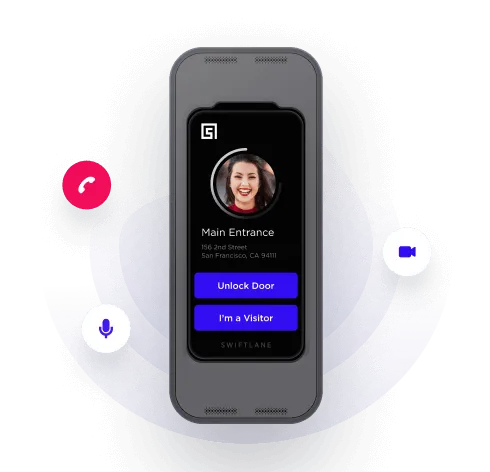
On-demand drivers from DoorDash, Uber Eats, or local services rarely have standing credentials. A video intercom lets staff or residents see who is at the door and unlock it remotely from a phone. An apartment intercom with door release replaces the lobby buzzer with verified, logged entry.
USPS Postal Carrier Access
Postal access follows its own rules under USPS Handbook PO-632:
- The Postal Service furnishes its own master access lock. The lock is not available to developers or builders to pre-install.
- Carriers will not accept keys to buildings or offices unless an electromechanical door lock system or key keeper box is used.
- A key keeper holds the building door key behind the USPS lock. Alternatively, an electronic postal lockbox can be wired to the intercom so the carrier’s key triggers a door release signal.
- For new developments, the local USPS Growth Manager coordinates the master lock installation. Existing buildings typically coordinate through their local Post Office.
Stage 2: Secure Storage Inside the Building
Once a courier is inside, packages need a destination other than the lobby floor. Open-lobby drop-offs are where most package theft and clutter problems start. Buildings typically choose among three options:
- Access-controlled package rooms: A storage room or closet secured with a credential-restricted door. Couriers and residents enter only with authorized credentials. See our guide to setting up a package room for layout and hardware planning.
- Smart package lockers: Automated compartments that assign each parcel a locker and release it to the recipient. They work well for standard parcel sizes but are limited by physical compartment capacity. Our package lockers for apartments playbook covers sizing and resident experience.
- Cold-storage staging: Refrigerated units or designated cold zones for grocery and meal-kit deliveries, so perishables aren’t left at room temperature.
Storage placement also matters for life safety. Review any room, locker bank, or overflow area near corridors or exits with the local AHJ or fire marshal. Package storage should also fit within the property’s broader apartment building security systems plan.
Stage 3: Automated Notification and Chain of Custody
A package isn’t truly delivered until the recipient knows it’s there and there’s a record of who handled it:
- Instant alerts: Enabling usage notifications on delivery PINs sends an alert each time a carrier’s PIN is used, so staff know a delivery has arrived without monitoring the door.
- Time-stamped entry logs: Each PIN entry can be logged with its label, timestamp, door, and a photo where the entry has a camera. Logs can be filtered by PIN, date range, or door to investigate incidents or resolve disputes.
- Package-level tracking: Locker systems and package room software can add parcel-level scanning, linking each package to its recipient and pickup time.
Together, these create the chain of custody that turns “I never got my package” into a question that can be answered.
Stage 4: Resident Retrieval, Holding Policies, and Outbound Returns
The final stage determines whether the system saves staff time or just moves the bottleneck:
- Self-service pickup: Residents retrieve packages with the same mobile credential, PIN, or fob they use for other doors, rather than waiting for office hours. Our key fob system guide covers credential options.
- Holding policies: Each property should define how long it holds packages, how it reminds residents, and what happens to unclaimed parcels. Write these policies into community rules and communicate them at move-in.
- Peak-season surges: Holiday and promotional periods can overwhelm fixed storage. Planning overflow space, temporary shelving, and staffing ahead of Q4 keeps packages out of hallways.
- Outbound returns: A designated return shelf or staging area lets residents drop off prepaid returns for scheduled carrier pickups, keeping outgoing parcels separate from incoming ones.
Package Rooms vs. Smart Lockers: Choosing the Right Infrastructure
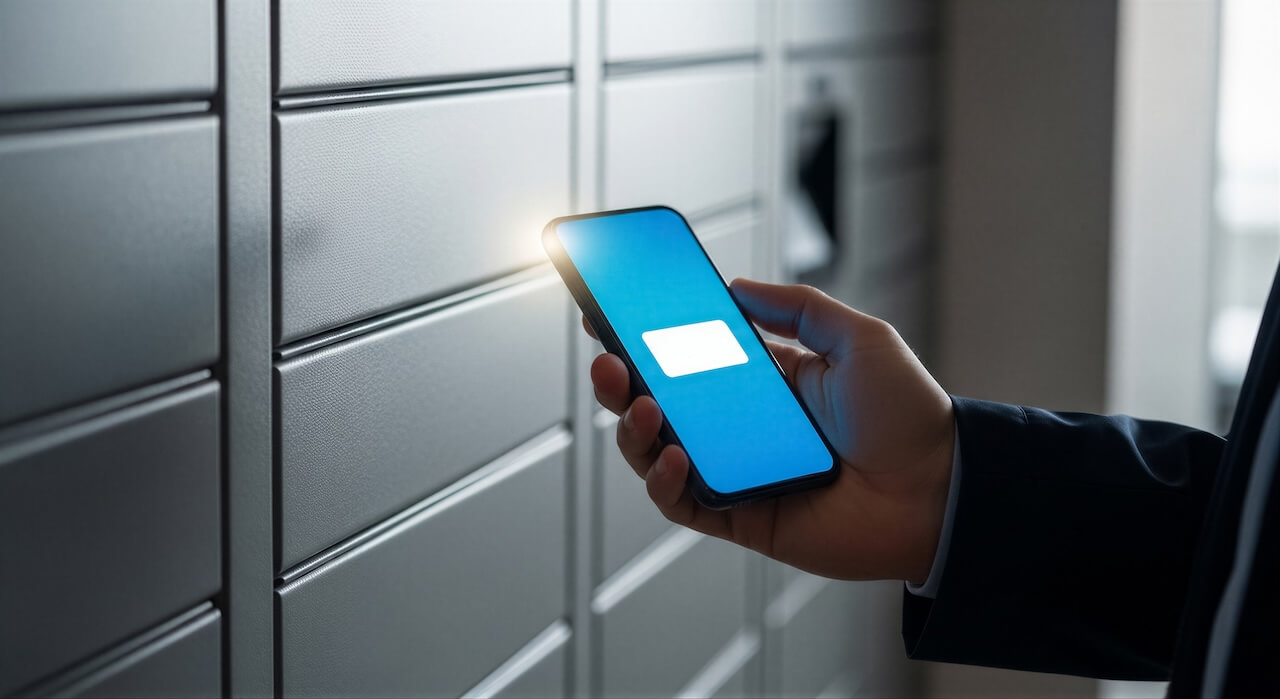
The storage decision shapes the rest of the system: how couriers drop off, how residents pick up, and how much hardware the property maintains over time. Neither option is universally better. The right fit depends on delivery volume, parcel mix, available space, and how much per-package tracking the property needs.
| Criteria | Access-Controlled Package Room | Smart Electronic Lockers | Best Building Fit |
| Storage capacity | Scales with shelving and room layout | Fixed by physical compartment count | Package rooms suit high-volume buildings |
| Oversized and odd-shaped parcels | Easily accommodated on open shelving or floor space | Limited to the largest compartment size | Package rooms handle bulk and oversized items |
| Floor space | Reuses an existing storage room, closet, or basement area | Requires wall or floor space with clear access paths | Lockers suit lobbies with no spare room |
| Upfront hardware | Moderate: access reader, electric strike or maglock, and shelving | Higher: modular locker units and kiosk hardware | Package rooms offer lower capital cost |
| Courier workflow | One entry, all parcels dropped in a single trip | Each parcel loaded into an assigned compartment | Package rooms are faster for high-volume drops |
| Package-level security | Any credentialed user can reach every package in the room | Each compartment opens only for its recipient | Lockers suit buildings with frequent theft disputes |
| Chain of custody | Door-level entry logs; parcel-level tracking requires added software | Parcel-level tracking built in | Lockers offer finer-grained records |
When a Package Room Makes Sense
- The building receives high daily volume or frequent oversized deliveries, such as furniture boxes or bulk household goods.
- An existing storage room, closet, or basement space can be converted.
- The property wants a lower-capital option that runs on the same access control system as its other doors.
The main trade-off is shared access. Any credentialed user can reach every package in the room, so these buildings benefit most from:
- Access groups that limit room entry to residents, staff, and approved carriers.
- A camera covering the room’s entry.
- Time-stamped entry logs to reconstruct who entered and when.
When Smart Lockers Make Sense
- The building’s parcel mix is mostly standard box and envelope sizes.
- There’s no spare room to convert, but lobby or corridor wall space is available.
- The property wants each package tied to a single recipient, with a digital pickup record.
The trade-off is capacity. When compartments fill during peak periods, overflow parcels need somewhere to go. Sizing, compartment mix, and resident experience considerations are covered in our package lockers for apartments playbook.
The Hybrid Approach
Some properties combine both: lockers for standard parcels, and an access-controlled package room for overflow, oversized items, and peak-season surges. The hybrid setup costs more to install, but it avoids the most common failure of each option. Package rooms struggle with package-level accountability, and lockers struggle with capacity.
Commercial Office vs. Multifamily Delivery Management
The four-stage lifecycle applies to both property types, but the priorities differ. Multifamily buildings optimize for 24/7 resident convenience. Commercial offices optimize for accountability and internal distribution.
| Factor | Multifamily Buildings | Commercial Offices |
| Recipients | Residents receiving personal orders | Employees and departments receiving business shipments |
| Pickup hours | Residents expect 24/7 access | Pickup follows office schedules |
| Parcel mix | Consumer orders, groceries, returns | Supplies, equipment, signature-required documents |
| Last step | Resident self-service pickup | Mailroom distribution to desks or teams |
| Chain-of-custody priority | Resolving missing-package disputes | Documenting receipt of sensitive shipments |
What Commercial Properties Should Prioritize
- Receipt logging: Legal, financial, and HR documents need a clear record of who received them and when.
- Restricted mailrooms: Limit mailroom entry to authorized staff, and log every door event.
- Hybrid schedules: When employees are on site part-time, holding policies and pickup notifications keep packages from piling up.
Mixed-use buildings can apply both models by giving residential and commercial tenants separate access groups, delivery PINs, and storage zones. For multi-door or multi-site offices, cloud-based access control lets facilities teams manage courier and mailroom permissions from one dashboard.
Budgeting & Implementation Considerations for Property Teams
Package delivery management costs vary widely by building, so it’s more useful to understand what drives the total than to rely on a single price range.
Key Cost Drivers
- Existing infrastructure: Buildings with compatible door hardware, network cabling, and power at entry points cost less to upgrade than those that need new runs. Retrofits typically cost more than new construction, where wiring can be planned from the start.
- Door and locking hardware: Each secured door needs a reader and locking hardware, such as an electric strike or maglock. Locking hardware on egress paths must meet local code, so review it with the AHJ before installation.
- Cabling and power: Readers and intercoms often run on Cat6 cabling with Power over Ethernet (PoE). Distance from the network closet and wall construction both affect labor.
- Storage infrastructure: A converted package room needs shelving and a secured door. Lockers add modular units and kiosk hardware, and a hybrid setup adds both.
- Software pricing model: Vendors typically charge recurring fees per unit, per door, or per locker bank. Comparing total cost over several years gives a clearer picture than upfront price alone.
Implementation Checklist
- Audit current delivery flow. Identify where packages land today, which carriers deliver most often, and when volume peaks.
- Choose storage. Match a package room, lockers, or a hybrid to the building’s volume and parcel mix.
- Assess doors and wiring. Confirm which entry points and storage doors need readers, locking hardware, or new cabling.
- Set up carrier access. Enroll in Amazon Key for Business, create separate delivery PINs for each carrier, and coordinate postal access with the local Post Office.
- Define and communicate policies. Set holding periods, reminder cadences, and unclaimed-package rules, then share them with residents or tenants.
- Review with the AHJ. Confirm locking hardware and storage placement meet local fire and egress requirements before go-live.
For a building-specific starting point, the Swiftlane estimate generator outlines likely hardware and project scope based on property details.
Why Choose Swiftlane for Package Delivery Management
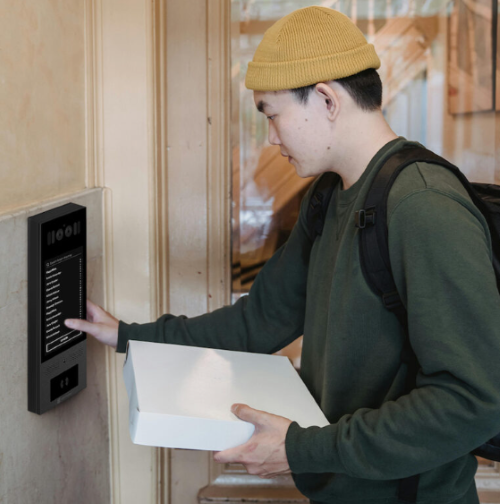
Swiftlane brings every stage of the delivery lifecycle into one cloud-based access control and video intercom platform, managed from a single dashboard.
Every courier path on one system:
- Amazon Key for Business integrates with Swiftlane.
- Other carriers get time-limited delivery PINs.
- Gig drivers are verified through video intercom calls that can be answered and unlocked from a phone.
- USPS carriers use a postal lockbox that triggers door release through the intercom.
Secured storage with a full audit trail: The same credentials that open the front door can secure the package room.
- Each PIN entry is logged with a label, timestamp, door, and photo, where the entry has a camera.
- Logs can be filtered to resolve disputes.
Offline resilience and integrations: The Swiftlane Access Control Unit (ACU) keeps doors working when network connectivity is lost. Property management software integrations, including Yardi, RealPage, Entrata, and AppFolio, keep resident access in sync with move-ins and move-outs.
Ready to streamline deliveries at your property? Get a quote for a solution built around your building’s layout and delivery volume.
Building a Delivery System That Keeps Up
Package volume isn’t slowing down, and every new carrier adds another way for parcels to go missing between the curb and the recipient. Buildings that control courier entry, secure storage, automate notifications, and log every handoff turn deliveries from a daily headache into a managed process.
Explore Swiftlane’s package delivery PIN access system, or request a package management quote tailored to your building.
Frequently Asked Questions
What is a package delivery management system?
A package delivery management system combines the access control, storage, and software that a building uses to receive, secure, and distribute parcels. It manages courier entry, stores packages in rooms or lockers, notifies recipients, and logs each pickup.
How do delivery drivers get into apartment buildings with access control?
Drivers typically enter through one of three paths: Amazon Key for Business, which verifies Amazon drivers through their delivery app; time-limited delivery PINs for carriers like UPS and FedEx; or a video intercom call to staff or residents, who unlock the door remotely.
What is the difference between a package room and package lockers?
A package room is an access-controlled space where parcels of any size are stored on open shelving, and any credentialed user can enter. Package lockers assign each parcel to an individual compartment that opens only for its recipient, but capacity is fixed.
How does automated package notification work for residents?
In locker systems, the courier or staff scans each parcel to a unit, triggering an app, text, or email alert to the recipient. In package rooms, delivery PIN usage alerts notify staff when a carrier enters, and parcel-level alerts require package management software.
How do buildings prevent package theft in common areas?
Buildings reduce common-area theft by ending open-lobby drop-offs. Packages go into access-controlled rooms or lockers, entry is limited to credentialed users and approved carriers, and time-stamped logs, with photos where cameras are installed, record who entered and when.
Can package management systems work for commercial office buildings?
Yes. Commercial offices use the same lifecycle but prioritize mailroom access control, receipt logging for sensitive documents, and notifying employees when shipments arrive, especially when hybrid schedules leave packages uncollected for days.