Property management software integration is the automated synchronization of resident, lease, and unit data between a property management system (PMS) and the building systems that manage access, visitors, and operations, so move-ins, move-outs, and credential changes require no manual entry.
Most property teams treat integration as a convenience feature. It’s better understood as a security control.
Your PMS already knows when a lease ends. Your access control system only knows what it’s told. If a move-out is entered in the PMS but never reaches the access system, a former resident still holds a working credential. Integration closes that gap automatically, and the details of how it closes the gap (what triggers the update, which direction data flows, and how often the systems check in) decide how small the gap actually gets.
This guide covers the mechanics: what syncs, what doesn’t, the integration methods behind the “we integrate with Yardi” claim, and the questions to ask before you sign. It’s not a ranking of property management platforms. If you’re still choosing a PMS, start with our property management software comparison.
How We Put This Guide Together
We reviewed published API and integration documentation for Yardi, RealPage, Entrata, AppFolio, and Buildium, along with the integration setup documentation Swiftlane maintains for each platform.
Key Takeaways
- “It integrates” isn’t an answer. What matters is which data moves, in which direction, and what event triggers the move.
- Sync method sets your exposure window. An event-triggered API update, a scheduled poll, and a nightly file each leave a different gap between a lease ending and a credential going dead. Know which one you’re buying.
- Directory sync is table stakes. Move-out revocation is the part that protects the building. Ask specifically how a lease end turns into a deactivated credential.
- Most access integrations are one-way. Data flows from the PMS to the building system. Don’t assume anything flows back unless the vendor shows you.
- Integrations break quietly. API changes, renamed fields, and expired credentials can stop a sync without anyone noticing. Monitoring matters as much as setup.
Table of Contents
- The Integration Capability Matrix
- How Property Management Software Integration Works
- The 5 Integration Categories That Matter
- PMS Platform Landscape in 2026
- What to Verify Before You Buy
- Common Integration Failures and How to Catch Them
- API vs. Batch vs. Native Connector
- How Swiftlane Approaches PMS Integration
- FAQs
Related Posts
- Property Management Access Control: 2026 Operations Guide
- Smart Building Technology: 2026 Guide to Systems, Architecture, and ROI
- Apartment Solutions: A Property Manager’s Guide to Modern Building Technology
The Integration Capability Matrix
Building-system integrations fall into eight categories. Seven connect to the PMS directly; staff single sign-on connects through your identity provider instead. Few products cover all eight, and directory and lease sync are by far the most common. Use this matrix to map what a vendor actually offers against what you need.
| Integration category | What syncs | Typical direction | Typical refresh | Operational impact |
| Resident and unit directory | Names, units, lease dates, contacts | PMS → building system | Real-time API, scheduled poll, or nightly batch | Ends manual directory updates; prevents stale credentials |
| Move-in / move-out automation | Lease start and end, occupancy | PMS → building system | Event-triggered or scheduled | Credentials provisioned at move-in and revoked at lease end |
| Access credential assignment | Which resident holds which credential | Bidirectional (where supported) | On assignment | Access rights follow the lease, not a spreadsheet |
| Visitor and guest passes | Temporary passes tied to a unit | Building system (logged to PMS where supported) | On issuance | Audit trail linked to the resident record |
| Package and delivery logging | Carrier events, pickups | Building system → PMS | Event-triggered | Less front-desk lookup work |
| Work orders and maintenance | Tickets, status, vendor | Bidirectional | Real-time | Vendor access requests route with the ticket |
| Billing and amenity charges | Fees, device fees, rebilling | Building system → PMS | Monthly | Charges land on the resident ledger |
| Staff single sign-on and role sync | Staff accounts, permissions | Identity provider (Okta, Microsoft Entra ID, Google Workspace) → building system | On change | Offboarding a staff member revokes their building and admin access |
For package and locker integrations in more depth, see our multifamily package management guide. For visitor workflows, see visitor management systems for apartments.
How Property Management Software Integration Works
Every PMS integration, whatever the brand names involved, has the same four layers. When an integration fails, the problem is almost always in one of them, so it helps to know which is which.
Layer 1: The PMS as System of Record
The PMS is the source of truth for who lives where and for how long. Leasing teams enter residents, units, lease start and end dates, and contact details there. A well-designed integration never asks staff to enter the same data a second time in the building system. If a field has to be typed twice, it will eventually disagree with itself.
Layer 2: The Integration Mechanism
This is how data physically leaves the PMS. There are four common methods:
- REST APIs: The building system requests data from the PMS (or the PMS pushes data out) through a documented interface. This is the most flexible method.
- Webhooks: The PMS sends a notification the moment something changes, such as a lease end. Changes arrive within seconds, but only if the PMS supports webhooks for that event.
- Scheduled reports or SFTP batch files: The PMS exports a file on a schedule, and the building system processes it. Simple and reliable, but changes wait until the next file.
- Native connectors and marketplace apps: Prebuilt integrations listed in the PMS vendor’s own marketplace. Under the hood, these still use one of the methods above.
We’ll compare these methods side by side later (see the API vs. Batch vs. Native Connector section).
Layer 3: The Building System
This is the access control platform, intercom, visitor system, or locker network that receives the data. It turns a PMS record into something physical: a mobile credential, an intercom directory entry, an access group assignment for the right doors and floors.
Layer 4: Sync Rules and Conflict Resolution
This layer gets the least attention and causes the most trouble. Sync rules decide:
- Mapping: Which PMS property, building, or unit corresponds to which site and access group in the building system.
- Triggers: Which PMS events create, update, or deactivate a user.
- Conflicts: What happens when the two systems disagree, such as when staff manually edit a resident in the access system and the next sync overwrites the change.
- Exceptions: How the integration handles people who aren’t on a lease, like caregivers, contractors, or a resident’s adult child.
When evaluating vendors, ask to see Layer 4, not just a logo on an integrations page.
The 5 Integration Categories That Matter
The matrix above lists eight categories. In practice, five of them drive most of the operational value, and they matter in roughly this order.
1. Resident Directory and Lease Lifecycle
This is the foundation everything else builds on. The integration pulls residents, units, and lease dates from the PMS and keeps them current in the building system, so the access roster stays in step with the rent roll without manual updates.
The question to ask: does the sync pick up changes (a renewal, a transfer to another unit, an added roommate), or only new records?
2. Credential Provisioning and Revocation
This is the security-critical category. Provisioning gives a new resident access on move-in day without a trip to the leasing office. Revocation deactivates that access when the lease ends.
Revocation deserves a closer look. Ask what event triggers it (the lease end date, a move-out entered by staff, or a manual step), how long it takes to reach the door, and what happens to residents who hold over past their lease end date.
3. Visitor and Delivery Workflows
When the building system knows which resident lives in which unit, guest passes and delivery notifications route to the right person automatically. A visitor pass tied to a unit also creates an audit trail linked to the resident record. Lockers and package rooms are a category of their own; see our package management guide for depth.

4. Maintenance Routing
Work-order integrations let a ticket in the PMS carry the access a vendor needs: a time-limited credential for the right door, issued when the ticket is scheduled and expired when it closes. It’s less common than directory sync, so confirm it exists rather than assuming it.
5. Amenity Booking and Billing
Amenity reservations, device replacement fees, and similar charges can flow from the building system to the resident ledger in the PMS. This saves accounting time but carries little security weight, so it usually ranks below the first four.
For how these categories fit into day-to-day property management workflows, see our guide to property management access control systems.
PMS Platform Landscape in 2026
Every major PMS controls third-party access through its own partner program, and that program shapes what an integration can do. This section covers how each platform opens its data to building systems. It’s not a ranking. For PMS selection, see our property management software comparison.
| PMS | How third-party building systems connect | Swiftlane setup guide |
| Yardi | Standard Interface Partnership Program (SIPP); licensed per interface | Yardi setup |
| RealPage | RealPage Exchange AppPartner program; certified integrations | RealPage setup |
| Entrata | API Partners program with tiered platform access | Entrata setup |
| AppFolio | AppFolio Stack marketplace and API; scheduled report exports | AppFolio setup |
| Buildium | Buildium Marketplace apps; Open API for custom builds | Buildium setup |
Yardi
Yardi routes third-party connections through its Standard Interface Partnership Program. Vendors sign a separate Data Exchange Agreement for each interface type and pay an annual license fee per interface, according to Yardi’s partner page. Yardi lists hundreds of standard interface partners. Because the program qualifies vendors on active Voyager clients, ask whether a vendor’s Yardi integration covers Voyager, Yardi Breeze, or both. “Integrates with Yardi” doesn’t always mean both products.
RealPage
RealPage connects partners through RealPage Exchange, where approved AppPartners offer RealPage-certified integrations. Property teams typically enable an integration by subscribing their properties to the partner in RealPage’s Integration Marketplace, then waiting for the partner to approve the subscription. Ask which RealPage product the vendor connects to, since RealPage runs several platforms, and confirm the integration is certified rather than a workaround.
Entrata
Entrata’s API Partners program offers tiered platform access, with a developer portal, sandbox environments, and webhooks among the listed capabilities. On the property side, an Entrata admin creates an API user for the vendor and grants it specific permissions, which also define what data the vendor can read. Entrata deprecated its legacy API gateway on April 15, 2025 and moved partners to a new one, a reminder that integrations need maintenance when platforms change.
AppFolio
AppFolio’s certified route is the AppFolio Stack marketplace. Partners go through an application, a security compliance questionnaire, and certification before they’re listed. Not every AppFolio integration runs through Stack, though. Some vendors use AppFolio’s scheduled reporting instead: the property schedules a recurring report, and the vendor processes it. That works, but updates arrive only as often as the report runs. Ask which method a vendor uses.
Buildium
The Buildium Marketplace lets property managers add prebuilt partner apps with no monthly subscription; you pay only for the integrations you use. For needs the Marketplace doesn’t cover, Buildium’s Open API lets teams sync Buildium data with other software. Buildium is popular with small and mid-size portfolios and community associations, so confirm that a vendor’s integration maps Buildium’s association properties as well as rentals if you manage both.
What to Verify Before You Buy
A logo on an integrations page tells you two systems can connect. It doesn’t tell you what happens on a resident’s last day. Ask every vendor these eight questions, and ask for answers in writing.
- Is the sync real-time, scheduled, or file-based? Get the actual interval. “Automatic” can mean seconds, hours, or once a day. Whatever the answer, know the longest a lease change can take to reach the door.
- Which direction does data flow? Most access integrations read from the PMS and write nothing back. If you need credential assignments, visitor logs, or charges to appear in the PMS, confirm that’s supported, not just planned.
- What triggers move-out revocation? The lease end date, a move-out entered by staff, or a manual step in the access system? Ask what happens to a resident who holds over, and to an early termination entered after the fact.
- Which PMS product and version is supported? “Yardi” can mean Voyager or Breeze. “RealPage” covers several platforms. Confirm the exact product you run.
- How are properties and buildings mapped? A single PMS property may span several buildings with separate entrances. Ask whether you can map at the building level so residents get access only to the doors they should.
- Is staff SSO and role sync supported? If your team signs in through an identity provider, ask whether removing someone there also removes their admin and door access.
- What happens during a PMS outage or API change? Do existing credentials keep working? Does the system alert you when a sync fails, or does it fail silently? Who updates the integration when the PMS changes its API?
- Who owns troubleshooting? When residents go missing from the access roster, find out whether you call the access vendor, the PMS, or both, and who has the logs.
For how to evaluate access control vendors more broadly, see our guide to property management access control systems.
Common Integration Failures and How to Catch Them
Most integration problems don’t announce themselves. The sync stops or drifts, and nobody notices until a resident can’t get in, or a former resident still can. These are the five failures to watch for.
1. Silent Sync Failure
The integration stops running, and neither system raises an alarm. Common causes include expired API credentials, a revoked API user, or a PMS-side authentication change. Entrata’s retirement of its legacy API gateway in April 2025 is the kind of platform change that breaks integrations that aren’t updated.
How to catch it: Ask whether the building system shows a last-successful-sync timestamp and alerts an admin when a sync fails. Check it monthly.
2. Field Mapping Drift
Someone renames a building in the PMS, adds a new unit type, or restructures a property. The integration still runs, but records land in the wrong access group or don’t land at all.
How to catch it: Re-check property and building mappings after any structural change in the PMS. Treat the mapping as configuration that needs an owner.
3. Duplicate Resident Records
A resident added manually in the access system before the integration went live, then imported again by the sync, can end up with two profiles and two sets of credentials. Revoking one leaves the other active.
How to catch it: Clean up manual entries before the first sync, and ask the vendor how the integration matches existing users (by email, phone, or a PMS ID).
4. One-Way Sync Assumptions
Teams assume a change in the access system flows back to the PMS. It usually doesn’t. A resident’s phone number updated at the front desk can be overwritten by the next sync from the PMS.
How to catch it: Make the PMS the only place resident data is edited. Train staff that the access system is downstream.
5. Manual Fallback Becoming Permanent
When a sync breaks, someone adds residents by hand “just for now.” Months later, half the roster is managed manually, outside the integration, and outside its revocation logic.
How to catch it: Run a periodic reconciliation, comparing active credentials against the current rent roll. Any credential with no matching active lease is a security finding, not a data cleanup task.
API vs. Batch vs. Native Connector
The integration method decides how fast a lease change reaches the door and how the integration fails. No method is wrong; each fits a different situation. What matters is knowing which one you have.
| Method | Typical latency | Typical failure mode | Typical use case | What to ask |
| Event-driven (webhooks) | Seconds to minutes | Missed events if the receiver is down and there’s no retry | Move-out revocation where speed matters | Are missed events retried or reconciled? |
| Scheduled API polling | Minutes to hours, set by the interval | Stops silently if credentials expire | Directory and lease sync | What’s the interval, and can it be changed? |
| Scheduled report or SFTP file | Hours to a day, set by the export schedule | A malformed or missing file skips an update | PMS platforms or plans without API access | Who schedules the export, and what happens if a file doesn’t arrive? |
| Native marketplace connector | Depends on the method underneath | Breaks when either vendor changes its API | Fast setup on a supported platform | What does the connector use underneath? |
Many integrations combine methods, such as a scheduled poll for routine sync plus a manual “sync now” for urgent move-outs. If your exposure window matters (a high-turnover building, a contentious eviction, a terminated employee), ask whether staff can force an immediate update or deactivate a credential directly in the access system without waiting for the next sync.
Credential Security for the Integration Itself
The integration is a privileged connection into your resident data, so treat its credentials like any admin account.
- Least privilege: Grant the integration’s API user only the data it needs. An access control integration typically needs resident and property records, not accounting or payment data.
- Token-based access over shared passwords: Prefer OAuth or API keys issued to the vendor over a shared username and password. Revoking a token cuts access without changing anyone’s login.
- Named ownership: Record who created the API user, when, and for which vendor. When you switch vendors, revoke the old integration’s access the same day.
- Review access regularly: Check the list of active API users in your PMS at least annually, and remove any that belong to vendors you no longer use.
How Swiftlane Approaches PMS Integration
Swiftlane connects its cloud-based access control platform to five PMS platforms: Yardi, RealPage, Entrata, AppFolio, and Buildium. The integrations focus on the two categories that matter most for building security: resident directory sync and lease-driven access. New residents are created as Swiftlane users, and residents whose leases end are deactivated.
| PMS | How it connects | What Swiftlane’s setup documentation describes |
| Yardi | Through a Yardi interface set up with Swiftlane Support | Recurring automatic sync; new residents created as users; users deactivated at lease end |
| Entrata | Entrata API user with read permissions | Users deactivated at lease end; mapping by Entrata site or by individual building |
| RealPage | Subscription through RealPage’s Integration Marketplace | Approval and setup by Swiftlane within 24 to 48 business hours |
| AppFolio | Scheduled AppFolio report sent to a Swiftlane-generated address | Users added, updated, or deactivated each time a report is processed |
| Buildium | Installed from the Buildium Marketplace | Tenant and owner data synced; one Swiftlane account can manage multiple Buildium properties and associations |
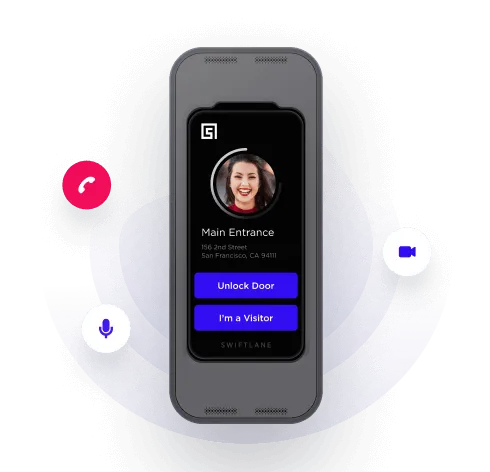
Across platforms, admins can turn on automatic invites so new residents receive a Swiftlane invitation and set up mobile access themselves, without a visit to the leasing office. PMS integrations can automate resident access provisioning and move-out revocation; confirm whether resident records also sync automatically to the video intercom directory. With Swiftlane elevator access configured, user-group permissions determine which floors a resident can access using their credential.
Swiftlane’s enterprise platform supports staff single sign-on and automated user provisioning (SCIM) through Okta, Google Workspace, and Microsoft Entra ID, and Swiftlane is listed in the Microsoft Marketplace for Entra ID single sign-on. On that platform, access updates automatically when someone joins, changes roles, or leaves. Availability varies by product tier and deployment, so if your property team signs in through one of these providers, confirm SSO is included during scoping.
Setup is a handoff, not a self-serve toggle. For most platforms, the property grants API or marketplace access on the PMS side, and Swiftlane’s support team completes the configuration and site mapping. Step-by-step instructions for each platform are linked in the table in the platform landscape section above.
To see how PMS sync would work across your portfolio, request a demo or explore Swiftlane Access Control.
FAQs
What is property management software integration?
It’s the automated syncing of resident, lease, and unit data between your PMS and building systems like access control, intercoms, and visitor management. Move-ins, move-outs, and credential changes made in the PMS carry through without staff re-entering them.
Does my access control system integrate with Yardi?
Check the vendor’s documentation, not just its logo page. Yardi integrations run through Yardi’s Standard Interface Partnership Program, licensed per interface. Confirm which Yardi product the vendor supports (Voyager, Breeze, or both), what data it syncs, and how often.
Is PMS integration real-time or scheduled?
It depends on the integration. Some use webhooks that update within seconds. Many poll the PMS on a fixed interval, and some process a scheduled report or file. Ask for the exact interval and whether staff can force an immediate update for urgent move-outs.
Can I integrate multiple buildings on different PMS platforms?
It depends on the vendor. PMS integrations typically map each PMS property or building to a site in the access system, and some platforms can hold several PMS connections in one account while others need a separate account per PMS. Ask the vendor to show you how a mixed portfolio would be set up, and whether you’d manage every building from one dashboard. Swiftlane integrates with Yardi, RealPage, Entrata, AppFolio, and Buildium. If your portfolio spans more than one of them, talk to our team about how your properties would be set up.
What data syncs between a PMS and an access control system?
At minimum: resident names, unit numbers, lease start and end dates, and contact details. Some integrations also sync roommates, owners, and building assignments. Payment, screening, and accounting data usually stay in the PMS.
Does PMS integration automatically revoke access at move-out?
Most directory integrations deactivate residents when their lease ends in the PMS. The questions are how long that takes to reach the door, and what happens with holdovers and early terminations. Verify the trigger before you rely on it.
Is PMS integration one-way or two-way?
Most access control integrations are one-way: the PMS sends data to the building system. Two-way integrations, where access events, visitor logs, or charges flow back to the PMS, are less common. Confirm the direction for each data type you care about.
What happens to building access if the PMS goes down?
In a well-designed integration, existing credentials keep working because the access system holds its own copy of the roster. New changes wait until the connection returns. Ask whether the vendor alerts you when syncs fail.
Do I need a specific PMS plan or add-on to integrate?
Sometimes. PMS platforms control third-party access through partner programs, marketplaces, and APIs, and the route available can depend on your subscription. Ask both your PMS account manager and the access vendor which route applies to your plan.
Who maintains the integration when the PMS changes?
The vendor should, but confirm it in writing. PMS platforms periodically change their APIs and authentication methods, and an integration nobody maintains will eventually stop syncing. Ask how the vendor monitors integration health and how quickly it responds to PMS-side changes.